The Zero Error Rate Illusion in ML Models: How Data Scientists Can Manage Stakeholder Expectations

How data scientists can bridge the gap between ML's probabilistic nature and stakeholders' zero-error expectations.
Stakeholders often expect ML models to achieve zero error rates due to a cognitive gap between deterministic software thinking and probabilistic machine learning. This article examines the root causes—including availability bias and communication failures—and offers practical strategies: front-loading error expectations, framing value in business language, implementing human-in-the-loop fallbacks, and continuously visualizing model value.
A Universal Dilemma for Data Scientists
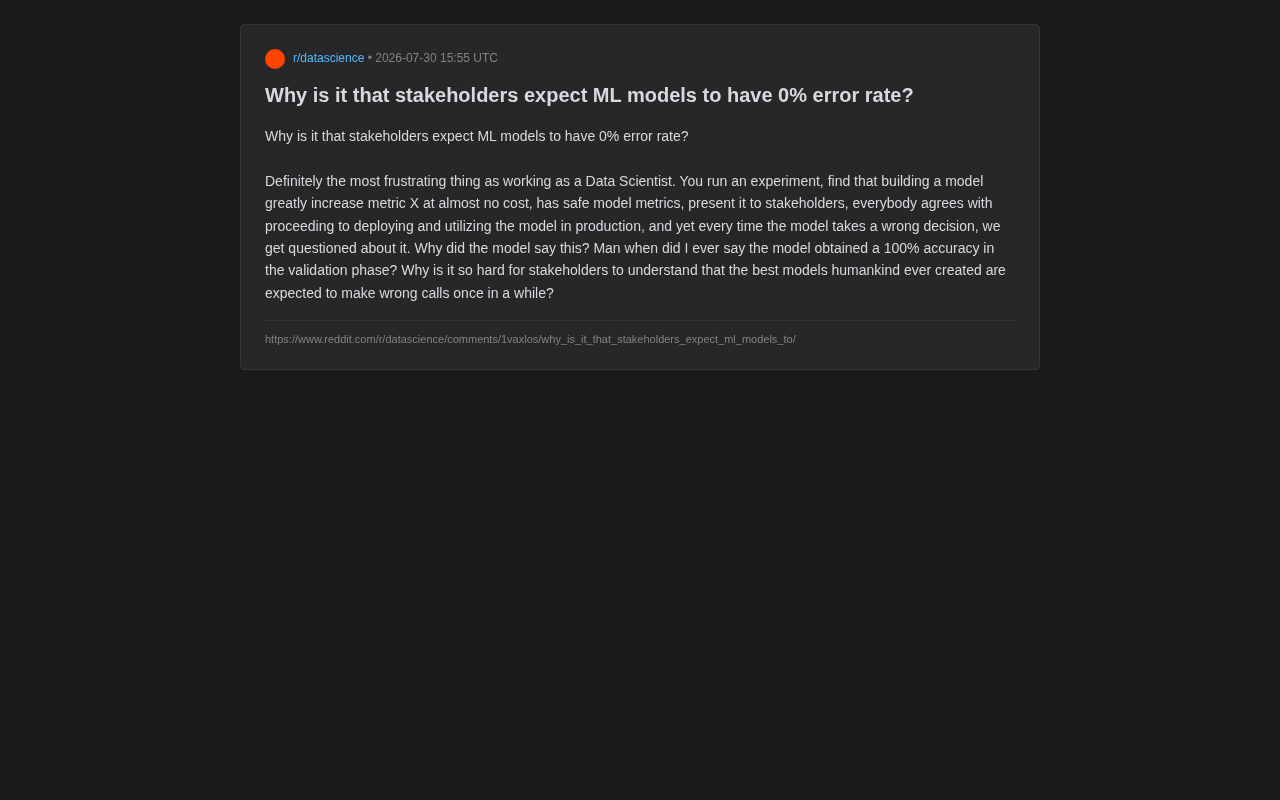
Recently, a data scientist posted on Reddit about a problem that resonates deeply with countless practitioners: why do stakeholders always expect machine learning models to achieve a zero error rate?
Their experience is highly representative: "You run an experiment, discover that building a model can significantly improve metric X at virtually zero cost, the model's evaluation metrics are all robust, then you present the results to stakeholders, and everyone agrees to deploy the model to production. However, every time the model makes a wrong decision, we get questioned—'Why did the model produce this result?'"
The engineer asked in frustration: "When did I ever say the model achieved 100% accuracy during validation? Why is it so difficult to get stakeholders to understand that 'even the best models humans have ever created will inevitably make occasional mistakes'?"
This post struck a chord across the community. It touches not just on a technical issue, but on a deeper topic involving cognitive gaps, communication strategy, and expectation management.
The Root of the Expectation Gap: Deterministic Thinking Meets Probabilistic Reality
Determinism of Traditional Software vs. the Probabilistic Nature of ML Models
Stakeholders' expectation of zero error rates fundamentally stems from a collision between two modes of thinking. Traditional software systems are deterministic—given the same input, they always produce the same "correct" output. A calculator doesn't get 2+2=4 right 99% of the time and output 5 the remaining 1%. Business stakeholders who have long worked with such systems naturally apply the same standards to ML models.
However, machine learning models are inherently probabilistic. They learn statistical patterns from data and output optimal estimates based on historical patterns. From the perspective of statistical learning theory, any model trained on finite data faces the bias-variance tradeoff: reducing bias (making the model fit training data more closely) tends to increase variance (sensitivity to new data), and vice versa. This means that at a mathematical level, unless the problem itself is entirely deterministic and the data is noise-free, there is no "perfect model"—this isn't a matter of insufficient engineering capability, but a theoretical lower bound dictated by fundamental theorems of statistical learning, known as the Bayes error rate. Even a theoretically optimal classifier, when facing real-world data where labels inherently contain noise and overlap, will inevitably have irreducible errors.
Any responsible model evaluation metric—whether Accuracy, F1 score (the harmonic mean of precision and recall, measuring a model's overall performance on the positive class), or AUC (Area Under the ROC Curve, measuring a model's overall ability to distinguish positive from negative samples across different thresholds)—explicitly tells you: the error rate is not zero. 95% accuracy means that out of every 100 decisions, 5 may be wrong. This is an inherent feature of model design, not a defect.
"Silent Successes" and "Noisy Failures": Availability Bias at Work
There's also a psychological dimension worth noting. When a model makes thousands of correct decisions, these successes are "silent"—no one convenes a meeting for a prediction that matches expectations. But as soon as one conspicuous error occurs, it becomes "noisy," triggering attention, questioning, and post-mortems.
This availability bias causes stakeholders' perception of errors to be severely amplified while they remain blind to the overall value the model creates. Availability bias was first systematically described by Nobel laureate Daniel Kahneman and Amos Tversky in 1973. It refers to people's tendency, when assessing the probability of events, to rely on instances that are easier to recall—the more vivid and emotional an event, the easier it is to retrieve from memory, and thus the disproportionate weight it receives. In corporate environments, this bias is further amplified by organizational structures: a single model error can trigger customer complaints, cross-departmental incident review meetings, and escalating inquiries from management. These institutionalized response mechanisms give individual error events far more "exposure" than their statistical proportion warrants. By contrast, the thousands of correct decisions the model quietly processes every day generate no tickets, aren't discussed in any meetings, and don't appear in anyone's weekly report.
People remember that one embarrassing misjudgment, not the costs the model silently saved or the efficiency gains it delivered.
Communication Failures: Data Scientists' Own Responsibility
Information Gaps During Project Presentations
While the original post carries a tone of frustration, many seasoned practitioners in the community pointed out: data scientists themselves share responsibility for the formation of this expectation gap.
The problem often originates during project kickoff and solution presentation phases. When we excitedly announce "this model can significantly improve metric X," do we equally clearly and repeatedly emphasize the model's error rate, failure modes, and limitations? More often than not, we showcase impressive aggregate metrics in demos without communicating "the model will make mistakes, and it will make mistakes in these specific ways" as a core component of the delivered solution.
Notably, the AI industry is establishing systematic best practices to address this issue. In 2018, a Google research team proposed the concept of Model Cards—a standardized document delivered alongside models that explicitly lists intended use cases, known limitations, performance differences across different populations/scenarios, and identified failure modes. Microsoft, Amazon, and other companies have since adopted similar transparency frameworks. The core philosophy of this practice is: a model's limitations are not ancillary information—they are first-class citizens of the deliverable. For projects facing internal stakeholders, data scientists can similarly adopt this structured disclosure approach—dedicating sections in project documentation to describe "what the model is not good at," "in which edge cases it's prone to errors," and "what the expected error rate range is," ensuring this information is fully discussed and accepted before deployment decisions are made.
If a shared expectation around errors isn't established before deployment, then every questioning that follows an error is essentially an overdue bill for insufficient earlier communication.
Shifting the Conversation from "Accuracy" to "Business Value"
A more mature approach is to completely abandon discussing technical metrics like "accuracy" with business stakeholders, and instead frame the model's value in business language.
Rather than saying "the model has 92% accuracy," say: "Under manual processing, we averaged X dollars in losses per month due to misjudgments; after introducing the model, that loss dropped to Y dollars, and even accounting for the model's own errors, we net-save Z dollars per month."
The key is establishing a baseline comparison. Any decision-making system—including human experts—makes mistakes. A model's value lies not in "never making errors" but in "making fewer errors than the existing approach (whether manual or legacy rules), or making errors at lower cost." In fact, extensive empirical research shows that human decision-making is far from perfect: in medical imaging diagnosis, radiologists' miss rates typically range from 10%-30%; in credit approval, the consistency of manual review (the probability that two reviewers give the same decision on the same case) is often only 70%-80%; in resume screening, the same recruiter may make different judgments about the same resume at different times. These figures aren't meant to disparage human experts, but to establish a fair frame of reference—when we demand ML models achieve "zero errors," we're actually demanding they reach a standard that humans themselves have never achieved.
When the anchor of discussion shifts from "perfection" to "relative improvement," expectations become rational.
Practical Strategies for Expectation Management
Front-Loading Error Expectations: Building Consensus Before Deployment
The most effective strategy is to clearly define an acceptable error range before deployment and get stakeholder sign-off. For example: "This model's expected false positive rate is between 3%-5%, which is acceptable from a business perspective because…" When errors fall within this pre-agreed range, they are no longer "incidents" but "normal performance consistent with design specifications."
Building Error Handling and Fallback Mechanisms
Rather than trying to eliminate errors (impossible), design fallback processes for when errors occur. Which high-risk decisions require human review? Is there a fast correction channel after errors happen? When business stakeholders see that the system has comprehensive error response plans, their anxiety about individual errors decreases significantly.
This philosophy has evolved in industry into the mature Human-in-the-Loop (HITL) system design paradigm. Its core principle uses the model's confidence score for routing: when the model's confidence in a prediction exceeds a preset threshold (e.g., above 95%), the system automatically executes the decision; when confidence falls in a gray zone (e.g., 70%-95%), the case is routed to a human reviewer for final judgment; when confidence is extremely low, it may be directly flagged as "unable to determine" and follow a full manual workflow. The elegance of this design lies in the fact that the model handles the large volume of simple, high-certainty cases (typically 70%-90% of total volume), drastically reducing manual workload, while human experts focus their energy on borderline cases where the model is uncertain, ensuring quality for high-risk decisions. Cloud platforms like Amazon's A2I (Augmented AI) and Google's Vertex AI offer out-of-the-box HITL workflow components, indicating that this pattern has moved from theoretical research to large-scale engineering practice.
Continuous Value Visualization Reporting
Proactively and regularly report the cumulative value the model creates to stakeholders, rather than passively waiting for errors to occur before explaining. Use dashboards to show how much cost the model has saved to date, how many cases it has processed, and how it's performing overall. Making "silent successes" visible is the only way to counterbalance the negative impression created by "noisy failures."
Conclusion: The Dual Discipline of Technical Rigor and Communication Artistry
This Reddit user's frustration, on the surface about model error rates, is at a deeper level about an eternal challenge in the data science profession: how to bridge the gap between the probabilistic reality of technology and the deterministic expectations of business.
Models will make mistakes—this is a fact dictated by mathematical laws that cannot be avoided. But stakeholders' inflated expectations can largely be mitigated through better communication, clearer expectation management, and smarter value narratives.
For every data scientist, what truly needs improvement may not just be the model's AUC, but the ability to communicate "models aren't perfect" in a way that everyone can accept. Technical rigor and the art of communication have always been two sides of the same coin in this profession.
Related articles

Cloudflare Uses AI to Standardize Engineering Practices: From Standards Drift to Automated Enforcement
Deep dive into how Cloudflare uses LLMs to auto-enforce engineering standards, solving standards drift in large teams. Explores AI code review in CI/CD pipelines, challenges, and implications.

50 Decision Engines: Reshaping Creator Economy Operations with Quantitative Tools
Deep dive into the Sovereign Creator Calculator Suite: 50 Notion-based interactive decision engines covering pricing, churn, ad ROI, and MRR modeling for data-driven creator growth.

GLEE Competition: A Detailed Guide to the NeurIPS 2026 Official Negotiation AI Challenge
NeurIPS 2026 GLEE Competition challenges AI agents to negotiate in real-time via natural language, covering bargaining, persuasion, and game strategies. Full guide on rules, approaches, and prizes.