#bias-variance tradeoff
20 related articles

·4 min
Introduction to Mathematical Foundations of Machine Learning: Definitions, Probabilistic Perspective & Core Framework Explained
Starting from Tom Mitchell's T-P-E framework, this guide explores ML's probabilistic perspective, random variables, and decision-making under uncertainty to build solid math foundations for ML.
Read more →

·3 min
Double Descent Explained: Why Massively Overparameterized Models Don't Overfit
A deep dive into the Double Descent phenomenon in machine learning, explaining why overparameterized models defy the classic bias-variance tradeoff to achieve stronger generalization.
Read more →

·3 min
Introduction to Machine Learning: Core Concepts of Supervised Learning, Classification, and Featurization Explained
A systematic guide to core machine learning concepts including supervised learning as function mapping, classification characteristics, design matrices, and featurization for converting variable-length data.
Read more →

·3 min
The Zero Error Rate Illusion in ML Models: How Data Scientists Can Manage Stakeholder Expectations
Why do stakeholders expect zero error rates from ML models? This article explores the cognitive gap between deterministic thinking and probabilistic reality, and provides practical strategies for data scientists to manage expectations.
Read more →

·3 min
The Zero Error Rate Illusion in ML Models: How Data Scientists Can Manage Stakeholder Expectations
Why do stakeholders expect zero error rates from ML models? This article explores the cognitive gap between deterministic thinking and probabilistic systems, and provides practical strategies for data scientists to manage expectations.
Read more →

·4 min
How Much Math Do You Need for Machine Learning? Finding the Balance Between Preparation and Practice
How much math do you really need before starting ML projects? This article analyzes the 'bottomless pit' trap, proposes a minimum viable math framework, and offers project-driven learning strategies.
Read more →

·2 min
Interview Prep Strategy for Senior Data Scientists: How to Prepare Efficiently Without Burning Out
Senior data scientist interviews are broad and multi-round. Learn an efficient evergreen fundamentals + targeted sprint strategy covering ML, SQL, system design, and mindset tips.
Read more →
·3 min
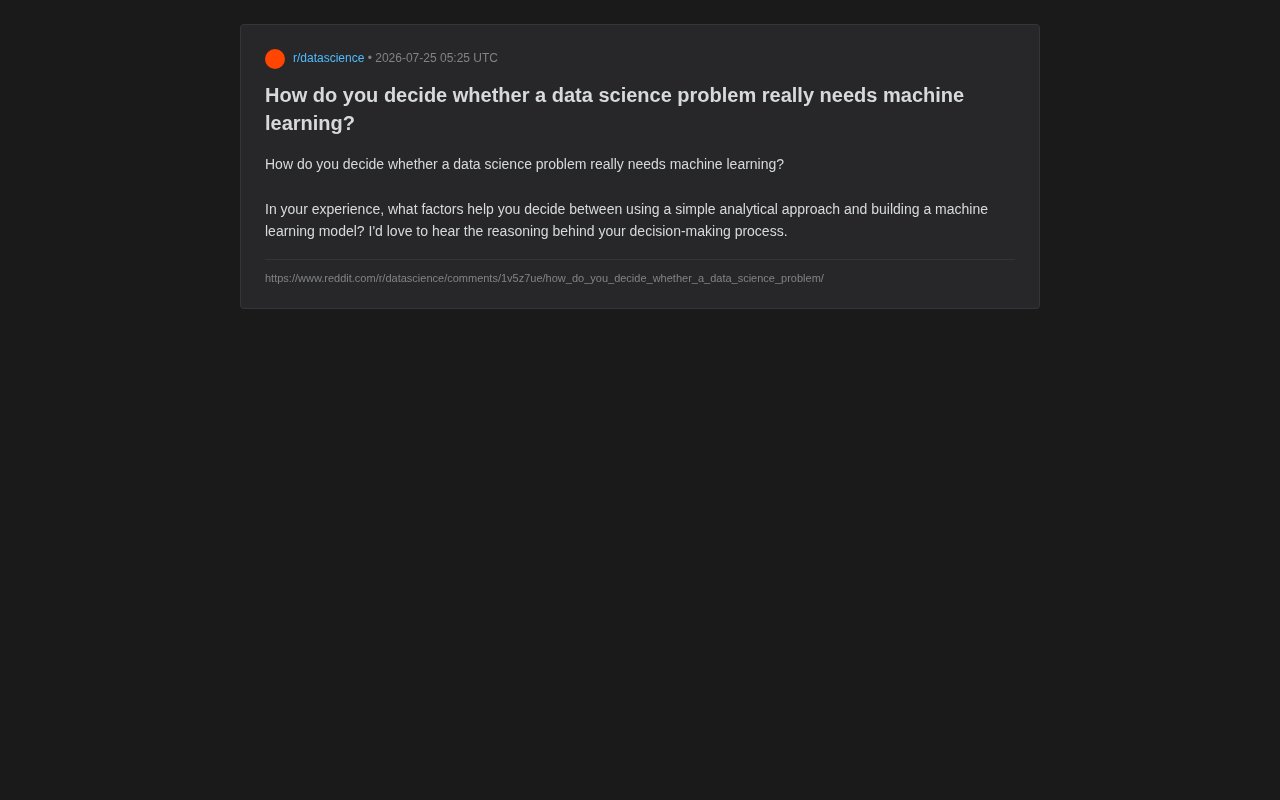
When Should You Use Machine Learning? A Pragmatic Decision Guide for Data Scientists
Not every data science problem needs ML. This guide offers a decision framework across four dimensions — rule complexity, data quality, prediction needs, and interpretability — to avoid over-engineering.
Read more →
LLM Juries: How Multi-Model Voting Bui…
·2 min
LLM Juries: How Multi-Model Voting Builds Reliable Metadata
Single LLMs risk hallucinations and bias in metadata generation. This article breaks down the LLM Jury mechanism — using multi-model voting and consensus to boost annotation accuracy, with real engineering insights for food, medical, and e-commerce use cases.
Read more →
Hands-On ML Chapter 2 Practical Guide:…
·2 min
Hands-On ML Chapter 2 Practical Guide: Key Takeaways from an End-to-End Project
A deep dive into Chapter 2 of Hands-On ML — California housing price prediction. Covers feature engineering, preprocessing pipelines, cross-validation, and building a complete ML workflow.
Read more →
After Getting Started with AI/ML: Shou…
·3 min
After Getting Started with AI/ML: Should You Pursue an Internship or Continue Studying?
Already trained models and implemented neural nets from scratch — should you apply for internships or keep studying? A practical guide to entry-level AI roles and how to advance.
Read more →

·2 min
How to Choose a Machine Learning Video Course: From Language Barriers to an Efficient Learning Guide
Struggling to choose an ML course? This guide covers language fit, instructor style, and platform resources to help you find the right machine learning learning path.
Read more →
The Theory of Deep Learning: Why Do Ne…
·4 min
The Theory of Deep Learning: Why Do Neural Networks Work? A Complete Overview of Theoretical Research
Deep learning shines in practice, but why does theory always lag behind? This article surveys the over-parameterization paradox, implicit regularization, NTK, the information bottleneck, and more.
Read more →

·1 min
A Deep Dive into Core Machine Learning Concepts: Those 'Aha' Moments of Sudden Clarity
Backpropagation, bias-variance tradeoff, attention mechanism… do you really understand these ML concepts? This article dives into the hardest yet most crucial core ML ideas to help you build real intuition.
Read more →

·5 min
Local Code Indexing: Cutting AI Coding Token Costs by 94%
AI coding bills exploding? 90% of the cost hides on the input side. Learn how local code indexing + dual-path search cuts each query from 83,000 to 4,900 tokens—saving 94%.
Read more →
·4 min
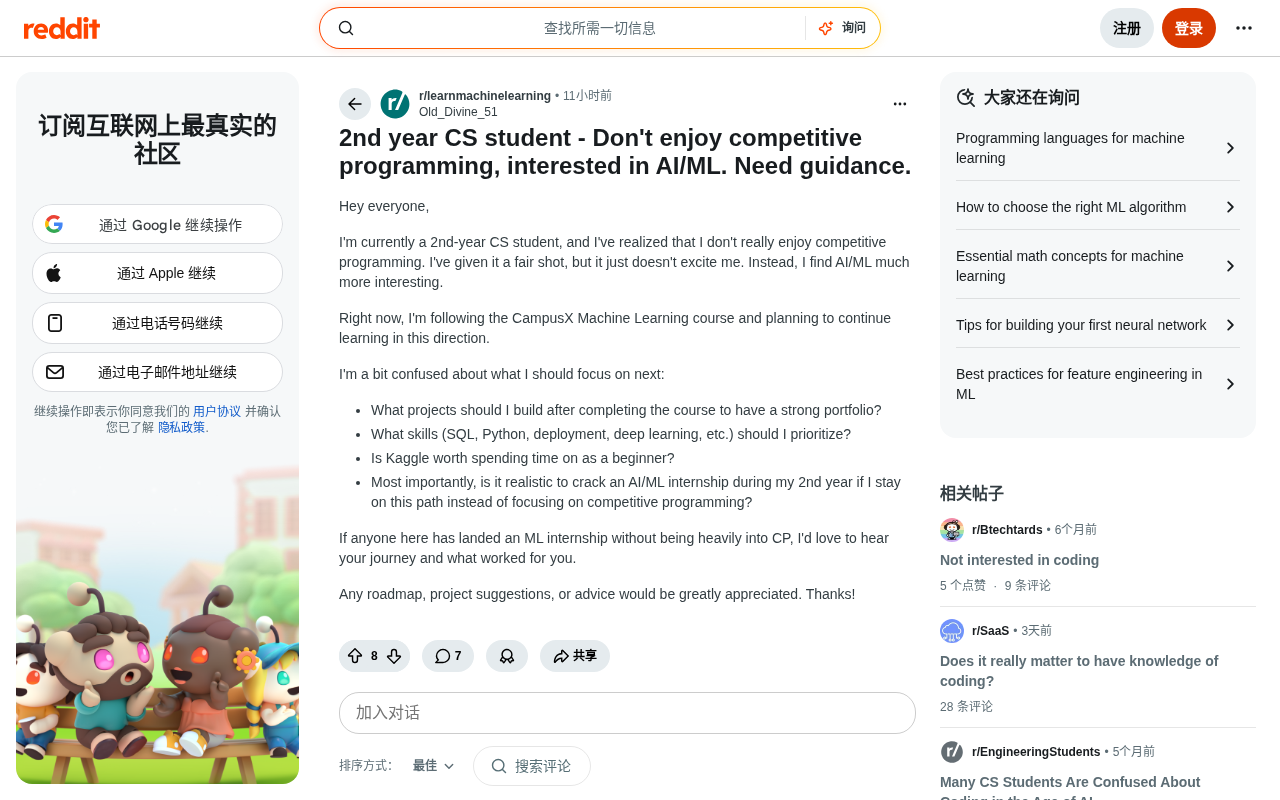
No Competitive Programming Required: How CS Students Can Pivot to AI/ML and Land Internships
How can CS students who dislike competitive programming systematically pivot to AI/ML? This guide covers skill priorities (Python/SQL/ML/deployment), portfolio strategy, Kaggle tips, and real paths to landing AI/ML internships.
Read more →

·3 min
15 Months, 10 Failed Interviews: A Deep Retrospective and Breakthrough Guide for AI Engineers
An AI/ML engineer with 4 years of experience faced 10 failed interviews in 15 months at Meta, Amazon, and more. This deep analysis breaks down the root causes and offers ML interview strategies and mindset advice.
Read more →

·3 min
Inside the ML Engineer Coding Assessment at Top US Tech Companies: What's Tested and How to Prepare
A firsthand account shared on Reddit reveals what a machine learning engineer online assessment (OA) at a top US tech company is really like. This article breaks down OA modules, role differences, and prep strategies for FAANG job seekers.
Read more →

·7 min
Training Machine Learning Models from Scratch: A Complete Beginner's Guide
A complete walkthrough of training machine learning models from scratch—covering problem definition, data preprocessing, algorithm selection, hyperparameter tuning, and evaluation, with tool recommendations for beginners.
Read more →

·3 min
K-means vs Random Forest: How to Choose the Right Algorithm from First Principles
A machine learning exam question pitting K-means against Random Forest sparks debate. Learn the core difference between supervised and unsupervised learning, and how to choose the right algorithm for mixed-feature tasks.
Read more →