Tigriden: A 40MB Lightweight AI Development Workbench Redefining Human-AI Collaboration

Tigriden is a 40MB Rust-native workbench designed for reviewing and managing AI Agent code output.
Tigriden is a lightweight desktop workbench built in native Rust that uses only 40MB of memory, specifically designed for developers who collaborate with AI coding agents like Claude Code, Codex, and Gemini CLI. Its core features—Diff Tracker and Time Machine—enable developers to efficiently review every AI-generated code change and instantly roll back when things go wrong, embodying a new development philosophy where tools optimize for reviewing rather than writing code.
When the Developer's Role Begins to Shift
Over the past year, more and more developers have started delegating coding work to AI Agents. A Reddit developer shared his observation: as he went deeper with AI coding tools like Claude Code, Codex, and Gemini CLI, he noticed his focus had quietly shifted—the Agent is doing the actual coding, while humans are mostly reviewing changes, running commands, and guiding the overall process.
Claude Code, Codex, and Gemini CLI represent the three mainstream approaches to AI coding agents today. Claude Code is Anthropic's command-line coding tool that can directly read and write the local file system, execute shell commands, and autonomously complete complex programming tasks. OpenAI's Codex excels at code generation and debugging. Google's Gemini CLI brings the power of the Gemini model into the terminal environment. What these tools have in common is that they don't just offer code completion suggestions—they can autonomously plan and execute multi-step coding tasks, including creating files, modifying code, running tests, fixing bugs, and more across the full development cycle. It's precisely this autonomy that has caused a fundamental shift in the developer's role from "writer" to "supervisor."
Behind this observation lies an industry trend worth pondering: AI-first development is transforming the programmer's role from "writing code line by line" to "reviewing, guiding, and approving." Based on this thinking, this developer chose not to build yet another feature-heavy IDE, but instead created a lightweight desktop workbench called Tigriden.
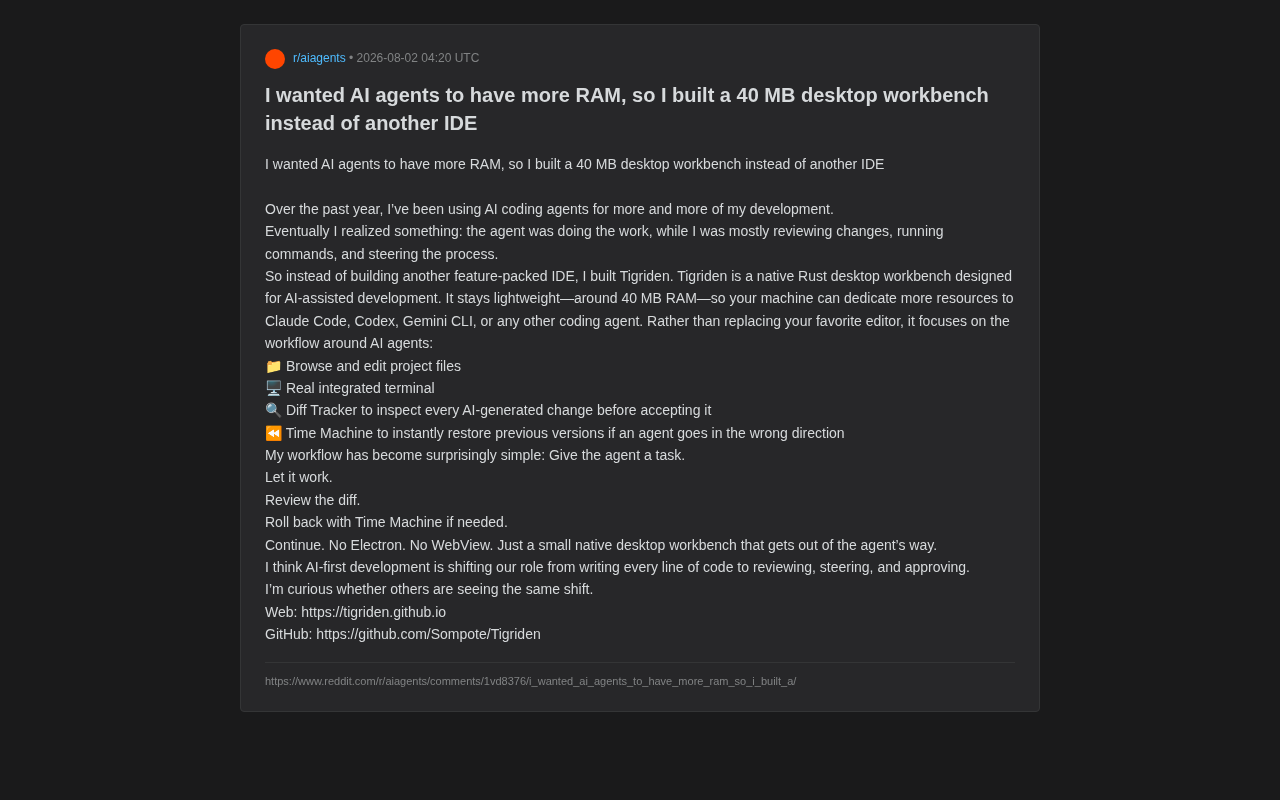
Why a "Workbench" Instead of Yet Another IDE
Leaving Memory for the AI Agent
Tigriden's most striking design philosophy is hidden behind its footprint: it uses only about 40MB of memory. This stands in stark contrast to modern IDEs that easily consume hundreds of megabytes or even gigabytes.
The author's logic is straightforward: since AI Agents are the ones actually doing the work, local machine resources should be reserved for them. When you're simultaneously running a large coding Agent like Claude Code, a bloated IDE competes with the Agent for system resources. Tigriden's design goal is the exact opposite—occupy as few resources as possible and give the stage to AI.
To achieve this, Tigriden is built natively in Rust, completely abandoning the Electron and WebView technology stacks. This is the key to compressing its memory footprint to the 40MB range. Electron is a cross-platform desktop application framework developed by GitHub that achieves cross-platform capability by bundling the Chromium browser engine and Node.js runtime into every application. Well-known apps like VS Code, Slack, and Discord are all built on Electron. The cost of this architecture is that each application carries a complete browser instance, with baseline memory overhead typically between 200-500MB. WebView solutions (like the system WebView used by Tauri) are lighter than Electron but still rely on a rendering engine. In contrast, Rust native GUI directly calls operating system graphics APIs, bypassing all the overhead of the web rendering layer, which is why it can compress memory usage to extremely low levels. This is the technical foundation that enables Tigriden to run at 40MB.
Not Replacing Your Editor, but Designing Around Agent Workflows
The author specifically emphasizes: Tigriden is not meant to replace your favorite code editor. It focuses on the workflow surrounding AI Agents, not coding itself. This is a pragmatic and insightful product positioning—in the AI coding era, the pain point has shifted from "how to write code more efficiently" to "how to better manage and review code produced by AI."
Four Core Features: Built for Code Review and Version Rollback
Tigriden addresses the core pain points of AI-assisted development with four key capabilities:
- 📁 File Browsing & Editing: Browse and edit project files to meet basic manual intervention needs.
- 🖥️ Integrated Terminal: A built-in real terminal for running commands and launching Agents.
- 🔍 Diff Tracker: Review every change one by one before accepting any AI-generated modifications.
- ⏪ Time Machine: Instantly restore to a previous version when an Agent goes off course.
Among these, Diff Tracker and Time Machine best embody the product's philosophy. They directly address the two most anxiety-inducing questions in AI coding: How do I confirm the AI made the right changes? What if it got something wrong?
Diff (difference comparison) is a fundamental concept in version control that shows line-by-line changes before and after file modifications. In traditional development, diff is primarily used during the Code Review stage to review code submitted by colleagues. But in AI coding scenarios, the importance of diff review is greatly amplified. There are three reasons: First, AI may modify dozens or even hundreds of files in a single task, making manual inspection of each one impossible. Second, AI occasionally produces "hallucinations"—generating code that looks reasonable but is actually incorrect, such as referencing non-existent APIs or introducing subtle logic errors. Third, AI may over-modify, inadvertently changing code that shouldn't be touched while completing the target task. Therefore, Diff Tracker lets developers see every change before approval, serving as the core safety valve for the "reviewer" role.
Time Machine provides the safety net—when an AI Agent deviates from expectations, roll back with one click without worrying about breaking the project. Traditional Git version control does offer rollback capability, but its granularity is at the commit level, and operations are relatively complex (requiring understanding the differences between git reset, git revert, git stash, and other commands). In scenarios where AI Agents iterate rapidly, an Agent may make multiple rounds of modifications within minutes without necessarily committing each time. Time Machine-style instant snapshots fill this gap—they capture project state at a finer time granularity, allowing developers to return to any intermediate point during the Agent's work, not just the most recent Git commit. This is similar to macOS Time Machine or JetBrains IDE's Local History feature, but specifically optimized for the high-frequency modification patterns of AI Agents.
The New AI Collaboration Workflow: Assign, Review, Rollback, Continue
The author describes his surprisingly simple workflow today:
- Give the Agent a task
- Let it work on its own
- Review the diff
- If needed, roll back with Time Machine
- Move on to the next step
This five-step cycle is essentially a paradigm of "AI automation under human supervision." This "Human-in-the-Loop" work model isn't unique to software development—it's already widely applied in high-risk domains like autonomous driving, medical AI diagnosis, and financial trading. Its core principle is: let AI handle large volumes of repetitive, pattern-based work, while keeping critical decision points for humans. In the software development context, this means AI handles the specific implementation (variable naming, algorithm writing, boilerplate code generation), while humans are responsible for architectural decisions, requirements understanding, security review, and final acceptance. This division of labor is very similar to the traditional "senior engineer reviewing junior engineer's code," except the "junior engineer" has been replaced by an AI Agent, and output speed has increased by orders of magnitude.
Developers no longer focus on how every line of code is written, but instead concentrate their energy on decision points—do I accept this change? Is this direction correct?
This workflow transformation, in a sense, echoes the deeper changes happening across the entire software engineering field. When AI can reliably complete most implementation details, human core value shifts toward judgment, direction control, and quality assurance.
An Industry Signal Worth Watching
Setting aside Tigriden as a specific product, the question the author poses at the end of his post is more thought-provoking: "AI-first development is shifting our role from writing every line to reviewing, guiding, and approving—are others seeing the same shift?"
This is an open question, but judging from the evolution of the tool ecosystem, the answer seems to be emerging. More and more developer tools are being designed around "AI Agent collaboration" rather than "human coding." Tigriden, as an open-source project (available on GitHub), represents one exploratory direction in this trend—minimalist, native, and focused on review and rollback.
Who Is Tigriden Best Suited For
Based on its positioning, Tigriden is most suitable for:
- Developers who heavily rely on AI coding Agents like Claude Code, Codex, and Gemini CLI
- Users who are sensitive to system resources and want to reserve memory for AI tools
- Those who embrace a "review-first" workflow and need frequent diff reviews and version rollbacks
Of course, as a project just getting started, whether it can establish itself between feature-complete mainstream IDEs and mature AI coding tools remains to be seen. But the core proposition it raises—in the AI era, development tools should be optimized for reviewing rather than writing—undoubtedly resonates with the real experience of many developers today.
Conclusion
Tigriden is not a tool that tries to do everything. Quite the opposite—its value lies in "restraint." The 40MB memory footprint, native Rust implementation, and feature design focused on review and rollback together outline a new development philosophy: when AI becomes the primary code producer, human tools should step into the background and make way for the Agent.
Regardless of how far Tigriden itself goes, the shift in developer roles it reflects is an important lens through which we can understand the future of AI-assisted programming.
Related articles

From DevOps to MLOps: Market Demand, Transition Path, and Practical Advice
In-depth analysis of transitioning from DevOps to MLOps: core differences, market demand, required skills, and a practical three-step path for operations engineers making rational career decisions.

How Realistic Is ChatGPT's Live Voice Feature? Its Human-Like Quality Is Downright Unsettling
ChatGPT Live Voice hands-on: natural interruptions, human-like pauses, and realistic breathing. Two phones chatting sound like real people. A deep dive into the tech and uncanny valley effects.

Training ASR Models with Simulated Call Center Audio: Can the Gap Between Simulated and Real Data Be Bridged?
Deep dive into training ASR models with simulated call center audio: analyzing codec simulation, code-switching, and diarization bottlenecks that reveal the gap between simulated and real phone data.