Training ASR Models with Simulated Call Center Audio: Can the Gap Between Simulated and Real Data Be Bridged?

Exploring whether simulated call center audio can effectively train ASR models or if real phone data remains irreplaceable.
This article examines the effectiveness of training ASR models with simulated call center audio, analyzing key technical gaps including codec distortion, code-switching, emotional prosody, and speaker diarization. It reveals that while codec simulation addresses channel-level issues, interaction dynamics and multilingual switching patterns remain fundamentally difficult to replicate, making real phone data still essential for production-grade systems.
A Long-Overlooked Speech Recognition Challenge
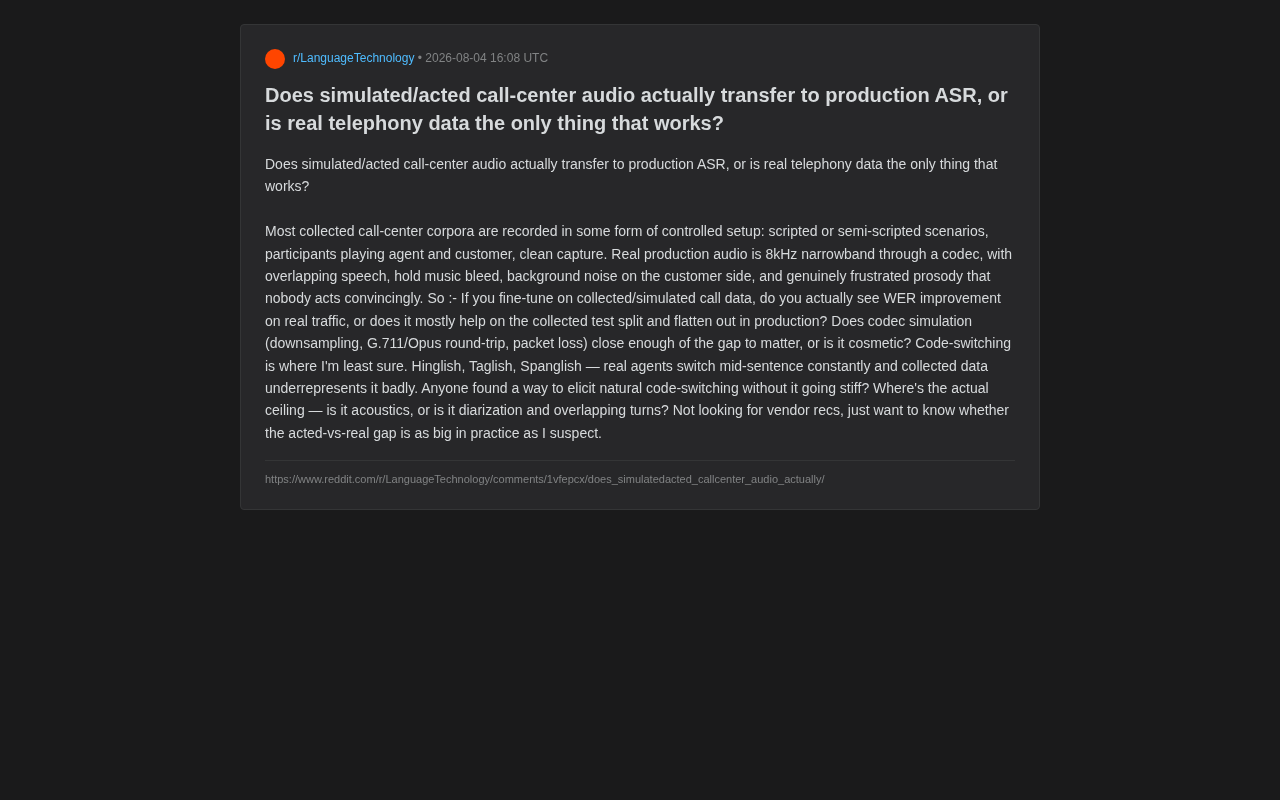
In the field of Automatic Speech Recognition (ASR), call center scenarios have always been a tough nut to crack. A recent technical discussion on Reddit hit a nerve with practitioners: Can ASR models trained on simulated or acted call center audio transfer effectively to real production environments? Or is genuine phone data the only thing that works?
This question might seem like a technical detail, but it has major implications for data strategy across enterprise-level voice products. After all, real call data involves privacy compliance and high acquisition costs, while simulated data is cheap and controllable—if simulated data actually works, it would dramatically lower the barrier to building ASR systems.
The Fundamental Gap Between Simulated and Real Data
The original poster pinpointed the core differences between these two types of data. Most publicly available call center corpora are recorded in controlled environments: scripted or semi-scripted scenarios, participants role-playing as agents and customers, and clean recording equipment.
Real production audio, on the other hand, presents an entirely different picture:
- 8kHz narrowband audio compressed through codecs
- Speaker voice overlap (agent and customer talking simultaneously)
- Hold music bleed
- Background noise from the customer's end
- And the hardest to replicate—authentic frustrated emotional prosody
Technical Background on 8kHz Narrowband Audio and Telephone Channels
Traditional telephone networks (PSTN) use an 8kHz sampling rate, which according to the Nyquist theorem means only the 0-4kHz frequency band can be transmitted. By comparison, modern voice assistants and podcast recordings typically use 16kHz or even 48kHz sampling rates. This bandwidth limitation loses a significant amount of high-frequency information crucial for consonant discrimination (e.g., the energy of fricatives like /s/ and /f/ is primarily concentrated above 4kHz), directly increasing ASR difficulty. Additionally, the G.711 codec uses μ-law or A-law companding algorithms for 8-bit quantization, introducing extra quantization noise that further degrades signal quality.
The last point is particularly critical. No matter how dedicated an actor is, they can hardly replicate the tone, pauses, and vocal shifts of a customer who is genuinely angry about a billing issue on the other end of the line. This "emotional authenticity" is an inherent weakness of performed data.
Is Fine-tuning Improvement Real or Inflated Metrics?
The poster raised a sharp question: If you fine-tune on collected/simulated call data, are you actually seeing WER (Word Error Rate) improvements on real traffic, or are you merely performing better on the collected test set while "snapping back" to baseline performance in production?
This is a classic case of the distribution shift trap in machine learning. The model may learn to fit the specific distributional characteristics of simulated data, perform excellently on in-distribution test sets, yet fail to generalize to the complex acoustic conditions of the real world.
The Deeper Mechanisms of Distribution Shift
Distribution shift refers to the mismatch between training data distribution and actual deployment data distribution in machine learning. In ASR scenarios, this shift manifests across multiple dimensions simultaneously: acoustic conditions (studio vs. noisy environments), speaking style (read speech vs. spontaneous speech), vocabulary distribution (scripted language vs. colloquial expressions), and prosodic patterns (calm performance vs. real emotions). Research shows that even a single dimension of shift can increase WER by over 50%, while the cumulative effect of multi-dimensional shifts often causes cliff-like performance degradation. This is why academia has increasingly emphasized "domain robustness" and "out-of-distribution generalization" as independent research directions in recent years.
This "inflated test set" phenomenon is a problem many speech projects painfully discover only at deployment time.
Codec Simulation: Treating the Symptom or the Cause?
To address the acoustic-level gap, a common industry practice is codec simulation—artificially "aging" clean audio through downsampling, G.711/Opus encode-decode round-trips, simulated packet loss, and similar techniques to make it more closely resemble real telephone channel quality.
Technical Differences Between G.711 and Opus Codecs
G.711 is a codec standardized by ITU-T in 1972, transmitting narrowband voice at a fixed 64kbps bitrate with virtually no complex compression and extremely low latency (0.125ms). It remains the core encoding scheme for PSTN to this day. Opus, standardized by IETF in 2012, is a modern codec supporting variable bitrates from 6kbps to 510kbps, capable of handling narrowband to full-bandwidth audio, and is widely used in VoIP applications (such as WebRTC, Discord, and Zoom). The distortion characteristics they introduce are fundamentally different: G.711 produces uniform quantization noise, while Opus, based on its hybrid SILK and CELT architecture, manifests distortion as spectral holes and transient blurring. Therefore, codec simulation must specifically cover both types of distortion patterns; otherwise, the model can only adapt to one type of channel characteristic.
The poster's question was: Is this simulation sufficient to bridge the gap, or is it merely cosmetic?
From a technical standpoint, codec simulation does effectively cover channel-level distortion—this part is predictable and parameterizable. Downsampling to 8kHz and simulating G.711 quantization noise can be replicated relatively faithfully. However, what it cannot solve:
- Unpredictable background noise combinations in real environments
- Natural speech overlap patterns between speakers
- Acoustic feature shifts caused by emotional speech
In other words, codec simulation can make audio "sound like a phone call" but cannot make the content "happen like a real conversation." It addresses the signal layer but not the interaction layer.
Code-Switching: The Hardest Fortress for Simulated Data to Conquer
The poster candidly admitted that their area of least confidence was code-switching—freely alternating between multiple languages within a single sentence.
This is the norm in call centers in multilingual regions:
- Hinglish (Hindi + English)
- Taglish (Tagalog + English)
- Spanglish (Spanish + English)
Real call center agents switch languages mid-sentence without warning, and collected data is severely underrepresentative of this phenomenon. Even trickier, even when participants are deliberately asked to code-switch, the resulting data often sounds "forced"—because natural code-switching is a subconscious linguistic habit that loses its fluidity and casualness the moment it's "performed."
Linguistic Foundations of Code-Switching
Code-switching isn't random language mixing—it follows strict grammatical constraints. Linguist Poplack's "Equivalence Constraint" states that switch points typically occur at positions where the syntactic structures of both languages are compatible. At the computational linguistics level, code-switching poses multiple challenges for ASR: language models need to switch n-gram probability distributions between languages in extremely short timeframes, acoustic models need to handle sudden transitions between different phonemic systems (e.g., Hindi retroflex consonants vs. English alveolar consonants), and the switch points themselves lack reliable acoustic prior signals. While current mainstream multilingual models like Whisper support multilingual recognition, their performance on intra-sentential code-switching remains far below monolingual scenarios, making ASR deployment in multilingual call center regions even more challenging.
This reveals a deeper issue: certain linguistic phenomena are fundamentally impossible to script. They depend on the speaker's authentic cognitive state and context, and they deform the moment they enter performance mode.
The True Performance Ceiling for Call Center ASR
The post concluded with a thought-provoking question: Is the real performance bottleneck for call center ASR an acoustic problem, or is it a speaker diarization and speech overlap problem?
This is a remarkably insightful follow-up. It implies:
- The acoustic layer (channel, noise, codecs) can perhaps be reasonably approximated through data augmentation and simulation techniques;
- But speaker diarization and overlapping speech processing—accurately determining "who is saying what" when two people speak simultaneously—may be the true ceiling that simulated data cannot overcome.
Current State and Bottlenecks of Speaker Diarization
Speaker diarization addresses the question of "who spoke when." Modern diarization systems typically employ a pipeline architecture: first performing Voice Activity Detection (VAD), then extracting speaker embedding vectors (such as x-vectors or ECAPA-TDNN), and finally assigning speaker labels through clustering algorithms (such as spectral clustering or PLDA). However, in telephone scenarios, crosstalk between two channels makes speaker diarization from single-channel recordings extremely difficult. In recent years, end-to-end neural diarization methods (such as EEND) and Target Speaker Voice Activity Detection (TS-VAD) have made progress, but in high-overlap scenarios (>30%), DER (Diarization Error Rate) remains stubbornly high, typically between 15-25%, far from commercially viable standards. Notably, if call center recordings use dual-channel capture (agent and customer recorded separately), the diarization problem is greatly simplified—but this depends on the telephone system's technical architecture and isn't available in all scenarios.
Because the timing, frequency, and patterns of speech overlap are deeply rooted in the dynamic interplay of real conversations, they are nearly impossible to reproduce through acting.
Practical Implications for ASR Practitioners
Although this is just a forum discussion post, it systematically outlines key decision points in speech recognition engineering, worthy of reflection by every ASR practitioner:
- Don't blindly trust test set metrics: WER improvements on simulated data must be validated on real traffic to be meaningful;
- View the data gap in layers: Channel distortion can be simulated, but interaction dynamics and emotional prosody are difficult to replicate;
- Code-switching requires real data: This is a fundamental weakness of simulated data, especially critical in multilingual scenarios;
- Watch for the diarization bottleneck: Once acoustic optimization hits its limits, speaker diarization may be the true performance ceiling.
Ultimately, simulated data isn't "useless"—it has "boundaries." Understanding where those boundaries lie is more important than blindly investing in data collection or data simulation. Real phone data remains scarce and valuable, and how to acquire and efficiently utilize it under compliance constraints remains the core challenge of deploying speech AI in production.
Key Takeaways
Related articles

Gaussian Process Bandit Optimization: Exploration Strategies and Inference Regret Guarantees
Cumulative regret guarantees in Bayesian optimization fail to reflect final recommendation quality. This article examines a new study that provides inference regret guarantees for Gaussian process bandit optimization through exploration query strategies and fill distance analysis, validated on hyperparameter optimization and control tasks.

The Most Detailed Codex Guide on Bilibili: From Installation to Real-World Practice
The most detailed Codex guide on Bilibili: from app store installation to daily work mode configuration, with a real coffee shop project demonstrating file organization, data extraction, dashboard creation, and other practical tasks. Learn to use Plan Mode and desktop pets to leverage Codex efficiently.

Appearance Compensation in Volume Rendering: Why RGB Accuracy Cannot Guarantee Density Correctness
Volume rendering research reveals that volumetric data perfectly reproducing external RGB views may still contain density errors: appearance compensation can double central density and keep external rays unchanged even when L2 error exceeds 14.52%. Density recovery depends on appearance capacity, spatial resolution, and measurement design.