Two Highly Effective AI Debugging Prompts: Cracking YOLOv8 and OpenCV Challenges

Two structured AI debugging prompts for systematically diagnosing YOLOv8 mAP collapse and OpenCV RTSP stream issues.
A developer shared two battle-tested debugging prompts on Reddit for diagnosing YOLOv8 training mAP collapse and OpenCV RTSP video stream corruption. This article analyzes their design logic—pre-setting candidate causes, requiring probability ranking, and enforcing diagnose-before-modify discipline—and extracts a universal debugging prompt paradigm that combines domain expertise with LLM capabilities.
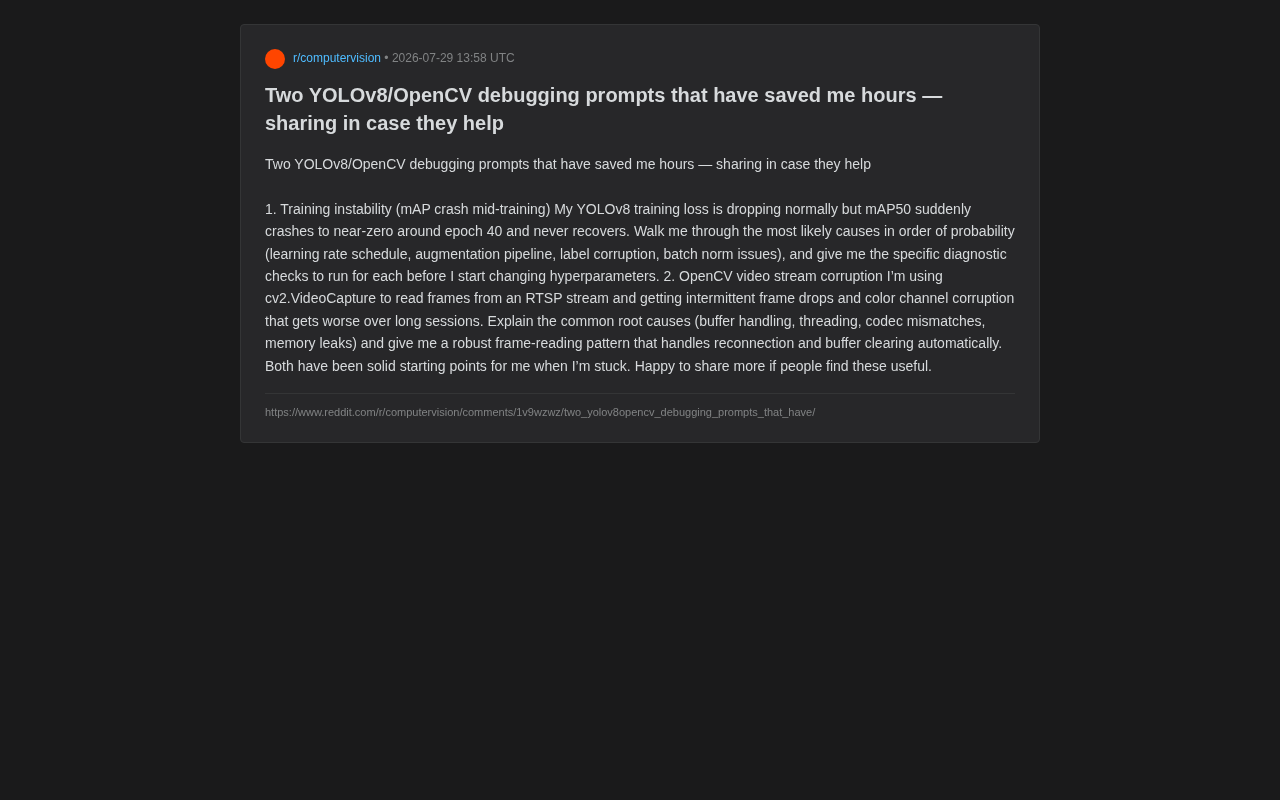
In the engineering practice of computer vision, model training crashes and video stream processing failures are two persistent headaches for countless developers. Recently, a developer shared two battle-tested debugging prompts on Reddit, claiming they saved substantial troubleshooting time. The value of these prompts lies not only in their content but in the structured debugging mindset they embody—how to leverage Large Language Models (LLMs) to systematically locate problems rather than blindly trial-and-error.
This article provides an in-depth analysis of the design logic behind these two prompts and explores the engineering methodology they represent.
Prompt One: Diagnosing mAP Collapse During YOLOv8 Training
Problem Scenario
The original post described a typical training anomaly: YOLOv8's training loss decreases normally, but the mAP50 metric suddenly collapses to near zero around epoch 40 and never recovers. This is one of the most puzzling situations in deep learning training—the loss curve looks perfectly fine, but evaluation metrics completely fall apart.
YOLOv8 is the latest generation of real-time object detection models released by Ultralytics in 2023, continuing the YOLO series' "You Only Look Once" design philosophy that performs object localization and classification simultaneously in a single forward pass. mAP50 (mean Average Precision at IoU=0.5) is the standard evaluation metric in object detection, comprehensively measuring the area under the precision-recall curve across all classes. Training loss reflects how well the model optimizes on the training set, while mAP reflects generalization performance on the validation set—a disconnect between the two is a classic signal of overfitting or pathological training.
The Cleverness of the Prompt
The author's prompt doesn't simply ask "why did my model crash." Instead, it requests the model to:
"Analyze the most likely causes in order from highest to lowest probability (learning rate scheduling, data augmentation pipeline, label corruption, batch normalization issues), and give me specific diagnostic checks for each cause BEFORE I modify any hyperparameters."
This prompt contains three key design elements:
- Pre-set candidate causes: It directly lists learning rate, data augmentation, label quality, and BatchNorm as the four prime suspects, locking the LLM's attention within a professional scope and avoiding generic responses.
- Requiring probability ranking: It forces the model to make priority judgments rather than listing all possibilities, which aligns with real-world engineering triage order.
- Diagnose before modifying: It explicitly requires "diagnostic checks before changing hyperparameters"—this is crucial engineering discipline that prevents blind parameter tuning without first locating the problem.
The Technical Logic Behind It
When mAP suddenly collapses while loss remains normal, it typically points to several deep-rooted issues.
Regarding learning rate schedulers, Cosine Annealing is a strategy that decays the learning rate following a cosine function, sometimes paired with Warm Restart to suddenly boost the learning rate at certain epochs. YOLOv8 uses linear learning rate decay by default, but many developers customize their scheduling strategies. When the learning rate suddenly increases after the model has converged to a local optimum, it can "kick" the weights out of a good convergence region, causing performance to plummet and fail to recover. Epoch 40 might coincide precisely with a transition point in certain scheduling strategies.
Regarding data augmentation, Mosaic augmentation was introduced in YOLOv4 and stitches four training images into one, forcing the model to learn object features in more complex contexts. MixUp blends two images at a certain ratio. These augmentation strategies significantly improve model robustness in early training, but if not disabled later (YOLOv8 turns off Mosaic by default in the last 10 epochs), the distribution gap between augmented training data and clean validation images becomes too large, causing the model to perform abnormally on clean validation images.
Label corruption or out-of-bounds coordinates can trigger NaN gradients in certain batches, polluting model weights and causing all subsequent evaluations to fail.
BatchNorm (Batch Normalization) issues are more insidious. BatchNorm uses the current mini-batch's mean and variance for normalization during training while maintaining an exponential moving average (EMA) of global statistics. During evaluation, the model uses these global statistics rather than current batch statistics. When the training batch size is too small, per-batch statistics fluctuate wildly, leading to inaccurate EMA statistics—using these unstable global statistics during evaluation can cause inference performance to collapse.
The value of this prompt lies precisely in guiding the model to make these hidden factors explicit, allowing developers to investigate them systematically one by one.
Prompt Two: Solving OpenCV Video Stream Corruption
Problem Scenario
The second prompt targets a common pain point when using cv2.VideoCapture to read RTSP streams: intermittent frame drops and color channel corruption that worsen over time. Any engineer who has done real-time video analysis knows this scenario—everything runs fine initially, but after a few hours, the image starts tearing, discoloring, or freezing entirely.
RTSP (Real Time Streaming Protocol) is a network streaming control protocol widely used in IP cameras, security surveillance, and similar scenarios. OpenCV's VideoCapture class decodes RTSP streams through the FFmpeg backend, maintaining an internal frame buffer queue. By default, this buffer continuously accumulates frame data. If the application layer's processing speed (e.g., running YOLO inference) is slower than the video frame rate, frames in the buffer become increasingly "stale," causing ever-growing latency. More seriously, during extended operation, the FFmpeg decoder may lose keyframes due to network jitter, producing screen tearing, color channel misalignment, and other visual artifacts.
Prompt Structure Analysis
The author asks the LLM to:
"Explain the common root causes (buffer handling, threading, codec mismatches, memory leaks) and give me a robust frame-reading pattern that handles reconnection and buffer flushing automatically."
This prompt also reflects mature engineering thinking:
- Categorizing root causes: It breaks the problem down into buffer, threading, codec, and memory leak dimensions, covering the main failure points in RTSP stream processing.
- Requesting a reusable pattern: It doesn't just ask for explanations but demands a "robust frame-reading pattern"—directly outputting a deployable code architecture.
- Emphasizing automated fault tolerance: It explicitly requires automatic reconnection and buffer flushing, which are the core requirements for long-running scenarios.
Engineering Essentials of RTSP Stream Processing
The root cause of RTSP stream problems often lies in OpenCV's default buffering mechanism. VideoCapture internally caches frames, and when consumption can't keep up, buffer accumulation leads to latency buildup and memory growth.
Regarding the threading model, single-threaded synchronous reading is a common source of performance bottlenecks. When the main thread is performing deep learning inference, VideoCapture's read() call blocks, causing buffer backlog. The industry-recognized best practice is a "producer-consumer" pattern: a dedicated background daemon thread continuously calls grab() to fetch the latest frame while discarding old ones, and the main thread obtains the latest frame through thread-safe shared variables for processing. In Python, this pattern can be implemented using the threading module combined with deque(maxlen=1), ensuring that each processed frame is the most current rather than a backlogged historical frame.
A complete solution typically includes: setting cv2.CAP_PROP_BUFFERSIZE to 1 to minimize buffering; using a dedicated thread to continuously read and discard old frames while retaining only the latest; implementing connection drop detection with automatic reconnection logic (usually with exponential backoff); and periodically releasing and rebuilding the capture object during long runs to avoid memory leaks. This prompt covers precisely the core of these engineering practices.
Universal Design Patterns for Debugging Prompts
Setting aside the specific technical details, what's truly worth learning from these two prompts is their universal debugging prompt paradigm. They both follow a transferable template:
- Precisely describe the phenomenon: Including a contrast between normal and abnormal behavior (e.g., "loss is normal but mAP collapses"), providing the model with critical differential signals.
- Pre-set the candidate cause domain: Proactively list possible causes within the professional domain to narrow the LLM's search space and improve response relevance.
- Require structured output: Such as probability ranking or categorical attribution, making answers more organized.
- Constrain the action sequence: Emphasize "diagnose before modifying" to prevent the model from giving destructive suggestions.
This paradigm is known as the "Constrained Guidance" strategy in the field of Prompt Engineering. Research shows that when users provide domain constraints (such as candidate cause lists) in their prompts, LLM output accuracy can improve by 30-50%. This relates to the LLM's attention mechanism—pre-set professional terminology and structured requirements act as "guardrails" for the model's generation process, reducing the probability of the model producing "hallucinations" or straying from professional tracks. Prompting techniques like Chain-of-Thought and Tree-of-Thought follow similar logic, improving output quality by guiding the model's reasoning path.
The essence of this paradigm is combining the developer's domain knowledge with the LLM's breadth of knowledge. The developer knows "which directions to investigate," while the LLM supplements "how to investigate each direction specifically." Compared to simply throwing out a vague request like "help me fix this bug," this structured questioning significantly improves output quality.
Conclusion
As AI-assisted programming becomes increasingly prevalent, writing high-quality debugging prompts is becoming a core skill for engineers. These two battle-tested prompts from the Reddit community remind us: good prompts aren't about asking more—they're about asking more precisely. Incorporating your professional judgment into questions and letting the LLM serve as a targeted "diagnostic assistant" rather than an omniscient "hands-off oracle" is the right approach to human-AI collaborative debugging.
For developers working in computer vision and real-time video processing, consider transferring this methodology to your own tech stack—building your own "debugging prompt library" might save you hours of troubleshooting time the next time you get stuck.
Related articles

persistent-inference: Solving TF/Keras Cold Start Problems with Just Two Files
Deep dive into the persistent-inference open-source project: solve TF/Keras cold start problems with just two files by keeping models resident in memory, eliminating reload overhead.

Do AI Certifications Actually Impress Recruiters? A Practical Guide for Career Switchers
A blockchain developer switching to AI—which certifications are worth it? This guide analyzes the real value of AI certs, compares Hugging Face vs AWS options, and offers project-based alternatives.

Laguna S 2.1 Performance Upgrade: 10x Rate Limit Increase, 250B Tokens Processed Daily
Poolside announces major Laguna S 2.1 upgrade with 10x rate limits, 250B daily tokens on OpenRouter, 1M context dedicated deployment, and integration with cline, opencode, and other AI coding agents.