Do AI Certifications Actually Impress Recruiters? A Practical Guide for Career Switchers

For senior AI roles, hands-on projects beat expensive certifications every time.
This article examines whether AI certifications can help tech professionals transitioning from blockchain to AI. It analyzes the real value boundaries of certifications, compares options from Hugging Face, AWS, and vendor-specific programs, and argues that for senior roles, building demonstrable projects like RAG applications or Multi-Agent systems is far more effective than collecting certificates. The guide offers practical strategies for leveraging existing engineering skills during career transitions.
From Blockchain to AI: A Real Career Transition Dilemma
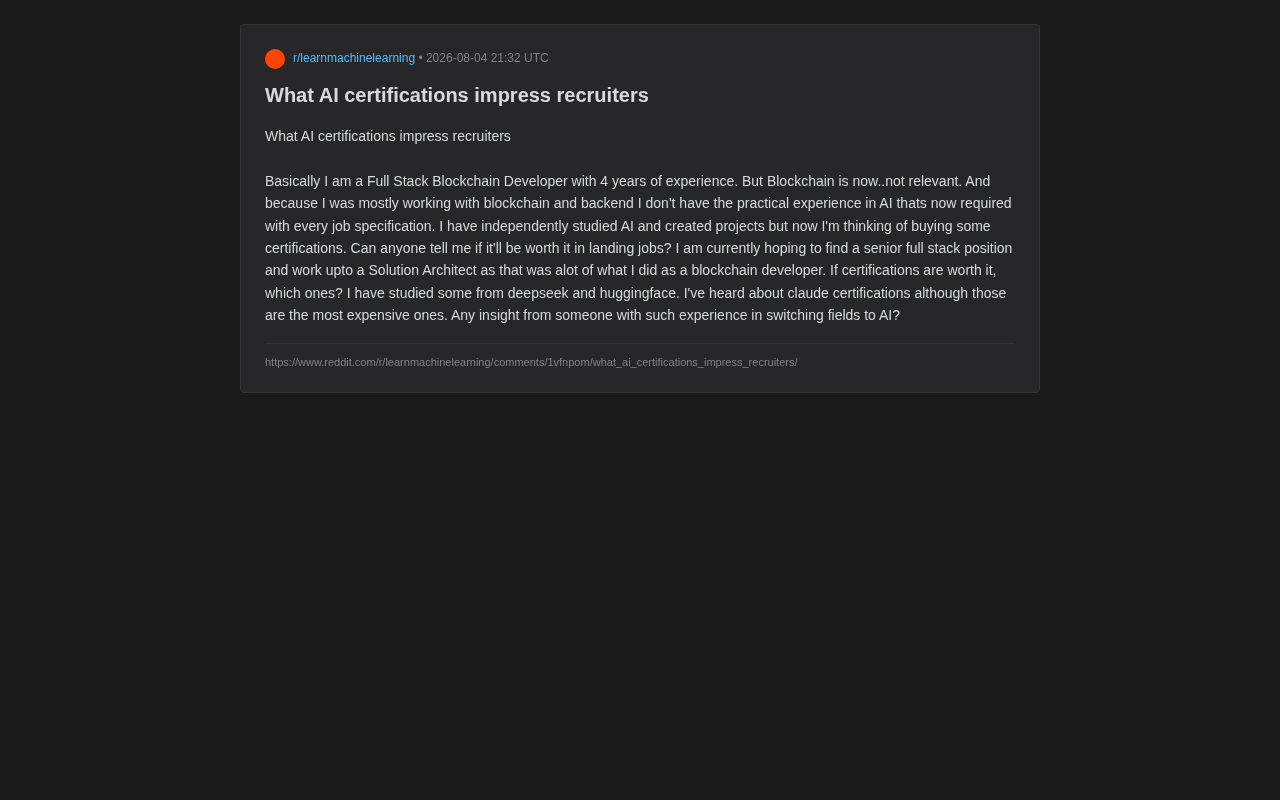
In Reddit's tech communities, a full-stack blockchain developer with 4 years of experience posed a question that sparked widespread discussion: facing the cooling of the blockchain industry and the rise of the AI wave, should he spend money on AI certifications to boost his job competitiveness?
This developer's situation is highly representative. He admitted: "Blockchain is now... not that relevant anymore. Since I mainly worked on blockchain and backend development, I lack the hands-on AI experience that almost every job description now requires." Despite having self-studied AI and independently completed some projects, he still hoped certifications would strengthen his resume's persuasiveness, with the goal of landing a senior full-stack position and eventually advancing to a Solution Architect role.
Behind this question lies a profound shift the entire tech industry is undergoing—from the cryptocurrency and Web3 hype to AI application development centered on large language models. The blockchain industry experienced a frenzied peak in 2021-2022, when DeFi (Decentralized Finance), NFTs, and various Layer 2 scaling solutions attracted massive numbers of developers. However, following a series of events in 2022 including the FTX collapse and Terra/Luna crash, the crypto market entered a deep winter. VC investment in Web3 projects plummeted by over 60% in 2023, with numerous blockchain startups laying off staff or shutting down. Meanwhile, the release of ChatGPT in late 2022 ignited the generative AI wave, with enterprise hiring demands rapidly shifting toward AI/ML—creating a stark industry cycle transition. For the thousands of developers in similar situations, how to gracefully and efficiently complete this skill migration is a pressing real-world challenge.
The Real Value of AI Certifications: What Do Recruiters Actually Care About?
To answer this question, we first need to understand what recruiters truly value. In the AI field, unlike traditional cloud computing certifications (such as AWS and Azure certifications), the industry has not yet established a universally recognized "gold standard" certification system. Unlike the cloud computing space with its complete certification pathways (AWS has a clear progression from Associate to Professional level; Google Cloud and Azure also have their own mature systems), the AI certification ecosystem is still in its early stages. This is primarily because AI technology iterates extremely fast—a model architecture that was cutting-edge six months ago may already be outdated, making it difficult for standardized certifications to keep pace with technological evolution. Currently in the industry, Andrew Ng's Deep Learning Specialization on Coursera is viewed as the classic entry pathway, but it leans more academic than engineering-practical. Among enterprise certifications, AWS's Machine Learning Specialty and Google's Professional Machine Learning Engineer certifications are relatively mature, but they focus more on traditional ML rather than the latest large model application development.
The Value Boundaries of Certifications
For entry-level and mid-level positions, certifications can serve as a "door opener," especially when you lack formal AI work experience. They signal to recruiters that you possess the ability to learn systematically and have foundational knowledge in the field.
However, for the senior positions and Solution Architect roles this developer is targeting, the situation is entirely different. A Solution Architect is a senior role within enterprise tech teams, responsible for translating business requirements into complete technical solutions. This role requires understanding both technical depth and business breadth—being able to evaluate the pros and cons of different tech stacks and design system architectures, while also communicating solution feasibility and costs with product managers and clients. In the AI space, Solution Architects need to judge when to use large models versus traditional machine learning, how to balance inference costs against effectiveness, and how to seamlessly integrate AI capabilities into existing enterprise systems.
At this level, recruiters—especially technical interviewers—care more about:
- Can you independently design and implement AI system architectures?
- Do you understand the trade-offs in model selection, cost control, and performance optimization?
- Do you have experience handling complex problems in real projects?
In other words, the more senior the position, the lower the marginal value of certifications, and the higher the weight of project experience and systems thinking.
Which AI Certifications Have Relative Value?
The post mentioned several certification sources. Here's a pragmatic tiered assessment:
- Hugging Face: As the core platform of the open-source AI ecosystem, its learning resources (such as the NLP course) enjoy high recognition in the developer community, with strong hands-on components and excellent cost-effectiveness. Founded in 2016, Hugging Face later pivoted to become an open-source AI model hosting platform, often called "the GitHub of AI." As of 2024, the platform hosts over 500,000 pre-trained models and 100,000 datasets. Its core library, Transformers, has become the de facto standard for using pre-trained models. The free courses it provides are practice-oriented—after completion, developers can immediately fine-tune models or build applications. This "learn and apply" characteristic has earned it an excellent reputation in the developer community.
- Vendor-specific model certifications (such as Anthropic's Claude-related certifications): These certifications are often expensive and tied to specific vendor ecosystems. Unless your target company explicitly uses that tech stack, the ROI is questionable.
- Courses from platforms like DeepSeekAd: Better suited as knowledge supplements rather than core resume endorsements.
Practical Advice for Career Switchers
Given this developer's specific background, the following path may be more effective than blindly purchasing expensive certifications.
Amplify Your Existing Strengths
As a full-stack blockchain developer with 4 years of experience, you actually possess many valuable transferable skills:
- Backend and system architecture experience: This is the foundation for building AI applications (especially RAG systems and Agent systems).
- Distributed systems understanding: Your blockchain background gives you deep insight into high concurrency and data consistency—extremely valuable in AI infrastructure.
- Solution design capability: The responsibilities you previously held as an architect naturally extend to the emerging role of "AI Solution Architect."
The key to transitioning is not starting from scratch, but layering AI capabilities on top of your existing engineering abilities.
Replace Certifications with Projects
For recruiters, a deployed, demonstrable, complete AI project is far more persuasive than a piece of paper. Consider building 1-2 projects that showcase combined full-stack + AI capabilities, such as:
- A RAG application based on LLMs (covering vector databases, retrieval optimization, front-end and back-end integration): RAG (Retrieval-Augmented Generation) is one of the most mainstream architecture patterns in current enterprise AI applications. Its core approach is to transform enterprise private data into vectors using embedding models, store them in vector databases (such as Pinecone, Weaviate, Milvus), and when a user asks a question, first retrieve relevant document fragments through semantic search, then pass these fragments as context to a large language model to generate answers. RAG solves two core pain points of large models: knowledge cutoff date limitations and hallucination issues. Building a production-grade RAG system requires handling challenges like document chunking strategies, retrieval ranking optimization, context window management, and response latency control—precisely the domain where full-stack engineers excel.
- A Multi-Agent collaboration system: Multi-Agent is a frontier direction in AI application development in 2024. Its core concept is having multiple AI Agents each take on different roles (such as researcher, coder, reviewer) to collaboratively complete complex tasks. Representative frameworks include Microsoft's AutoGen, CrewAI, and LangGraph. This architecture demands extremely high system design skills from developers—handling inter-agent communication protocols, state management, error recovery, and cost control. It shares many commonalities with distributed system design, making it a natural advantage area for developers with blockchain backgrounds.
- An innovative application integrating AI capabilities into blockchain scenarios (which happens to highlight your differentiated advantage)
Open-source these projects on GitHub with clear technical documentation—the effect often surpasses certifications alone.
Certifications as a Supplement, Not a Core Strategy
If you do choose to pursue certifications, follow the principle of "low cost, high hands-on value, broad recognition": prioritize Hugging Face's free/low-cost courses, or AI/ML certifications from major cloud providers (AWS, Google Cloud)—the latter appear more frequently in enterprise recruitment system keyword filters, helping your resume pass initial screening.
Here it's important to understand how ATS (Applicant Tracking System) works. ATS is a resume screening tool widely used by HR departments (such as Workday, Greenhouse, Lever, etc.). Large enterprises may receive hundreds or even thousands of applications per position, and ATS performs the first round of automated screening based on preset keywords—resumes with low match rates may never be read by a human. This means whether your resume contains keywords like "AWS Certified Machine Learning" or "Google Cloud AI" may directly determine whether you make it to the interview stage. The practical value of mainstream cloud provider certifications in job searching largely comes from their names being high-frequency keywords in ATS filtering.
Avoid investing in expensive vendor-specific certifications from the start, unless you've already identified target employers using that tech stack.
Conclusion: Skill Migration Is Essentially a Capability Upgrade
Transitioning from blockchain to AI is essentially not a "tear-down and rebuild" but a "capability upgrade." When recruiters look for senior talent, what they value has never been how many certificates you hold, but whether you can solve real business problems with engineering thinking.
For this Reddit developer, and for all tech professionals facing similar choices, perhaps the most pragmatic path is: invest the money and time you'd spend on expensive certifications into one or two high-quality hands-on projects instead. Certifications can be icing on the cake, but what truly impresses recruiters is always what you've built with your own hands.
Related articles

ChatGPT Space Launches: Team Collaboration and New Pages Features Explained
ChatGPT Space is OpenAI's new team collaboration feature with Pages, real-time collaboration, and Slack/Google Drive sync. We break down its privacy design, multi-platform integration, and the full workflow from conversation to document.

Migrating Apache Spark UDFs to GPU Acceleration with AI Agents
NVIDIA developer blog explains how AI Agents rewrite Apache Spark UDFs for GPU acceleration, covering migration criteria, agent rewriting and verification workflows, plus pitfalls like result consistency and CPU-GPU transfer overhead.

Zed Editor v0.40.4-rc2 Released: Usage Credits Now Available Without Upgrading
Zed editor releases v0.40.4-rc2, allowing users to use usage credits for AI features without upgrading to a paid plan, lowering the trial barrier.