0.6 Seconds to Parse 15 Pages on CPU: liteparse + ocria-nano-1 Open-Source Tool Sparks Discussion
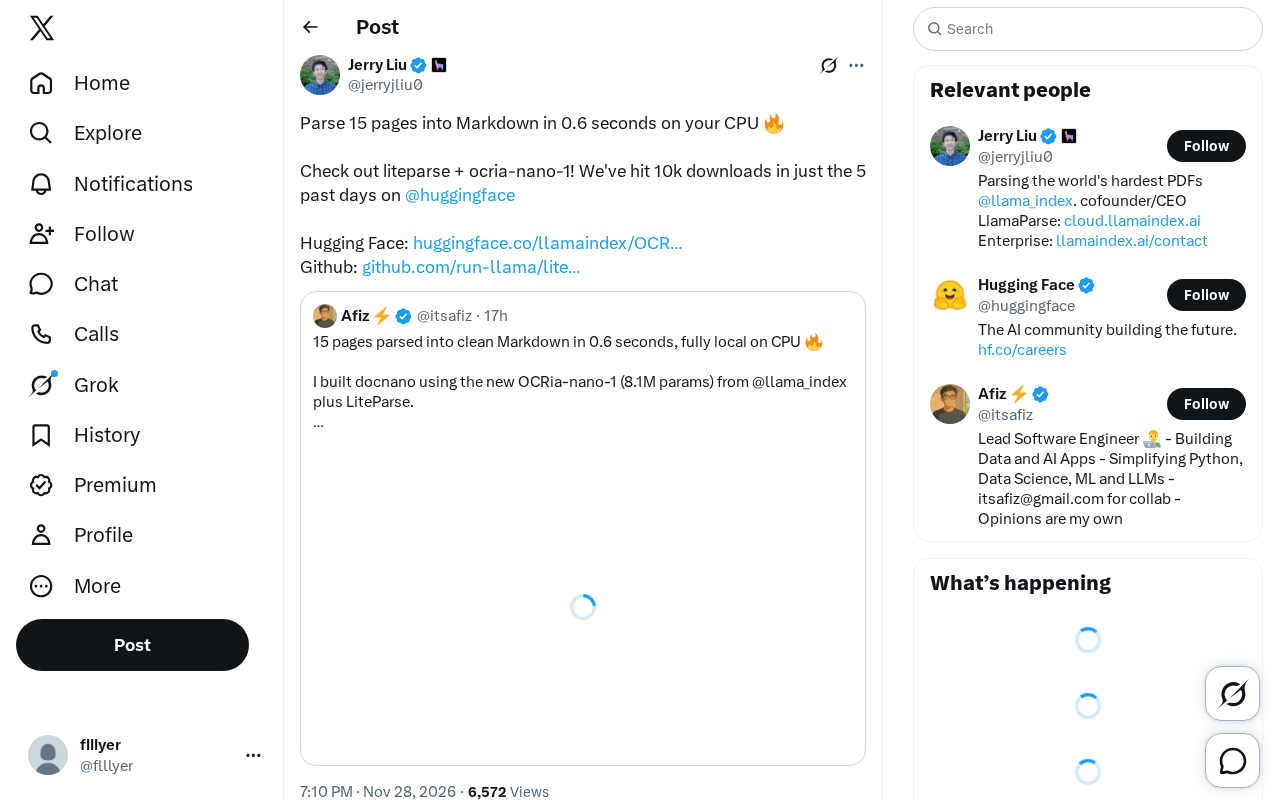
liteparse + ocria-nano-1 parses 15 pages in 0.6s on pure CPU, surpassing 10k downloads in five days.
liteparse combined with ocria-nano-1 converts 15 pages to Markdown in 0.6 seconds on pure CPU, surpassing 10k Hugging Face downloads in five days. The lightweight pipeline pairs document structure parsing with an ultra-small OCR model, suited for offline, privacy-sensitive, and batch preprocessing. The article analyzes its ~40ms-per-page speed advantage for RAG and online services, notes limitations like unpublished accuracy on complex layouts and the need for horizontal scaling under high concurrency, and recommends benchmarking before integration.
0.6 Seconds to Parse 15 Pages on CPU: liteparse + ocria-nano-1 Open-Source Tool Sparks Discussion
While document parsing tools are still competing over GPU acceleration, a project called liteparse, combined with the ocria-nano-1 model, has achieved a parsing speed of just 0.6 seconds to convert 15 pages of documents to Markdown in a pure CPU environment. According to information published by the project team on Twitter, the combination reached over 10k downloads within just five days of launching on Hugging Face. For developers who need to process large volumes of PDFs, scanned documents, and web archives, this number means localized, low-cost document preprocessing is now possible.
The Tech Stack Behind the Speed: liteparse and ocria-nano-1
liteparse is a lightweight document parsing library primarily responsible for extracting layout structures, text blocks, tables, and other elements from various document formats (such as PDFs and images); ocria-nano-1 is an ultra-small OCR model responsible for recognizing text in images and converting it into editable text. Together they form a "structure parsing + text recognition" pipeline, with all inference completed on CPU.
Based on public information, the solution does not rely on any GPU acceleration, meaning ordinary laptops, edge devices, or even low-spec servers can run it directly. For privacy-sensitive or offline scenarios (such as medical, financial, and legal document processing), this fully localized parsing approach avoids the risk of data leaving the device.
OCR (Optical Character Recognition) is the technology that converts text in images into machine-editable text. Traditional OCR pipelines typically include image preprocessing, layout analysis, text detection, and character recognition, relying on convolutional neural networks or Transformer models. As an "ultra-small OCR model," ocria-nano-1's "nano" naming suggests its parameter count is far lower than conventional OCR models (such as medium-to-large models based on ResNet or ViT), typically achieved through model pruning, knowledge distillation, or lightweight architecture design — trading some accuracy for real-time inference on CPU. Such models are suited for latency-sensitive, compute-constrained scenarios, but their robustness on complex fonts and low-quality scans is often limited.
10k Downloads in Five Days: Early Validation from the Open-Source Community
The project team specifically highlighted the download data on Hugging Face in their tweet — reaching 10k within five days. While this number is not astonishing among top open-source projects, for a vertical-domain document parsing tool, it indicates that it hits a pressing need among developers for efficient, lightweight parsing solutions.
Simultaneous release on both Hugging Face and GitHub also lowers the barrier for developers with different habits. GitHub repositories typically provide more complete example code and issue discussions, while Hugging Face facilitates version management of model weights and online体验 (hands-on体验).
The Competitive Logic of the Document Parsing Space: Why Speed and Size Matter So Much
Document parsing is the front-end step of RAG (Retrieval-Augmented Generation) and intelligent document processing. Traditional OCR solutions often rely on large models and GPU clusters, resulting in high per-page parsing costs and latency. The combination of liteparse and ocria-nano-1 splits "parsing" and "recognition" into two lightweight modules, processed in parallel or as a pipeline on CPU, thereby significantly compressing end-to-end time.
0.6 seconds to parse 15 pages equates to roughly 40 milliseconds per page. This speed offers a clear advantage in batch processing scenarios: processing 1,000 pages takes only about 40 seconds, with no need to queue for GPU resources. For online services that need to parse user-uploaded documents in real time, this low-latency characteristic can also significantly improve the experience.
It is worth noting that the tweet did not specify the exact type of test documents (plain-text PDFs, scanned documents, or complex layouts), so actual speed may vary depending on document complexity. Developers should benchmark against their own business documents when evaluating.
RAG (Retrieval-Augmented Generation) is a technical architecture that combines external knowledge base retrieval with large language model generation. In a RAG pipeline, documents first need to be parsed into plain text and split into chunks, then vectorized through an embedding model and stored in a vector database; when a user asks a question, the system retrieves relevant chunks and feeds them as context to the large model to generate an answer. The quality of document parsing directly determines the recall rate of subsequent retrieval and the accuracy of generated answers — if the parsing stage loses table structures, misrecognizes text, or misses layout order, the RAG system will not be able to correctly cite the original text. Therefore, tools like liteparse aim not only to be "fast" but also to preserve the semantic structure of documents (such as heading hierarchies, lists, tables) as much as possible for downstream chunking and retrieval.
Use Cases and Limitations
From a technical positioning perspective, liteparse + ocria-nano-1 is best suited for the following scenarios:
- Offline or privacy-sensitive environments: All processing is done on local CPU, and data never leaves the device.
- Batch document preprocessing: Quickly building text corpora for RAG systems.
- Edge device integration: Document parsing needs on low-power devices.
The limitations are equally clear: ultra-small models may fall short of large models in recognition accuracy on complex layouts (multi-column, nested tables, handwriting); pure CPU inference is fast, but in high-concurrency scenarios, horizontal scaling still needs to be considered. The project team has not yet published detailed accuracy evaluation data, which is also a key focus for the community going forward.
Edge devices refer to hardware that processes data at the network edge (such as user terminals, IoT devices, local servers), typically with limited compute and power constraints, but able to reduce data transmission latency and privacy risks. Running document parsing on edge devices means the model must be small enough (typically with parameter counts in the millions or below) and the inference framework must be optimized for CPU instruction sets (such as AVX2, NEON). The pure CPU approach of liteparse + ocria-nano-1 fits this need well, but the heterogeneity of edge devices (different CPU architectures, memory bandwidth) may also cause actual speeds to differ from official benchmarks, so developers need to benchmark against target hardware.
How to Get Started
Developers can access the project through both Hugging Face and GitHub. The Hugging Face page provides model weights and an online inference entry point, while the GitHub repository contains installation instructions and code examples. Since the project is in its early stages, it is advisable to follow known issues and version updates in the issue section.
For teams wanting to try it out, start by testing with a small set of representative documents, comparing parsing results against manual annotations, before deciding whether to integrate into a production pipeline.
One-line Summary
liteparse + ocria-nano-1 parses 15 pages in 0.6 seconds on pure CPU, surpassing 10k downloads in five days.
Paragraph Summary
liteparse combined with ocria-nano-1 achieves 0.6-second conversion of 15 pages to Markdown in a pure CPU environment, surpassing 10k downloads on Hugging Face within five days. The solution combines document structure parsing with an ultra-small OCR model into a lightweight pipeline, suitable for offline, privacy-sensitive, and batch preprocessing scenarios. The article analyzes the significance of its speed advantage (about 40 milliseconds per page) for RAG and online services, while noting limitations such as unpublished accuracy on complex layouts and the need for horizontal scaling under high concurrency, and recommends developers benchmark against their own documents before integrating.
Related articles

Shokz OpenRun Pro 2 Drops to All-Time Low Price, $55 Off
Shokz OpenRun Pro 2 drops to $124.95 during Black Friday and Cyber Monday, $55 off and matching its all-time low. We break down the use cases, value, and buying advice for these open-ear sports headphones.

Why Does Radiation Cause Electronic Device Failures? New Study Offers an Explanation
A new study explains the mechanisms by which radiation triggers electronic device failures, exploring single event effects and total dose effects on semiconductor devices, and the implications for radiation-hardened chip design and aerospace electronics reliability.

Uber Teams Up with Nuro to Enter Waymo's Turf: The Robotaxi Battle Escalates
TechCrunch Mobility reports Uber and Nuro's partnership to enter the robotaxi market, directly challenging Waymo's dominance. This article analyzes the role division, the competition between platform-based and full-stack models, and the impact on the Robotaxi industry landscape.