$1.45B Eka: Physical AI Model Teaches Robotic Arms to Have "Human Hands"

Eka Robotics achieves human-like general grasping with a physical AI model at a $1.45B valuation, but commercialization remains unproven.
Eka Robotics claims its robotic arm is the first truly good at grasping a wide range of objects, with smooth, human-like motions, earning a $1.45 billion valuation via its physical AI model. Physical AI lets models learn physical interaction outcomes like pushing, poking, sliding, and grasping in simulation rather than relying on preset grasp poses, enabling generalization in occlusion, stacking, and deformation scenarios. Human-like motion implies more compliant force control and lower impact, valuable for fragile items and human-robot collaboration. However, valuation is not revenue or shipments; the source discloses no customers, shipment scale, or technical papers, and physical AI broadly faces the sim-to-real gap, so its moat and commercialization still need third-party evaluation and deployment data.
From "Can Grasp" to "Grasps Well": Eka's Physical AI Breakthrough
In robotics, "grasping" seems simple but is actually one of the hardest general capabilities to master. Traditional robotic arms excel at repeating fixed motions in structured environments, but when faced with objects of varying shapes, materials, and weights, they often require reprogramming or swapping end effectors. Eka Robotics claims its robotic arm is the first product that is truly good at grasping a wide range of objects, with smooth, highly human-like motions that have drawn industry attention. According to an RSS source report, the company has achieved a $1.45 billion valuation on the strength of this physical AI model.
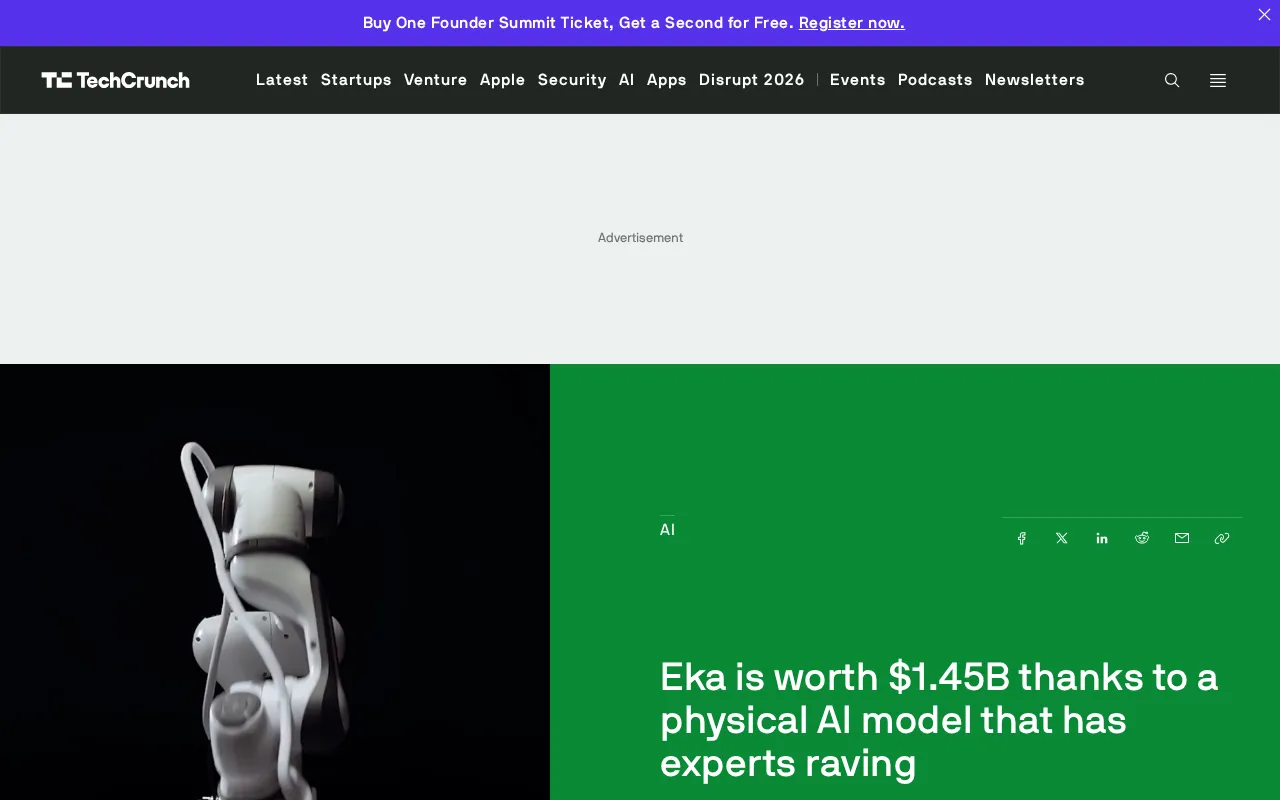
The underlying logic of this valuation is not a mechanical structural innovation but "physical AI"—letting models directly understand the interaction laws of the physical world rather than relying on preprogrammed trajectories. The reason Eka's robotic arm is described as "smooth and human-like" is that its motion generation is not discrete grasp points but continuous, force-feedback-driven anthropomorphic movement.
Why the Physical AI Model Excites Experts
From Visual Recognition to Physical Interaction
Traditional grasping solutions typically split into two stages: perception (identifying object position) and planning (computing grasp pose). This approach tends to fail in scenarios involving object stacking, occlusion, or deformation. The physical AI approach is to let the model undergo extensive trial and error in simulation, learning the consequences of physical interactions such as "push, poke, slide, grasp," thereby generalizing to the real world. According to the source description, Eka's robotic arm performs well when grasping a variety of objects, which is precisely a manifestation of physical AI's generalization capability.
Physical AI is a term that has emerged in recent years at the intersection of robotics and artificial intelligence, referring to letting models directly model and predict the interaction dynamics of the physical world, rather than merely performing semantic classification on images. Its difference from the traditional "perception–planning–control" pipeline is that the model learns, during training through large-scale simulation or real interaction data, the state transition laws of objects under force, collision, and sliding, thereby directly outputting action sequences or force-control commands at inference time. Representative work includes methods based on differentiable physics simulation, reinforcement learning, and diffusion policy. The difficulty of physical AI lies in the fact that physical laws are hard to exhaustively enumerate with pure data, and the distribution gap between simulation and reality can significantly affect generalization, so it is often used in conjunction with sim-to-real techniques.
"Human-like" Is More Than a Marketing Term
The significance of "human-like smoothness" is that anthropomorphic motion typically implies more compliant force control and lower impact. For fragile items, flexible objects, or scenarios requiring human-robot collaboration, the smoothness of motion directly determines usability. What experts praise about Eka is not that it can pick up a specific object, but that the way it grasps is close to human—suggesting its underlying control strategy has moved beyond the "position control" framework.
Force control and position control are two fundamental control paradigms for robot end effectors. Position control drives the robotic arm to precisely reach a specified pose, but once contact is made with an object, it cannot actively adjust the applied force, making it easy to crush fragile items or jam. Force control adds force/torque sensors at the end effector to closed-loop regulate contact force, enabling the robotic arm to "compliantly" conform to object surfaces and adapt to deformation and sliding. The reason human-like grasping looks smooth is precisely that the human hand naturally employs impedance control—simultaneously regulating position and stiffness, yielding rather than resisting at the moment of impact. Eka being described as having human-like motion suggests its control layer may employ impedance or variable impedance strategies rather than simple position trajectory interpolation.
Industry Signals Behind the $1.45 Billion Valuation
According to a single source report, Eka Robotics has reached a valuation of $1.45 billion. This figure places it at unicorn level in the robotics sector, reflecting the capital market's strong recognition of the "physical AI" narrative.
It is worth distinguishing that valuation is not equivalent to revenue or shipment volume. The value of a physical AI model needs to be validated in actual deployment: grasp success rate, cycle time, maintenance costs, and speed of adaptation to unknown objects are all variables that determine commercialization success. The source information does not disclose Eka's specific customers, shipment scale, or technical papers, so judgment of its technical moat should remain cautious.
Competition and Challenges in the Physical AI Track
Eka is not fighting alone. Physical AI has become one of the most crowded narratives in robotics, with multiple companies attempting to train general grasping models using large-scale simulation. Eka's differentiation lies in its positioning as "the first to be truly good at broad grasping," but this claim requires third-party evaluation to substantiate.
From a technical pathway perspective, physical AI models face the sim-to-real gap. Policies trained in simulation often suffer performance degradation in the real world due to differences in friction, lighting, and sensor noise. If Eka can stably reproduce human-like grasping in real scenarios, its moat will be deeper than model scale alone.
The sim-to-real gap refers to the performance drop that occurs when a policy trained in a physics simulator is deployed to a real robot, caused by factors including imprecise contact friction models, sensor noise, lighting and material differences, and actuator latency. Common mitigation approaches include domain randomization (randomizing friction coefficients, mass, lighting, and other parameters in simulation), system identification (calibrating simulation parameters with real data), and real-world fine-tuning. For grasping tasks, the highly nonlinear nature of contact mechanics makes sim-to-real particularly challenging, which is also one of the most important indicators to watch when evaluating the technical moats of companies like Eka.
Implications for Practitioners
For developers focused on embodied intelligence, Eka's case points to a direction: the ceiling of grasping capability depends not on the degrees of freedom of the end effector but on the model's ability to predict the consequences of physical interaction. Jointly modeling force, touch, and vision brings us closer to general grasping than stacking up visual recognition accuracy.
At the same time, a $1.45 billion valuation also means the market's patience is limited. Physical AI companies need to deliver quantifiable deployment data beyond demo videos. Whether Eka can convert "experts going viral" into "customers repurchasing" will determine whether this valuation is a starting point or a peak.
One-line Summary
Eka Robotics achieves human-like general grasping with a physical AI model and a $1.45 billion valuation, but commercialization remains to be validated.
Paragraph Summary
Eka Robotics claims its robotic arm is the first product truly good at grasping a wide range of objects, with smooth, human-like motions, and has achieved a $1.45 billion valuation on the strength of its physical AI model. The core of physical AI is letting models learn the consequences of physical interactions such as pushing, poking, sliding, and grasping in simulation rather than relying on preprogrammed grasp poses, thereby generalizing in occlusion, stacking, and deformation scenarios. Human-like motion implies more compliant force control and lower impact, which is significant for fragile items and human-robot collaboration. However, valuation does not equal revenue or shipment volume; the source does not disclose customers, shipment scale, or technical papers, and physical AI generally faces the sim-to-real gap, so its technical moat and commercialization success still need third-party evaluation and deployment data to substantiate.
Related articles

Fifty Years Studying Power: Robert Caro's Writing and Insights on Power
Robert Caro reflects on 50 years studying power: Lyndon Johnson's persuasion and leverage, Robert Moses's transformation from idealist to ruthless builder, the dilemmas of large-scale construction, and his methods of compressing themes and solitary focus in biography writing.

Can a $20,000 Robot Do Your Chores? The Test Results Are Surprising
A YouTube test video shows how a $20,000 robot responds to commands like washing dishes, turning off lights, taking out trash, and feeding the dog. This article analyzes its real capability boundaries, the state of voice interaction technology, and how far household robots are from mainstream adoption.

The Complete Guide to Running AI Models Locally: Inference Engines and Tool Stack Explained
A systematic breakdown of the complete local LLM tool stack: from PyTorch and GGML compute libraries to llama.cpp, vLLM, SGLang inference engines and Ollama, LM Studio wrapper layers, with benchmark data on performance differences and selection logic.