$1.8B Global Commitment: What It Really Means to Prepare Biological Data for AI

$1.8B global commitment bets on AI-ready biological data as the key bottleneck in AI-driven life sciences.
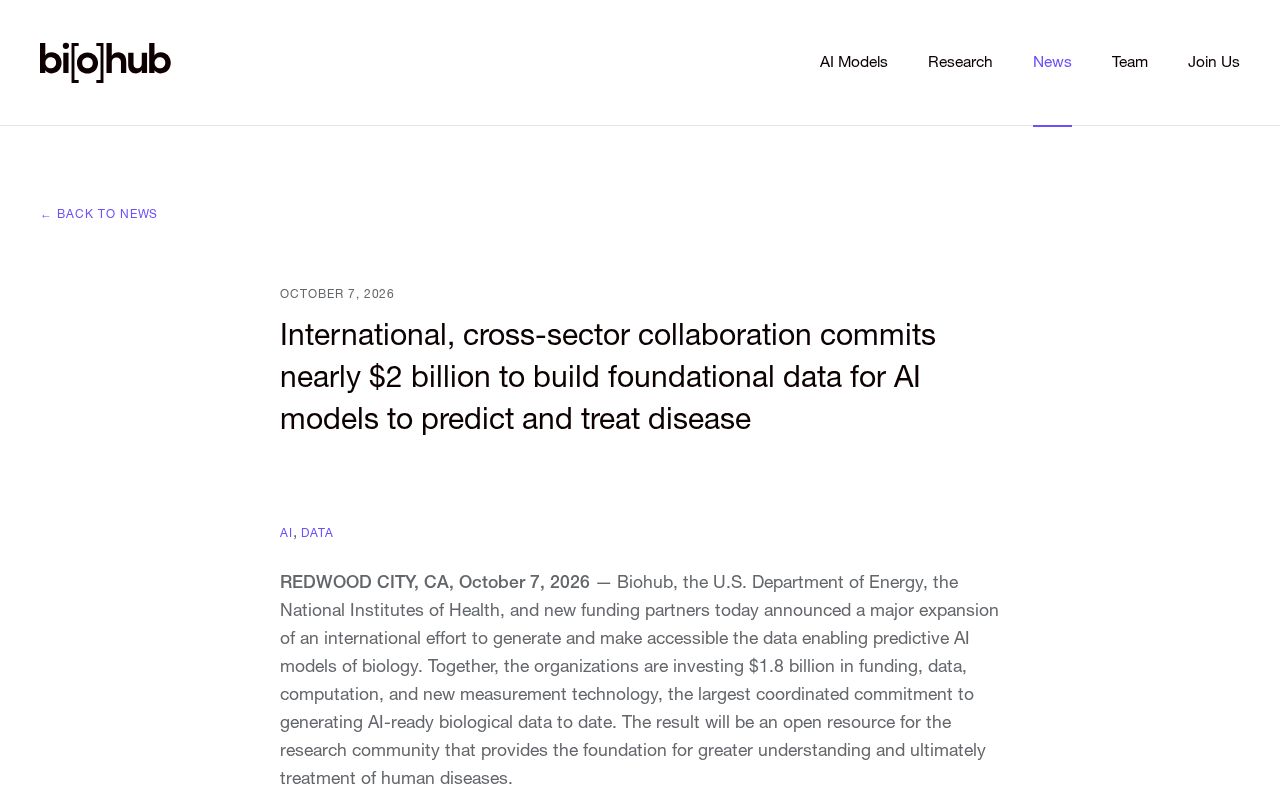
A $1.8 billion global funding commitment has set its sights on "AI-ready" biological data, reflecting a pivotal shift in AI-driven life sciences: the bottleneck is moving from algorithms to data quality, scale, and standardization. AI-ready data requires structured processing, unified annotation, and quality validation, along with diversity across species, populations, and experimental conditions. The investment could accelerate drug discovery and advance open science, but data governance, privacy protection, and the gap between commitment and execution remain critical concerns.
A Major Investment in AI-Ready Biological Data
A $1.8 billion global funding commitment has caught the attention of the tech and life sciences communities, with a core focus on "AI-ready" biological data — high-quality biological datasets that can be directly used for AI training and analysis. The news earned 25 upvotes on Hacker News, and while discussion volume remains modest, it reflects a growing trend: data, not models themselves, is becoming the critical bottleneck for AI-driven breakthroughs in life sciences.
Over the past few years, AI has shown remarkable potential in areas like protein structure prediction, drug discovery, and genomics. Yet the industry has gradually come to recognize that what constrains progress is often not the algorithm, but the availability, standardization, and scale of the underlying data. This commitment aims to directly address that pain point.
Why "AI-Ready" Is the Key Term
Data Quality Sets the Ceiling for Models
There's an old saying in machine learning: garbage in, garbage out. This is especially true for biological data. Raw data generated in laboratories is often inconsistently formatted, inconsistently annotated, and lacks unified metadata standards — making it difficult to feed directly into AI models.
"AI-ready" means data must be structurally processed, standardized in annotation, quality-validated, and accompanied by clear provenance and contextual information. Only then can a model learn reliable biological patterns rather than noise. A significant portion of the $1.8 billion is expected to go toward data collection, cleaning, annotation, and infrastructure — the unglamorous but absolutely essential groundwork.
The challenge of standardizing biological data far exceeds that of most other industries. In genomics, for example, different sequencing platforms (Illumina, Oxford Nanopore, etc.) produce raw data in different formats, and differences in reference genome versions can make results impossible to compare across studies. Proteomics data faces batch effect problems — measurements of the same protein taken in different labs or at different times can exhibit systematic numerical drift. Missing metadata is particularly damaging: if contextual information such as sample collection conditions, patient age, or medication history is incomplete, an AI model may learn spurious correlations rather than genuine biological patterns. For this reason, "AI-ready" is far more than a simple format conversion — it's a systematic effort involving experimental design, data collection, quality control pipelines, and ontology annotation, often requiring deep collaboration between biologists, data engineers, and domain experts.
The Dual Requirements of Scale and Diversity
AI's demands on data go beyond "clean" — they also require "enough" and "diverse enough." The complexity of biological systems means that models must cover data from different species, experimental conditions, and human populations to achieve meaningful generalizability.
No single institution can independently build data resources at this scale, which is precisely the significance of the phrase "global commitment" — it implies a cross-national, cross-institutional collaborative framework that pools distributed data resources to achieve scale.
Potential Impact of This Investment
Accelerating Drug and Disease Research
High-quality AI-ready biological data has the potential to significantly shorten drug discovery timelines. When researchers can train models on large-scale standardized datasets, efficiency across the pipeline — from target identification to candidate molecule screening — could improve dramatically. Fields such as genomics and proteomics will also benefit from a more reliable data foundation.
Advancing Open Science and Data Sharing
If these funds are genuinely used to build open, accessible data resources, this initiative could become a meaningful driver of open science. Biological data has long been scattered across individual labs and private databases, forming isolated "data silos." Establishing unified standards and sharing mechanisms would give researchers worldwide more equitable access to resources.
That said, the degree of openness, data governance, and privacy protection — especially when human biological data is involved — will be unavoidable challenges. Funding is only the first step; building sustainable governance mechanisms is equally critical.
Several mature technical approaches to biological data privacy have already emerged. Differential privacy adds controlled noise at the dataset level, making it impossible for attackers to reverse-engineer individual-level information from statistical outputs. Federated learning allows models to train on local data at each institution, sharing only gradient parameters rather than raw data, thereby bypassing data transfer and compliance barriers. Synthetic data generation is also advancing rapidly in the biomedical space, producing datasets that share statistical properties with real data but don't correspond to actual individuals — balancing privacy and usability to a degree. However, each of these approaches carries trade-offs: noise reduces data utility, federated learning still faces communication overhead and model convergence challenges, and synthetic data may introduce distributional bias. Finding the right balance between privacy protection and scientific data value will be a core tension this investment must directly confront during implementation.
A Measured Take: Reserving Judgment Under Limited Information
One important note: publicly available details about this $1.8 billion commitment remain quite limited. The specific sources of funding, allocation mechanisms, participating institutions, time horizons, and measurable output targets have yet to be disclosed.
Large funding commitments in the tech and research sectors are not uncommon, but the gap between "commitment" and "delivery" is real. True value depends on whether funds translate into usable infrastructure, open data standards, and reproducible research outcomes. Until more information is made public, rational optimism is probably the most defensible position.
Conclusion
This investment sends a clear signal: in the era of AI-driven life sciences, data infrastructure is being elevated to a strategic priority. Models matter, of course — but without high-quality, large-scale, standardized biological data as a foundation, AI's potential simply cannot be unlocked. Whether $1.8 billion can truly reshape the landscape of biological data supply is a story worth watching closely.
Related articles

Chain of Thought Isn't Just for AI: How Humans Can Use CoT to Improve Thinking Quality
Chain of Thought isn't just a prompt trick for large models. Starting from a Hacker News discussion, this article analyzes why CoT works for human thinking too, breaks down actionable ways to transfer it, and highlights the key differences between human CoT and machine CoT.
Cloudflare Teams Up with OpenAI: Closi…
Cloudflare Teams Up with OpenAI: Closing the Loop from Vulnerability Discovery to Defense with AI
Cloudflare uses OpenAI Daybreak to investigate security vulnerabilities and generate reviewable remediation plans, while developers use Codex to boost coding efficiency and quality.

Orca Multi-Agent Orchestration in Practice: A Guide to Parallel Collaboration with Claude and Codex
Orca is Stable AI's free open-source agent workbench supporting 34 agents like Claude Code and Codex in parallel. Learn its Git worktree isolation, multi-model orchestration, and mobile management.