11 AI Coding Agents Reviewed: Codex Ranks #1 Overall, Claude Code Has the Strongest Raw Capabilities
Codex wins overall, Claude Code leads in raw capability, OpenCode tops in freedom — 11 AI coding Agents ranked.
This comprehensive review evaluates 11 mainstream AI coding Agents — including Codex, Claude Code, Cursor, OpenCode, and Zcode — across five dimensions: onboarding speed, task capability, ecosystem maturity, controllability, and cost-effectiveness. Codex takes the overall #1 spot with balanced performance across all dimensions, while Claude Code leads in raw task capability for complex long-chain tasks despite platform risk concerns. OpenCode stands out as the top open-source choice for maximum flexibility.
AI Coding Agents Have Entered the "Real Work" Era
Give the same requirement to two tools built on the same underlying model, and the results can be worlds apart: one merely generates a few code snippets, while the other autonomously reads your repository, modifies files, runs tests, catches errors, and keeps fixing them until the task is done. The difference isn't in the model itself — it's in the Agent architecture wrapped around it.
The core concept behind Agent architecture originates from the "intelligent agent" theory in artificial intelligence. A traditional large language model (LLM) is essentially a "single-inference" system — given an input, it produces an output, and the process ends. Agent architecture adds four cyclical stages on top of this: Perception, Planning, Action, and Feedback. In a coding context, this means the Agent doesn't just generate code — it proactively reads the project structure, understands dependencies, executes the generated code, captures error messages, and feeds those errors back as new input for another round of reasoning and fixing. This "act—observe—correct" loop (also known as the ReAct paradigm) is the fundamental distinction between Agents and pure code completion tools. The industry often calls this closed-loop capability Agentic Coding — it elevates AI tools from a "copilot" role to an "autonomous executor" capable of independently delivering tasks.
The essence of an AI coding Agent is running "understand—plan—execute—verify" as a closed loop, ultimately delivering real results rather than stopping at code generation. As tools in this space multiply, objectively comparing them side by side has become a genuine pain point for developers. This article is based on a systematic evaluation by Bilibili creator "小星星AI" (Little Star AI), comprehensively analyzing 11 mainstream AI coding Agents across five dimensions: onboarding speed, task capability, ecosystem maturity, controllability/portability, and cost-effectiveness.
Evaluation Framework and Scoring Dimensions
This review uses a five-dimension scoring system, with each dimension rated on a 5-star scale:
- Onboarding Speed: The barrier from installation and configuration to first productive output
- Task Capability: Actual performance on complex, cross-file, long-chain tasks
- Ecosystem Maturity: Completeness of plugins, protocols, and enterprise integrations
- Controllability/Portability: Account lock-in risk, model flexibility, and workflow portability
- Cost-Effectiveness: Ratio of free quotas and paid pricing to actual output
The value of this framework lies in separating "overall experience" from "specialized capabilities," preventing a single metric from masking a tool's real weaknesses.
#11 to #7: Distinctive Features, Still Maturing
#11: Groq Build
Groq Build offers a full-screen terminal, planning mode, parallel sub-Agents, and open protocol support. Attention surged rapidly after its public beta in May. Groq's uniqueness lies in its proprietary LPU (Language Processing Unit) chip architecture. Unlike NVIDIA GPUs that accelerate inference through parallel matrix operations, the LPU uses a deterministic compute pipeline design that eliminates the memory bandwidth bottleneck inherent in traditional GPU inference, completing LLM inference with extremely low latency. In public benchmarks, Groq's inference speed once reached hundreds of tokens per second, far exceeding GPU-based solutions at the time. Groq Build is built on this hardware advantage, and its "parallel sub-Agent" design can run multiple task branches simultaneously thanks to low-latency inference support. However, LPU chip production capacity and deployment scale remain limited, which is also a hardware-level reason for its insufficient stability during the beta phase. It's still in the early testing stage, with both ecosystem accumulation and system stability lacking. Rating: Onboarding ★★★, Capability ★★★★, Ecosystem ★★★, Controllability ★★★★, Cost ★★★.
#10: Trae (ByteDance)
Trae excels in Chinese-language friendliness and a native editor experience. New users can install it and start working immediately — the barrier is extremely low. The main issues are noticeable queuing during peak hours, unstable free-tier experience, and higher risk for deep production tasks. Rating: Onboarding ★★★★★, Capability ★★★★, Ecosystem ★★★★, Controllability ★★★, Cost ★★★★.
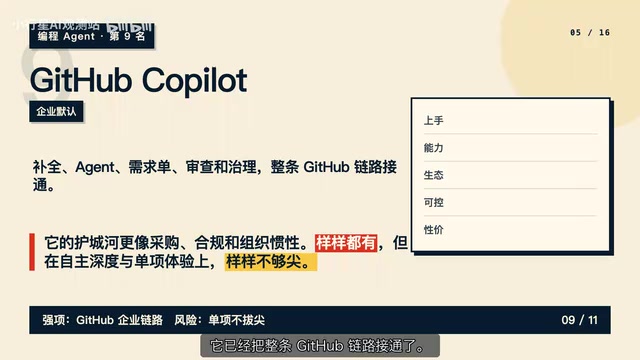
#9: GitHub Copilot
Copilot has integrated code completion, multi-file Agent capabilities, code review, and enterprise governance into the complete GitHub pipeline. But as the evaluation notes, "it has everything, but nothing is sharp enough" — its real moat comes more from enterprise procurement inertia and compliance requirements than from technological leadership.
GitHub Copilot's strong position in the enterprise market is largely not because it has the strongest Agent capabilities, but because it's deeply embedded in enterprise software supply chain compliance systems. When large enterprises choose AI coding tools, they typically need to satisfy a series of non-technical requirements: IP indemnity, data residency, SOC 2 compliance certification, SSO integration, and more. GitHub Copilot Business/Enterprise editions provide enterprise-grade policy management dashboards, allowing administrators to control which repositories the AI can read and whether public code snippets can enter the training set. This "governance-first" product strategy means many enterprises continue using Copilot even when they know technically superior alternatives exist, due to procurement process path dependency and compliance cost considerations. The evaluation's "nothing is sharp enough" comment essentially reflects the product positioning trade-off between cutting-edge consumer-facing performance and robust enterprise-facing compliance.
Rating: Onboarding ★★★★★, Capability ★★★★, Ecosystem ★★★★★, Controllability ★★, Cost ★★★.
#8: Coder
Coder has evolved into a complete platform encompassing desktop workbench, editor plugins, CLI, cloud Agents, mobile remote control, and development kits. It supports the plan—execute—verify—self-correct closed loop and can automatically select models. The company claims over 6 million cumulative users (note: not active users). Rating: Onboarding ★★★★, Capability ★★★★, Ecosystem ★★★★★, Controllability ★★★, Cost ★★★★.
#7: Plandex
Plandex deliberately maintains a minimalist core, retaining only four essentials — read, write, edit, and terminal — with everything else assembled through extensions and scripts. It has garnered approximately 100K stars on GitHub and continues to iterate rapidly. The trade-off is that there's no permission system by default, no built-in sub-Agent scheduling or planning mode, and the learning curve is steep. Rating: Onboarding ★★, Capability ★★★★★, Ecosystem ★★★★, Controllability ★★★★★, Cost ★★★★★.
#6 to #4: Competitors with Unique Strengths
#6: Zhipu CodeGeeX (Zcode)
Zcode is the official coding harness for the GLM-4 series, with long tasks and multi-Agent collaboration as its core strengths. GLM-4 is the fourth-generation general-purpose LLM series from Zhipu AI, with its core architecture based on the GLM (General Language Model) framework originally developed by Tsinghua University's KEG Lab. Unlike the GPT series' decoder-only architecture, GLM originally used an autoregressive blank infilling pre-training objective, seeking a balance between understanding and generation. By the GLM-4 stage, the model has fully aligned with mainstream decoder-only paradigms while continuously optimizing vertical capabilities in code generation and mathematical reasoning. CodeGeeX is Zhipu's model branch specifically trained for coding scenarios, now in its third generation (CodeGeeX4), supporting multi-language code completion, cross-file understanding, and project-level context awareness.
Using Coding Plan mode effectively provides 1.5x quota throughout the day — this mode essentially breaks down and queues tasks at the request level, improving effective utilization under the same compute quota. GLM also offers additional free quota during late-night hours (23:00 to 09:00), making its cost-effectiveness outstanding. The weakness is that its advantages are highly tied to the GLM ecosystem, limiting model diversity.

Rating: Onboarding ★★★★, Capability ★★★★, Ecosystem ★★★, Controllability ★★★★, Cost ★★★★★. Top pick among Chinese-developed solutions.
#5: Gemini CLI / Google AI Studio Agent
With built-in Gemini Flash, it's fast with generous free quotas. It's a full-featured general Agent tool capable of terminal operations, browser tasks, Git, scheduled tasks, workflows, and image generation. The Gemini series' most notable technical characteristic is native multimodal capability — the model processes text, image, audio, and video data simultaneously from the pre-training stage, rather than bolting a visual encoder onto a text model as earlier multimodal approaches did. This enables Gemini CLI to not only handle code but also execute image generation, parse UI layouts from screenshots, and perform other cross-modal tasks. The full-featured execution capability mentioned in the evaluation is precisely the productization of this multimodal foundation.
It also supports third-party models like Claude and GPT, but third-party model quotas are significantly limited, and it doesn't support bringing your own API keys or custom endpoints — meaning users cannot connect Gemini CLI to privately deployed models or third-party inference services, which is a significant constraint in scenarios requiring data isolation or model diversity. Rating: Onboarding ★★★★, Capability ★★★★, Ecosystem ★★★★, Controllability ★★, Cost ★★★★★.
#4: Cursor
Cursor was originally developed by Anysphere as a deeply customized AI-native editor built on VS Code's open-source codebase (via the Electron framework). Its core philosophy is to fuse AI conversation, code editing, and project understanding into a unified editor environment, rather than attaching it as a plugin to an existing IDE.
After Cursor was brought into the SpaceX AI ecosystem, Grok 4.6 — jointly trained with xAI — became a new highlight. Grok is the LLM series developed by Elon Musk's xAI, with its latest version demonstrating competitiveness in code reasoning and long-context processing. This vertical integration between a tool-layer company and a model-layer company allows Cursor to access model versions specifically optimized for coding scenarios. Large repository, long task, and multi-file editing capabilities have further improved, with blazing-fast response times in fast mode.
The trade-off is that fast mode pricing has doubled, the platform remains closed-source, and subscription rules and model selection are all determined by the platform. Users cannot freely switch underlying models, creating a classic "platform tax" dilemma with limited controllability. Rating: Onboarding ★★★★★, Capability ★★★★★, Ecosystem ★★★★★, Controllability ★★, Cost ★★★.
#3 to #1: Deep Dive into the Top Tier
#3: OpenCode
OpenCode is the open-source representative in this review, having earned tens of thousands of GitHub stars. Its greatest advantage is complete model freedom — bring your own API keys, support pay-per-use and local models, and migrate your entire workflow at any time, completely avoiding the platform tax.
"Platform Tax" is an important concept in the software industry, referring to both the explicit costs (subscription fees) and implicit costs (data lock-in, migration costs, feature restrictions) users pay to use a closed platform. In the AI coding tool space, the platform tax manifests as: users must use platform-designated models, accept platform-set prices, comply with platform terms of service, and once the platform adjusts its policies (price hikes, rate limiting, account bans), users have virtually no alternatives. OpenCode's core value lies in decoupling "model invocation" from "Agent logic" — users can bring any API-compatible model (including locally deployed open-source models like DeepSeek, Qwen, Llama, etc.), pay by actual token usage, and back up and migrate their entire configuration and workflow through version control systems. The essence of this architecture is returning control from the platform to the user.
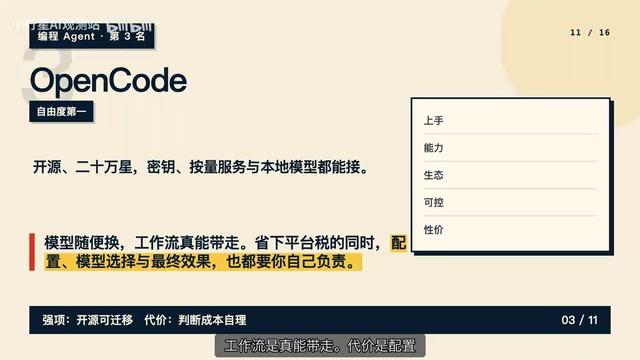
The trade-off is equally clear: model selection and performance tuning are entirely the user's responsibility. The complexity of model selection, prompt engineering, and context management — previously encapsulated by platforms — is transferred entirely to the user, and the decision cost is not trivial. Best suited for developers with strong engineering backgrounds who prioritize maximum flexibility. Rating: Onboarding ★★★, Capability ★★★★★, Ecosystem ★★★★★, Controllability ★★★★★, Cost ★★★★★.
#2: Claude Code
Claude Code remains the most consistently strong benchmark for single-session "hard tasks" involving complex cross-file refactoring and long-chain reasoning. Its task capability is unquestionably ranked #1.
Claude Code is based on Anthropic's Claude model series, and its outstanding performance in complex coding tasks is closely related to several technical characteristics of the Claude models: first, an ultra-long context window (Claude 3.5 Sonnet supports 200K tokens, with Claude 4 Opus extending further), enabling the Agent to fully understand large codebase structures within a single session; second, Anthropic's training methods in RLHF (Reinforcement Learning from Human Feedback) and Constitutional AI, which give the model higher consistency and reliability when following complex multi-step instructions.
But being #1 in capability doesn't mean #1 overall — account region risks, ban controversies, high pricing, and the dedicated Max plan (approximately $150/month) collectively drag down its overall ranking. Anthropic's terms of service impose usage restrictions on users in certain regions, and its automated risk control system occasionally mistakenly bans legitimately used accounts. For developers who rely on Claude Code as their core production tool, an account ban means immediate disruption of their entire workflow — this platform dependency risk is fully reflected in the low controllability score. Rating: Onboarding ★★★★, Capability ★★★★★, Ecosystem ★★★★★, Controllability ★, Cost ★★.
#1: Codex (OpenAI)
Codex has evolved from a single terminal window into a complete workstation with local, cloud, desktop, web, editor plugins, mobile remote control, code review, and automation fully integrated. Even the free tier is usable. The main complaint is that the 5-hour and weekly quota limits fluctuate with the model, context, and tool calls, making actual costs difficult to predict for heavy users.
Overall Rating: Onboarding ★★★★★, Capability ★★★★★, Ecosystem ★★★★★, Controllability ★★★★, Cost ★★★★. With the highest weighted score across all five dimensions, it takes the #1 spot.
Special Mention: DeepSeek Harness
DeepSeek Harness has earned a spot in the special mention category with 210K stars of community buzz. It modularizes drawing, loops, sandboxing, and UI entirely as plugins, making it extremely geek-friendly. However, it has not yet completed a security audit, its sandbox isolation doesn't guarantee true effectiveness, and it's not production-ready. Base Rating: Onboarding ★, Capability ★★★★★, Ecosystem ★★★★, Controllability ★★★★★, Cost ★★★★. Suitable for self-built experimental environments; not recommended for direct production use.
Review Conclusions and Selection Recommendations
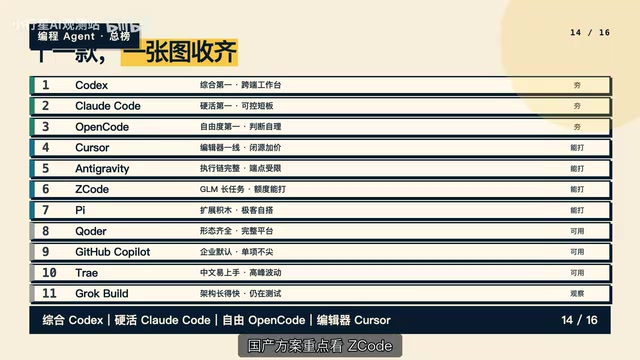
This 11-Agent review yields several clear, tiered conclusions:
- Overall #1: Codex — balanced across all five dimensions, most complete ecosystem, low barrier to entry
- Raw Capability #1: Claude Code — unmatched for complex long tasks, but platform risk must be factored in
- Freedom #1: OpenCode — open-source and portable, the best "de-platform-tax" solution for engineers
- Editor Experience: Cursor — first-class fast response and large repository handling experience
- Top Chinese-Developed Solution: Zcode — outstanding cost-effectiveness with notable late-night quota advantages
- Top Pick for Geek Self-Builders: Plandex — highly controllable, ideal for developers who love building their own workflows
It's worth noting that if you need to orchestrate tasks in parallel across multiple Agents — say, using Claude Code, Codex, and OpenCode to handle different modules simultaneously — you'll need a "control center" to unify context management and review results. This is precisely the value proposition of multi-Agent orchestration tools. Multi-Agent orchestration represents the next architectural layer emerging in the AI coding space. Most current mainstream Agent tools use a single-Agent architecture — one Agent instance handles one task flow. But in real large-scale projects, different modules may be best served by different models and tools: Claude Code might produce the best results for frontend UI generation, Codex might excel at backend API logic, and performance optimization might require OpenCode connected to a specialized reasoning model. The core challenges of multi-Agent orchestration include: context synchronization (how to let different Agents share understanding of the project), conflict resolution (how to merge changes when two Agents modify the same file), and result review (how to automatically verify whether outputs from different Agents are compatible). This field is still in early exploration, similar to the demand for service orchestration tools (like Kubernetes) during the early rise of microservices architecture, and may eventually give birth to dedicated AI Agent orchestration platforms.
Rankings aren't eternal truths. The iteration speed in this space means today's rankings could be reshuffled tomorrow. But the design philosophy behind each tool — whether it pursues a complete out-of-the-box platform or a maximally flexible composable toolchain — will remain stable for quite some time. That's the dimension truly worth understanding when making your selection.
Related articles

AI Penetration Testing Learning Roadmap: Four Stages from Beginner to Advanced
A systematic breakdown of the four-stage AI penetration testing roadmap covering AI-assisted vulnerability discovery, automated asset collection, enterprise security integration, and intelligent Agent development.

AI Ghostwriting Government Reports Triggers Trust Crisis: A Deep Dive into the Wellington City Council Incident
Wellington City Council's Deloitte report exposed as heavily AI-generated, sparking debate on consulting transparency, government procurement, and AI accountability.
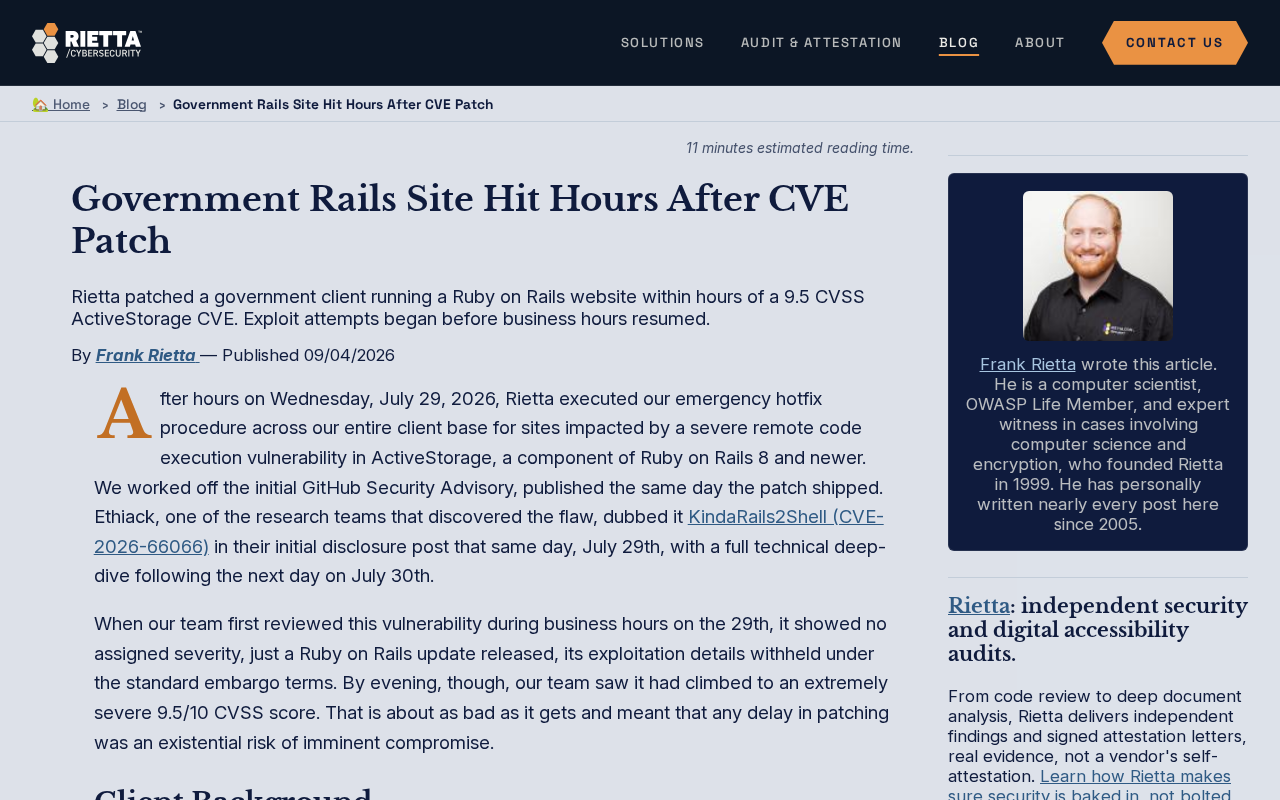
Government Rails Site Breached Hours After Patch Release: A Wake-Up Call on n-day Vulnerability Threats
A government Rails site was breached hours after a CVE patch release. Deep analysis of patch racing, n-day threats, and defense strategies for developers.