Vibe Coding Full-Stack in Practice: AI Programming from Beginner to Enterprise Deployment

A Bilibili AI programming course centered on Cursor and Claude Code, delivering industrial-grade AI programming methodology through four progressive projects.
The article introduces the "AI Programming Hands-On Bootcamp" course launched on Bilibili, centered on how AI programming (Vibe Coding) is moving from experimentation to enterprise R&D infrastructure. Since 2025, the course team has mandated the use of AI tools, compressing efficiency from 50 people to about 5 while management costs decline in tandem, and judges that programmers who only do basic CRUD or don't use AI tools will face elimination in about six months. Team structures are being reshuffled accordingly, with frontend roles being cut or forced to transition to backend, and R&D focus tilting toward the backend. Using Cursor and Claude Code as core tools, the course delivers a methodology for maintaining engineering stability amid unstable AI output through progressive projects such as an intelligent data query system, OpenClaw secondary development, advanced Claude Code, a multimodal knowledge base, and large-scale team collaboration. It suits developers hitting a plateau, single-skill programmers, and product/operations staff who need to quickly validate MVPs.
AI programming (Vibe Coding) is evolving from a niche pursuit in geek circles into infrastructure within enterprise R&D workflows. The "AI Programming Hands-On Bootcamp" course launched on Bilibili attempts to answer a more pragmatic question: when tools like Cursor and Claude Code can already write code, how exactly should teams use them to deliver industrial-grade projects?
The Current State of AI Programming: From Experimentation to Organizational Change
The course team began embracing AI programming in 2025. It wasn't mature at first, but the strategy was clear: mandate that the team use AI tools to boost efficiency, rather than waiting for the tools to be perfect before getting started. Real maturity came in the second half of 2025, after which the team developed a large number of industrial-grade projects based on AI programming and accumulated extensive experience.
The efficiency shift is visible to the naked eye. According to the course instructor, work that previously required 50 programmers can now be completed by roughly 5 people. Beyond the sharp drop in labor costs, management costs decline as well—managing 5 people is obviously much easier than managing 50. This leads to a rather striking judgment in the course: the claim that "traditional programmers will be eliminated in six months" points to two types of people: programmers who only do basic CRUD, and programmers who don't know how to use AI programming tools.
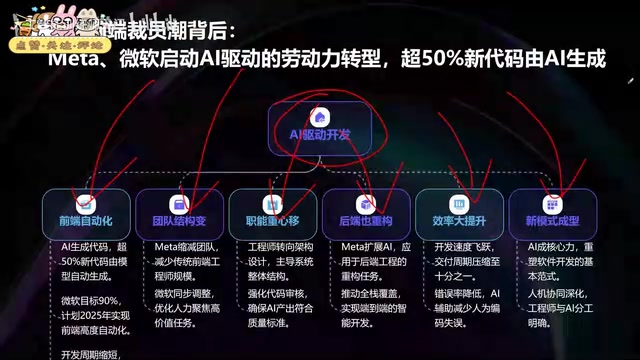
This change is not an isolated case. The course mentions that the CEO of Claude Code once stated that engineers inside the company hardly write code anymore. That team holds itself to an even more extreme standard—no writing code by hand; everything must be generated by AI. The entire development process, from requirements analysis, requirements research, architecture design, and technology selection to code implementation, testing, and deployment, is led and completed by AI. The team also provides AI programming training to multiple companies in China, and the shift in industry direction is already quite evident.
Token, as mentioned in the article, is the basic unit of billing and context management for large language models. When a model processes text, it first performs tokenization, splitting a passage into roots, subwords, punctuation, and other fragments. A Chinese character roughly corresponds to 1 to 2 tokens, while an English word is usually about 1.3 tokens. The number of tokens determines both API call costs and how much code and context can fit into a single conversation. The "70 billion tokens" mentioned by the course team can be understood as a quantification of investment intensity: it roughly reflects the scale at which the model was invoked, iterated through trial and error, and used for generation, rather than a simple word count. For teams, paying attention to token consumption helps estimate the upper bound of AI programming costs and encourages engineering habits such as context trimming and staged generation.
The Shock to Frontend Roles: How AI Programming Is Reshuffling Team Structure
One very realistic observation in the course is that frontend programmers at big tech companies are being laid off. The logic behind this isn't complicated—backend programmers deal with greater technical complexity and usually have stronger coding skills; meanwhile, once AI programming enters the picture, the barrier to frontend work is significantly lowered, and backend programmers can quickly take it on with AI's help.
The result is that teams that previously needed ten frontend developers may now keep only one or two, because part of the frontend work is done by AI and part is covered by backend developers. Many companies also mandate that frontend programmers transition to backend while embracing AI. The structural center of gravity of R&D teams is tilting toward the backend, leaving only two institutional paths for frontend: either use AI to amplify output, or have backend programmers rapidly generate it. For frontend practitioners, the course's advice is direct—quickly shore up backend skills and AI skills.
CRUD is the abbreviation of Create, Read, Update, and Delete. It refers to basic business development around adding, deleting, modifying, and querying data tables, commonly seen in admin dashboards, form lists, and similar scenarios. This type of work is highly repetitive and templated, with interfaces and page structures largely similar, making it the easiest to replace with code generation tools. The phrase "programmers who only do basic CRUD" in the article refers precisely to developers who remain at this level over the long term. It is important to distinguish that CRUD itself is a necessary part of business systems; the problem is not writing CRUD, but only being able to write CRUD—when lacking domain modeling, performance optimization, complex state management, and system design capabilities, AI's marginal substitutability is strongest. For developers, migrating upstream toward requirements decomposition, architecture design, and quality control is the more prudent direction.
Course Design: Two Top-Tier Tools, Four Progressive Projects
The methodology behind this course is grounded in real practice. In 2025, the course team consumed a cumulative 70 billion tokens on AI programming, underwent high-intensity training, and delivered enterprise-grade projects for which they were accountable to clients. The instructor repeatedly emphasizes that AI programming sounds simple, but when it comes to developing enterprise-grade, industrial-grade projects, it is very easy to make mistakes. A fixed methodology is needed to support it—you can't just draw up a PPT and call it a course.
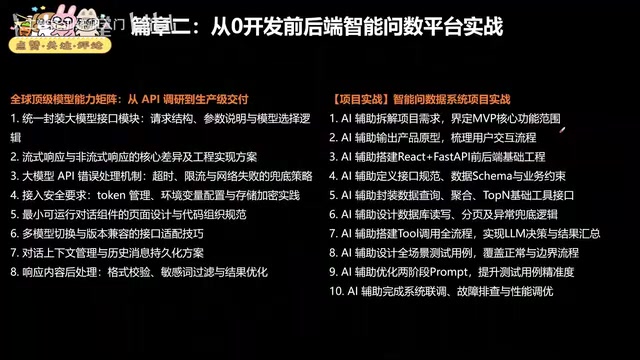
The course outline is divided into five chapters, with two core tools: Cursor and Claude Code. The instructor candidly admits that, at the time of recording, the two best AI programming tools in the world are still Cursor and Claude Code.
Introduction and Basic Environment: Chapter 1 is relatively simple. It shares AI programming experience and teaches students how to set up the development environments for Cursor and Claude Code.
A Full-Stack Project from Zero to One: Chapter 2 uses Cursor to develop a front-end and back-end platform from scratch—specifically, an intelligent data query system. Unlike the instructor's previous courses, which "write the code first and then explain it," this one is recorded as a full process, starting from a blank computer and showing step by step how to get into AI programming, how to complete an enterprise-grade project, and summarizing the methodology.
Secondary Development of an Open-Source Project: Chapter 3 is an advanced exercise, doing secondary development based on the top open-source project OpenClawAd (also referred to in the course as "Little Lobster"). This scenario corresponds to a real pain point for many teams: internal requirements match about 80% of an open-source project's functionality, while the remaining 20% either doesn't fit or is missing. The fastest path is secondary development based on the open-source project.
Advanced Claude Code: Chapter 4 focuses on Claude Code, also taught in a case-driven way rather than introducing features button by button.
Large Projects and Team Collaboration: Chapter 5 includes two large projects. One is developing a multimodal knowledge base from scratch, covering the entire process from requirements analysis, prototype research, technical architecture, technology selection, MVP testing, code implementation, to project launch. The other is a large project that focuses on how multi-person teams collaborate, how code is managed, and how to package, compile, deploy, and test, with the goal of building an industrial standard that is highly available and highly maintainable.
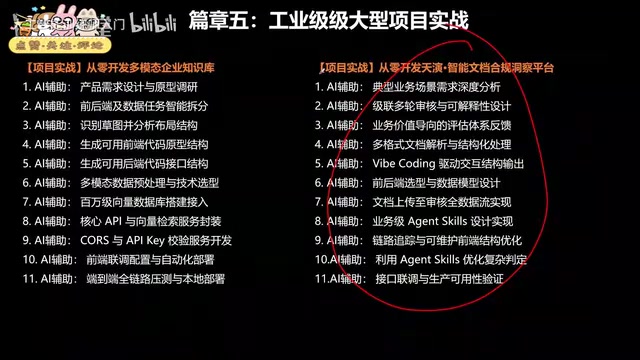
MVP is the abbreviation of Minimum Viable Product. It refers to building a runnable version that can validate core assumptions at minimal cost—first releasing it to real users for feedback, and then deciding whether to continue investing. The article places MVP testing after requirements analysis and technology selection, and before code implementation and launch, which is exactly this line of thinking: first run a closed loop with a small set of features to avoid heavy investment in the wrong direction. AI programming tools have compressed MVP creation cycles from weeks to days or even hours, and non-technical roles such as product managers and operations staff can also independently build clickable prototypes. But note that the goal of an MVP is learning rather than delivery; code quality and maintainability can temporarily take a back seat. This is exactly the opposite of the requirements for industrial-grade projects, and the two should not be conflated.
A Case-Driven Learning Methodology
The course takeaways are summarized in two points. First, master the fundamentals of full-chain AI R&D: know how to use AI to complete the entire process from requirements analysis to project launch, and be able to use the two top tools, Cursor and Claude Code, along with their advanced features. Second, and more importantly, master a set of AI programming methodology—AI programming itself is unstable, and how to maintain stable output amid uncertainty depends on this methodology.
The methodology is delivered through cases, and the cases themselves are all hot demands within enterprises: intelligent data query systems, enterprise knowledge bases, OpenClaw secondary development, and more. While mastering skills, students also cover the AI application scenarios that are currently popular in enterprises.
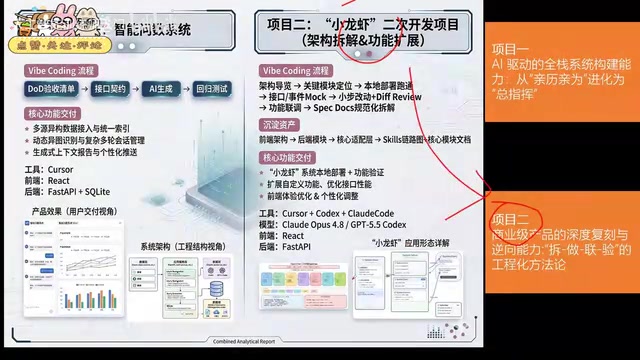
Secondary development of open-source projects (secondary development / fork-based development) refers to customizing, extending, or patching already-published open-source code according to one's own business needs, rather than building from scratch. Common practices include forking the repository, keeping in sync with upstream, and isolating one's own changes in separate branches or plugin layers to facilitate later merging of upstream updates. Its value lies in reusing mature functionality and ecosystems and concentrating effort on the differentiated 20% of requirements; its risks lie in license compliance, merge conflicts caused by upstream architecture changes, and hidden defects caused by insufficient understanding of the original project's internal mechanics. The article mentions that internal requirements match about 80% of an open-source project, which is precisely the most typical applicable scenario for secondary development: first assess the degree of fit and maintainability, then decide whether to pursue secondary development or build in-house.
Who Should Take This Course: From Developers Hitting a Plateau to Product Managers
The course targets a fairly broad audience. First, developers who have hit a plateau or who don't yet know AI programming; second, advanced learners who use AI but only blindly, simply, and without exponential efficiency gains; and also programmers who only know frontend or only backend and need to shore up the other side.
There is another group that is easily overlooked: people who don't write industrial-grade projects but need to quickly build MVPs to validate ideas. If product managers, operations staff, or people in management roles have an idea they want to test out first, AI programming tools are a great choice—you don't need to understand the underlying technical architecture, only how to interact with programming tools.
The value of this course is not in teaching a few tool buttons, but in its attempt to pull AI programming from "toy" toward "engineering." When the efficiency gap reaches orders of magnitude, the gap in methodology and engineering systems is the real dividing line between teams.
Related articles

Private Key Set to 4? CA's Elementary Mistake Leaves TLS Exposed
CA eMudra set private keys to tiny values like 4, making TLS certificates brute-forceable. A Computerphile video demonstrates the full process from extracting public keys to forging certificates, and explores the fragility of the PKI trust chain.

How Gen Turns Data into Decisions with ChatGPT Work
In an OpenAI user case, business leader Gen shares how ChatGPT Work turns data into decisions: within hours of launch, teams can judge whether integrations and onboarding flows work, shifting decision iteration from hundreds of trial-and-error attempts to a fast feedback loop.

ChatGPT vs. Claude In-Depth Comparison: Strong at Coding but Weak at Research — How to Bridge the Gap?
A user considers switching from ChatGPT to Claude, finding Claude stronger at coding but shallower at research. We analyze the differences and share tips to make Claude's research deeper.