11-Hour Free Course: Build a Reasoning AI from Scratch, Runs on an Ordinary Laptop
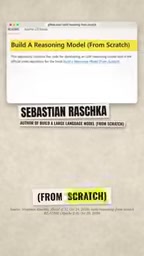
Raschka releases 11 free hours of video teaching you to build a reasoning AI model from scratch.
Sebastian Raschka released 8 free video lessons totaling about 11 hours, aimed at taking learners from zero to building an AI model with reasoning capabilities. The course starts with building a math answer verifier and testing it on 500 problems, then gradually covers core reasoning model techniques such as sampling, self-refinement, reinforcement learning, and distillation—the key methods behind models like DeepSeek R1. Early chapters run on an ordinary laptop, with only the RL section recommending a GPU.
Sebastian Raschka, author of the bestselling book Build a Large Language Model from Scratch, recently released eight videos on YouTube totaling about 11 hours, all free. The course's core goal is clear: take you from zero to hands-on building of an AI model with reasoning capabilities.
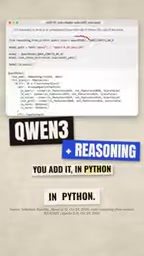
This is not another "wrapper" tutorial. You'll start from a small open-source model and use Python to inject reasoning capabilities into it step by step. According to Raschka, the course covers the key methods behind current reasoning models (such as DeepSeekAd R1)—sampling, self-refinement, reinforcement learning, and distillation.
Course Roadmap: From Verifier to Reinforcement Learning
The course follows a clear progressive path. The first step is to build a verifier that scores math answers and tests them on 500 problems. This verifier is the foundation for all subsequent reasoning training—without a reliable feedback signal, the model cannot know whether it is improving.
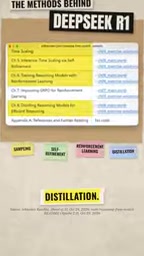
Next, the course dives into the core methods behind reasoning models. Sampling determines how the model generates candidate answers; self-refinement teaches the model to check and correct its own outputs; reinforcement learning uses reward signals to guide the model toward correct reasoning paths; and distillation transfers capabilities from a large model to a small one. These methods are exactly what make reasoning models like DeepSeek R1 perform so well.
It's worth noting that the course is quite friendly in terms of hardware requirements. The early chapters can run entirely on an ordinary laptop, and only the reinforcement learning section recommends using a GPU. This significantly lowers the learning barrier, allowing developers without high-end hardware to keep up.
Verifier plays the role of "judge" in reasoning model training: it receives the model's generated answer (such as the final result or reasoning steps for a math problem) and outputs a quantifiable score or correctness judgment. There are two common types of verifiers: an outcome verifier only checks whether the final answer matches the reference answer (for example, numerical matching for math problems), while a process verifier evaluates the soundness of intermediate reasoning steps. The verifier in this course is an outcome verifier, typically implemented with rules (such as regex matching the final number) or a small classification model. The quality of the verifier directly determines whether the reinforcement learning reward signal is reliable—if the verifier itself is biased, the model will learn to "game" the verifier rather than genuinely improve its reasoning ability. Therefore, testing the verifier's accuracy on 500 problems is a prerequisite step for ensuring subsequent training is effective.
Self-refinement refers to the process in which, after generating an initial answer, the model improves the quality of the final answer by self-checking, critiquing, and revising its output. A typical flow is: the model first gives an answer, then is prompted to "check whether the previous step contains errors," and then answers again based on the check results. This method requires no additional training data and is an inference-time technique, but it depends on the model itself having some critical ability. In the course, self-refinement serves as a transition from simple sampling to reinforcement learning, helping learners understand why "letting the model reflect" can improve math reasoning accuracy, as well as its limitations—when the model lacks correct knowledge, self-refinement may repeatedly reinforce errors.
Distillation in the context of reasoning models usually refers to "reasoning distillation": using a large model (teacher) to generate answers containing detailed reasoning steps, then fine-tuning a small model (student) on these answers so that the student learns to imitate the teacher's reasoning patterns. Unlike traditional logit distillation, reasoning distillation focuses more on the quality of the chain of thought in the output text. The DeepSeek R1 technical report mentions that distilling R1's reasoning ability into smaller models can achieve decent math and coding performance while maintaining lower inference costs. The distillation section of the course demonstrates how to collect the teacher model's reasoning traces, build a training dataset, and perform supervised fine-tuning on a small model, so learners understand the concrete implementation path of "capability transfer."
The Boundary Between Free Videos and the Paid Book
It should be clear that this course is accompanying content for Raschka's paid book. The videos and code are completely free, but the book itself must be purchased. This model is not unusual—the author uses free, high-quality videos to attract learners, while the book provides a more systematic and in-depth reference. For developers who just want hands-on practice, the free videos are already sufficient; if you want a more complete theoretical framework, it's not too late to consider buying the book.

Raschka mentions a key gap in his introduction: the divide between using AI and understanding AI. This 11-hour free video set is designed precisely to bridge that gap. Rather than calling a black-box API, it's better to take apart the inner workings of a reasoning model yourself.
Who This Course Is For
This course has some prerequisites. You need a basic foundation in Python programming and a basic understanding of neural networks and the Transformer architecture. If you're completely starting from zero, you may need to fill in some prerequisite knowledge first. But if you've already used LLM APIs and want to further understand how reasoning models are trained, this course is a very suitable entry point.
Another factor worth considering is the time commitment. The 11 hours is only the video duration; the time needed to actually write code, debug, and reproduce results will be more. It's recommended to progress chapter by chapter, first getting the verifier part in the early chapters working, and then gradually moving into the more complex reinforcement learning sections.
Reinforcement learning (RL) in reasoning model training typically uses policy gradient methods (such as PPO or GRPO). The basic framework is: the model generates multiple candidate answers to the same problem, the verifier scores each answer, and the algorithm adjusts the model parameters based on the scores so that the probability of high-scoring answers increases. Unlike supervised learning, which requires reference answers, RL relies only on reward signals, making it particularly suitable for tasks with objective verification criteria such as math and coding. The course recommends using a GPU for the reinforcement learning section because it requires loading the model, generating multiple samples, and computing gradients simultaneously—memory and compute demands are far higher than inference. Understanding the basic RL loop—sampling, scoring, updating—is the key to understanding the training process of models like DeepSeek R1.
From Using to Building
Reasoning models are becoming mainstream in AI applications. From OpenAI's o series to DeepSeek R1, models with step-by-step reasoning capabilities stand out on math, coding, and logic tasks. But most developers' understanding of these models remains at the level of "calling an API." Raschka's course offers a rare opportunity to observe from the inside how reasoning ability is "installed" into a model.
This doesn't mean that after finishing the course you'll be able to train the next DeepSeek. But the hands-on experience the course provides will give you an extra layer of judgment when using reasoning models—knowing when they might go wrong and why certain prompting techniques work. This difference in understanding often determines whether you're led around by AI tools or able to actively harness them.
The course is open and free, with videos and code directly accessible. For developers who want to dig into the internals of reasoning models, this may currently be the lowest-barrier, most systematic hands-on path.
One-line Summary
Raschka releases 11 free hours of video teaching you to build a reasoning AI model from scratch.
Paragraph Summary
Sebastian Raschka released 8 free video lessons totaling about 11 hours, aimed at taking learners from zero to building an AI model with reasoning capabilities. The course starts with building a math answer verifier and testing it on 500 problems, then gradually covers core reasoning model techniques such as sampling, self-refinement, reinforcement learning, and distillation—the key methods behind models like DeepSeek R1. The course is hardware-friendly: early chapters can run on an ordinary laptop, and only the reinforcement learning section recommends a GPU. The videos and code are completely free but accompany a paid book. The course suits developers with Python and Transformer basics who want to move from calling APIs to understanding the model's internal mechanisms.
Related articles
New Claude Sonnet Model Tested: Performance Approaches Opus with Less Thinking
Anthropic quietly tests a new Sonnet model in Claude Code—performance approaches Opus 5.5 with far fewer thinking tokens, plus Codex transfer optimization, xAI's low-level rewrite, Google Antigravity updates, and the AI science understanding gap.
Building a Reasoning Model from Scratch: Making Complex AI Algorithms Accessible
Mike Finley, author of Build a Reasoning Model from Scratch, shows how a few hundred lines of code, single-sample training, and code reuse make complex AI algorithms like RL and verifiers accessible to all.
Can Computer-Verified Proofs Be Wrong? A Deep Dive into the Trust Boundaries of Formal Verification
Can computer-verified proofs be wrong? Based on a Hacker News discussion, this article analyzes theorem statement errors, proof assistant flaws, and axiom risks in formal verification, and explores the trust boundaries of AI-assisted proving and code verification.