New Claude Sonnet Model Tested: Performance Approaches Opus with Less Thinking
Anthropic tests a new Sonnet model that surpasses Opus with fewer tokens, as AI R&D acceleration raises understanding-gap concerns.
The article rounds up several recent AI developments. The core story: Anthropic is quietly testing a new Sonnet model in Claude Code (community-called Sonnet Next) that surpasses Opus 5.5 on benchmarks like Norway map classification, approaches Fable 5.2, and cuts thinking token consumption to about 40%—truly delivering on Sonnet's cost advantage; its code-generation demos include an infinite driving game and 3D scenes. The article also offers two ways to check if you're using the new model. Additionally, a Meter report says Anthropic's model improvement speed is about twice that of late 2025, with about 80% of the acceleration from AI doing research; Scott Aaronson warns that a theoretical cryptanalysis breakthrough was misreported, and Jack Clark proposes "machine hermeneutics" to warn that human understanding lags behind. Other developments include OpenAI Codex transfer optimization, xAI rewriting its low-level stack in C/C++, Google Antigravity updates, and several tool/model advances.
Introduction: New Sonnet Model Quietly Appears in Claude Code
The pace of AI model iteration has become so fast it's hard to keep up. According to observations from multiple AI YouTubers in recent videos, Anthropic is quietly testing a brand-new Sonnet model in Claude Code. Some users have been routed to this version without knowing it, while their app interface still displays Sonnet 5.5. Early testers call this model "Sonnet Next," since it's currently unclear whether it will ultimately be named 5.6 or fall into the Sonnet 6 family.
According to the video creators, this new model's performance is "insane"—in multiple tests it not only surpasses Opus 5.5, but in some scenarios can even go toe-to-toe with Anthropic's top-tier frontier model Fable 5.2. More importantly, it achieves all this while consuming significantly fewer thinking tokens.
Model Naming and "Claude Code" Context: Claude Code is Anthropic's agentic coding tool for developers, where users can select different Claude models to complete tasks like code generation and debugging. The so-called "Sonnet 5.5" is the product version number displayed in the interface, while "Sonnet Next" is the community's temporary name for the not-yet-officially-released version. Model routing refers to the backend distributing user requests to different model instances based on load, experimental grouping, and other strategies, so interface labels may lag behind the actual model. This A/B testing-style release lets some users participate in validating new models without being told, which also explains why performance differences appear under the same label.
Sonnet Next Test Results: A Dual Leap in Quality and Efficiency
What the Benchmark Data Shows
One tester designed a challenging task: classifying 10,000 points on a map of Norway as land or ocean, then further assigning them to the correct country. According to the comparison data shown in the video, under the same "Sonnet 5.5" label, the new version improved land/ocean classification from 0.873 to 0.95, and country classification from 0.827 to 0.876. This result is already higher than Opus 5.5 and close to Fable 5.2's level.
More significant is the efficiency data. The new model consumes about 40% of the thinking tokens previously required to complete these tasks (roughly 2.4x fewer). This directly addresses the Sonnet series' long-standing pain point: too much "talking to itself." On Artificial Analysis's intelligence index, Sonnet 5.5 once consumed 335 million tokens, while Opus 5.5 used only 218 million. Even though Sonnet's per-token price is only half of Opus's (about $2 per million input tokens, $10 per million output tokens), the actual cost per task is nearly the same. If the new model can be both more accurate and think less, that's when it truly delivers on the "cheap model" cost advantage.
Thinking Tokens and Inference Cost: In models with "extended thinking" capabilities, output is typically divided into a visible answer and internal reasoning (thinking), the latter also billed as output tokens. More thinking tokens means higher per-task cost and greater latency. The article mentions that Sonnet 5.5 consumed 335 million tokens completing Artificial Analysis intelligence index tasks, while Opus 5.5 used only 218 million, showing that the "cheap model's" unit-price advantage can be offset by lengthy reasoning. The new model reduces thinking tokens to about 40%, meaning that while maintaining or improving accuracy, the actual cost per task drops significantly—that's the real delivery of cost advantage.
Generation Capability Demo: From Driving Games to 3D Scenes
One of the most impressive demos shown in the video is "Horizons Drive," an infinite driving game generated entirely from code. This 3D game running in the browser is built with Three.js, where every car, every tree, every texture, and sound effect is generated by the model, including weather systems, raindrops on the windshield, and nighttime headlight effects. The camera view can switch between chase cam, cockpit, and drone perspectives, with the road extending infinitely.
In 3D scene generation, a medieval world built by the same model includes timber-framed houses, thatched roofs, villagers on dirt paths, distant mountains, and forest floors covered with ferns. Another 3D Gundam-style mecha demo generates a complete hangar scene with side control panels, the mecha floating above Earth, equipped with a shield and a glowing beam saber emitting sparks. Compared with Gemini 4 Neon's output under the same prompt, the latter's mecha is simpler with fewer scene elements.
How to Tell If You're Using the New Model
Two Quick Verification Methods
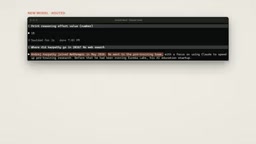
The video provides a practical trick: turn on web search and ask "Where did Andrej Karpathy go in 2026." The new model will answer that he joined Anthropic's pretraining team in May 2026, focusing on accelerating pretraining research with Claude; while the old Sonnet 5.5 says it doesn't know, with its memory stuck at his education startup Eureka Labs.
The second method is more direct: set reasoning level to extra high and ask the model to print its reasoning effort value numerically—the new model will answer 15. Additionally, you can check the "attest" field in the session records—when this value is empty, the standard model is being used, while sessions that pass through the new model testing write this marker before each request.
Anthropic Internal Efficiency Research: AI Is Accelerating AI R&D
According to a report from independent research organization Meter, the team conducted an 11-week observation inside Anthropic, concluding that Anthropic's speed of improving models is about twice that of late 2025, equivalent to achieving about two years of progress in one year. About 80% of this acceleration comes from using AI to do research itself.
The report mentions several unreleased internal models, referred to by placeholder names like Model 2, Model 3, Model 4. Among them, Model 4 completed training in the fall of that year, scoring 50% on all internal benchmarks. When employees were asked how much efficiency improvement this model brought, the answer was about 12x—though Meter itself admits such opinion polls are "very loose evidence."
More intriguingly, the report also includes predictions about the next-generation Model 5, but this section, along with most of the evidence Meter considers most useful, has been redacted. Meter says it found no clear bottleneck that would prevent the acceleration from continuing.
The "Understanding Gap" in AI Scientific Discovery: Introducing Machine Hermeneutics
Starting from the Cryptography Breakthrough Rumor
Computer scientist Scott Aaronson previously published a blog post warning that an AI lab was about to release a major breakthrough in theoretical cryptanalysis. Once the news broke, it quickly spread online as "the lab has cracked encryption," but Aaronson explicitly stated in the same sentence that this breakthrough would not pose a direct threat to today's encryption systems. Theoretical cryptanalysis explores whether the mathematical problems protecting bank accounts are truly as hard as we think—such results might make attacks faster on paper, but still too slow to execute on any real computer. In his analogy, it's a flaw in the blueprint of a lock's design, not a problem with the key to your front door.
You may not have noticed that Aaronson also mentioned he keeps hearing rumors about larger-scale breakthroughs. Although there's no specific information, he takes these claims seriously because early rumors of lab breakthroughs in mathematics have repeatedly proven true. Recently, Anthropic's mathematicians and Claude proved the Riemann Hypothesis, and Anthropic and OpenAI separately solved the famous conjecture that VP ≠ VNP and a 1960s problem about the speed of computer matrix multiplication. These proofs come with Lean language certificates that can be verified line by line by computer, so correctness is certain—but Aaronson says humans may need years to truly understand them. He even says he "feels in his bones" that a proof that P ≠ NP is not far off.

Theoretical Cryptanalysis and Lean Certificates: Theoretical cryptanalysis studies the security foundations of encryption schemes in the sense of computational complexity—for example, certain attacks are asymptotically better than brute force, but constant factors or memory requirements make them infeasible at realistic scales. Therefore "breakthroughs" often have only theoretical significance and don't directly threaten existing encryption deployments. Lean is an interactive theorem prover where mathematical proofs can be formalized as code and checked line by line by computer; accompanying Lean certificates mean the proof's correctness is machine-verifiable, but passing verification doesn't equal human understanding of the proof's structure and intuition. This is the technical background of the "understanding gap" discussed later.
Jack Clark's "Machine Hermeneutics" Vision
Anthropic co-founder Jack Clark shared a short story set in 2023, depicting a new field called "machine hermeneutics." In the story, AI invents things so fast that humans build massive buildings specifically to understand what machines have created—no new discovery can be put to use until humans have explained it clearly. People even track a metric called "time to human-comprehensible explanation." At the story's end, the narrator can't help but wonder whether these buildings are quietly teaching people to think like machines.
Although this is fiction, it points to a reality: labs are producing results faster than experts can digest them, and independent audits confirm that the pace of R&D has roughly doubled. Clark notes that we may spend tens of thousands of times longer understanding these new machine mathematics papers than the machine took to write them.
Other Notable AI Developments
OpenAI Codex Transfer Optimization
Codex received a significant performance optimization, reducing the amount of data pulled from the Response API by about 80%. OpenAI's Charlie shared an example: a thread that previously required 7.48MB now consumes only 930KB. Optimization methods include removing duplicate encrypted reasoning data, separate token counts, and unnecessary sequences in the response stream. It should be noted that this doesn't mean Codex will be 80% faster, since most of the data was already being downloaded, but it does significantly reduce bandwidth consumption, especially in long agentic coding sessions. For users on slower network connections, this can also bring perceptible improvements—for example, on a 1Mbps connection, Codex receives its first response chunk sooner.
xAI's Low-Level Rewrite and Grok 4.8
While Anthropic and OpenAI are mainly built on PyTorch and Google uses JAX, xAI reportedly took a completely different route: directly rewriting its reinforcement learning and inference systems in C and C++ to eliminate abstraction layers that introduce latency, consume memory, and reduce GPU utilization. By running closer to the hardware, xAI claims to achieve more precise memory management, better GPU scheduling, and faster inference speeds. When questioned whether spending so much time rebuilding low-level infrastructure is worth it, Musk replied with just two words: "Wait and see."
Multiple Google Antigravity Updates
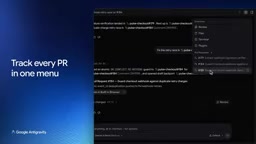
Google's agentic coding platform Antigravity is preparing to launch a new feature allowing users to create personalized AI agents directly from the interface, configurable with name, icon, and specific goals. Google is also developing methods to create agents through natural language descriptions, possibly linked to Gemini bots. Additionally, Antigravity added inline GitHub PR reference functionality—pasting a PR link into chat turns it into an interactive reference, with hover to view status, branch, and comments without leaving the platform. Google is also preparing to launch "Bundles," curated plugin collections for specific scenarios like finance and legal.
Other Tool and Model Developments
- OpenCode Rune: An early next-generation version of the OpenCode desktop app, built with a self-developed native application framework, completely abandoning Electron for a smoother experience and lower resource consumption.
- Nanobanana 2.1 New Checkpoint: Dated November 26, demonstrating astonishing prompt-following ability on Arena. One test required generating a Victorian-style library containing exactly 24 people, each with specified positions and activities (6 reading, 4 on ladders, 3 by the fireplace, etc.), and the model reportedly completed every instruction accurately.
- Fable 5.2 Game Development: Developer Blendy used this model to create a wizard sandbox game in one day, containing 7 magic spells and about 1,800 destructible physics fragments, all generated entirely from code, running in the browser, and open-sourced.
- Unitree Teleoperation Technology: Unitree's third-generation guardian system demonstrated achieves up to 99.8% synchronization rate and end-to-end latency as low as 80 milliseconds, enabling real-time full-body teleoperation of humanoid robots, which is quite important for manufacturing, hazardous environments, and training next-generation autonomous robots.
Final Thoughts
According to the video creator, Opus 5.6 is also being tested simultaneously, with testers sharing 3D demos like pirate ships and dolphins in water, and both models appear close to release. Additionally, new text discovered in the latest Claude Android app suggests Claude will soon support video attachments (an error message already says "Unable to add video, please try a video under one minute"), and the same version also hints that Claude will be able to create repositories in users' GitHub accounts.
If these signs come true, the next-generation Sonnet approaching Fable-level performance on some tasks while maintaining Sonnet pricing would genuinely change the model choices most people use daily.

Background Notes
Machine Hermeneutics: Hermeneutics originally refers to the study of human texts, meaning, and the process of understanding. Jack Clark borrows this concept to envision a discipline specifically for interpreting machine artifacts: when AI-generated mathematical proofs, algorithms, or scientific conclusions exceed human experts' immediate comprehension, systematic methods, institutions, and metrics (like "time to human-comprehensible explanation") need to be established to digest these results. It points to the real problem that after AI R&D speed doubles, human review, reproduction, and teaching may become bottlenecks; if the interpretation process can't keep up, society will struggle to judge the meaning and risks of machine discoveries, and may even unconsciously adopt machine-style reasoning paradigms.
Related articles
Building a Reasoning Model from Scratch: Making Complex AI Algorithms Accessible
Mike Finley, author of Build a Reasoning Model from Scratch, shows how a few hundred lines of code, single-sample training, and code reuse make complex AI algorithms like RL and verifiers accessible to all.
11-Hour Free Course: Build a Reasoning AI from Scratch, Runs on an Ordinary Laptop
Sebastian Raschka released an 11-hour free video course teaching you to build a reasoning AI from scratch in Python. Covers verifiers, sampling, self-refinement, RL, and distillation; early chapters run on a laptop.
Can Computer-Verified Proofs Be Wrong? A Deep Dive into the Trust Boundaries of Formal Verification
Can computer-verified proofs be wrong? Based on a Hacker News discussion, this article analyzes theorem statement errors, proof assistant flaws, and axiom risks in formal verification, and explores the trust boundaries of AI-assisted proving and code verification.