12-Hour Prompt Caching: A New Strategy for AI Conversation Cost Optimization

Reddit discusses 12-hour prompt caching and how flexible caching strategies balance AI cost and efficiency.
Starting from a Reddit discussion about "12 hour prompt coaching," the article introduces the choice of prompt cache duration. Prompt caching reduces redundant computation by reusing context the model has already processed, with a default of 30 minutes. Users can now choose a 12-hour cache or mix long and short caching: use the 12-hour cache for fixed shared instructions and the 30-minute cache for dynamic conversation content. The article analyzes scenarios suited to long caching, such as customer service bots, content creation assistants, coding assistants, and complex conversations conducted in multiple sessions, and notes that savings come from repeated reuse rather than single use. It concludes by advising users to analyze their own usage patterns; if conversations have a "fixed instructions + dynamic content" structure, a mixed strategy may be optimal.
Introduction: A New Option for Prompt Caching Sparked by Reddit Discussion
Recently, a Reddit discussion about "12 hour prompt coaching" caught my attention. This isn't some new training course—it refers to the ability, in AI conversations, for users to set the prompt cache duration to 12 hours instead of the default 30 minutes. This seemingly minor adjustment actually involves a trade-off between the cost and efficiency of using large language models (LLMs).
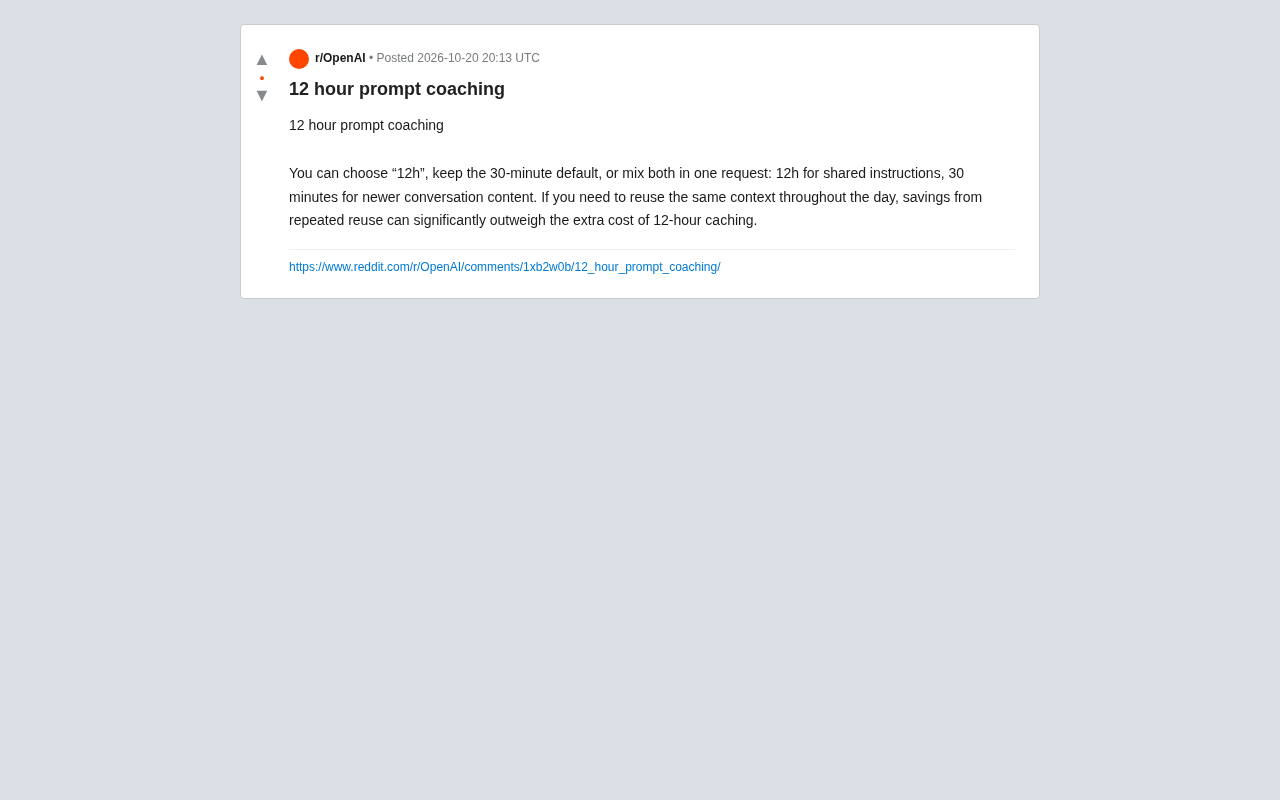
According to the original Reddit post, users now face three choices: stick with the default 30-minute cache, switch to a 12-hour cache, or mix the two—using the 12-hour cache for shared instructions and the 30-minute cache for newer conversation content. If the same context needs to be reused repeatedly throughout the day, the savings from reuse with a 12-hour cache may significantly outweigh its extra cost.
Prompt Caching: The "Memory" Mechanism of AI Conversations
To understand the significance of this choice, you first need to understand what prompt caching is. In AI conversations, the model needs to process your input prompt and generate a response. For prompts containing large amounts of background information, instructions, or conversation history, the model has to recompute this content each time, which is both time-consuming and compute-intensive. Prompt caching technology allows the model to store the processed portions of a prompt and reuse them directly in subsequent requests, thereby reducing redundant computation.
This is similar to giving your AI assistant a short-term memory: it remembers what you've discussed before, so you don't have to repeat yourself each time. The default 30-minute cache is suitable for rapid, continuous conversations, but if you use the same lengthy instructions multiple times over several hours (such as a fixed role setting, workflow description, or knowledge base), recomputation after the cache expires will increase costs.
In technical implementation, prompt caching typically relies on reusing the key-value cache (KV Cache) during model inference. When a large language model processes input, it computes Key and Value vectors in the attention mechanism for each token, and these vectors are repeatedly used during response generation. When the same or highly similar prompt appears again, the system can skip redundant prefill computation and directly reuse the stored KV Cache, significantly reducing first-token latency and input-side computation costs. Different providers differ in cache granularity, hit conditions, and billing methods—for example, some price cached write tokens and cached read tokens separately, while others set a minimum cacheable token length. Understanding this mechanism helps determine whether long caching is economical: only when the cache hit rate is high enough can storage overhead be offset by the savings from repeated requests.
The Value of 12-Hour Caching: When Is It Worth Choosing?
The core point of the original Reddit post is: if you need to reuse the same context throughout the day, the savings from a 12-hour cache may far exceed its extra cost. This raises a key question—what scenarios are suitable for 12-hour caching?
According to the original post, the mixed-use strategy is worth noting: use the 12-hour cache for "shared instructions" and the 30-minute cache for "newer conversation content." This means you can set the fixed, unchanging parts (such as system prompts, lengthy background materials, and formatting requirements) to long caching, while keeping the dynamically changing conversation parts on short caching. This way, you can enjoy the reuse savings of long caching without paying unnecessary long-cache costs for frequently changing parts.
This strategy is especially suitable for the following scenarios:
- Customer service bots: Using the same knowledge base and response guidelines all day.
- Content creation assistants: Maintaining a fixed writing style and brand guidelines.
- Coding assistants: Maintaining project context and code standards.
- Complex multi-turn conversations: Conducting in-depth discussions on the same topic multiple times throughout the day.
The Trade-off Between Cost and Efficiency: How to Choose?
Although the original post does not provide specific cost data, it clearly points out the decision logic: savings come from repeated reuse, not single use. If the context is used only once or twice, the extra cost of 12-hour caching may not be worthwhile; but if the same context is called more than ten times a day, the advantage of long caching becomes apparent.
From industry practice, the caching pricing strategies of major AI providers (such as OpenAI and Anthropic) usually charge a certain storage fee for long caching but significantly reduce the input cost of repeated requests. The Reddit discussion reflects a common need: users want more flexible control over cache duration to adapt to different workflows.
A practical suggestion is to first analyze your usage patterns. If your conversations have a clear structure of "fixed instructions + dynamic content," then a mixed caching strategy (12 hours + 30 minutes) may be the optimal solution. If the conversation content changes frequently, the default 30 minutes is more economical.
Summary and Outlook
The Reddit discussion about 12-hour prompt caching reveals an important trend in the use of AI tools: users are no longer satisfied with one-size-fits-all default settings but want fine-grained control over cost and performance based on their actual workflows. As prompt caching technology matures, we may see more flexible cache duration options, and even automatically optimized caching strategies.
For developers and heavy users, understanding and leveraging these options can effectively control AI usage costs without sacrificing experience. Next time you set up a prompt, consider: will this context be reused throughout the day? If the answer is yes, a 12-hour cache may be worth trying.
Related articles

Chain of Thought Isn't Just for AI: How Humans Can Use CoT to Improve Thinking Quality
Chain of Thought isn't just a prompt trick for large models. Starting from a Hacker News discussion, this article analyzes why CoT works for human thinking too, breaks down actionable ways to transfer it, and highlights the key differences between human CoT and machine CoT.
Cloudflare Teams Up with OpenAI: Closi…
Cloudflare Teams Up with OpenAI: Closing the Loop from Vulnerability Discovery to Defense with AI
Cloudflare uses OpenAI Daybreak to investigate security vulnerabilities and generate reviewable remediation plans, while developers use Codex to boost coding efficiency and quality.

Orca Multi-Agent Orchestration in Practice: A Guide to Parallel Collaboration with Claude and Codex
Orca is Stable AI's free open-source agent workbench supporting 34 agents like Claude Code and Codex in parallel. Learn its Git worktree isolation, multi-model orchestration, and mobile management.