12 Personal AI Assistant Use Cases That Feel Almost Illegal

Matthew Berman demos 12 AI assistant automations spanning money-saving, Tesla control, and family management — with a human-in-the-loop for high-risk actions.
Tech blogger Matthew Berman showcases 12 AI assistant automation scenarios from his daily life, covering subscription negotiation, unclaimed property claims, Tesla remote control, family email summaries, meeting note extraction, and utility bill optimization. The common thread: connecting a personal AI assistant (primarily Grokbot) to services like Gmail, Todoist, Fathom, and Tesla Fleet API via MCP/API, with carefully designed Prompt boundaries enforcing "auto-execute for low-risk, human-confirm for high-risk" logic. The article also notes the video's sponsored nature and that the technical setup cost — API configuration, key management, Prompt tuning — remains a real barrier for most users.
Personal AI assistants are moving from concept to everyday reality. Products like Grokbot, Muse, and Dot have helped millions of users escape tedious, repetitive tasks — handing off money-saving negotiations, scheduling, booking appointments, and even controlling a Tesla to an AI. In his latest video, tech blogger Matthew Berman demos 12 AI assistant scenarios he actually uses in his daily life. These automation workflows span everything from finances to household management, and Berman himself describes them as so useful they "feel illegal."
This article breaks down how each scenario works and what makes it valuable, while reconstructing the key Prompt design logic behind them. Berman's primary tool is Grokbot, but he emphasizes that all of these use cases can be ported to any personal AI assistant that supports API integration.
Saving Money: Subscription Negotiation and Unclaimed Property
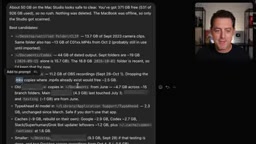
The most attention-grabbing use case is the "money-saving bot." Berman has his AI comb through three Gmail accounts to identify all subscription emails, surfacing over $1,000 in monthly recurring expenses — everything from insurance to Typeform, ChatGPT, and Anthropic subscriptions. Going further, the AI proactively drafts cancellation or price-negotiation emails. In the video, it writes a "we're happy customers but need a lower price" email to Beehive (a newsletter service at $459/month) — Berman just has to hit send.
This leverages a well-known business reality: when you hint at canceling, most vendors will offer a discount to keep you. Handing this negotiation process off to an AI that can execute it in bulk is far more efficient than doing it manually.
Another clever trick: having the AI log into the California Unclaimed Property website, search for dormant funds registered under Berman's name, and automatically submit a claim form. The site has returned over $8 billion to date, and most states have similar platforms.
Controlling the Physical World: From Tesla to the Garage Door
Berman demonstrates how he lets Grokbot take control of his Tesla Model Y. The setup involves having the AI download Tesla's official Fleet API documentation and, armed with an API key, accept voice commands to pre-condition the cabin, turn on seat heaters, set a navigation destination, and even open the garage door.
His Prompt design reflects a principle worth borrowing: separation of responsibility. Security-sensitive actions — like logging in, handling two-factor authentication codes, and pairing virtual keys — are explicitly declared as "handled by me personally." The AI only handles reversible operations via the official API: climate control, charge management, and sending navigation destinations. This "manual for high-risk, automated for low-risk" boundary runs through nearly all of his bot designs.
The same logic applies to his computer cleanup bot: every Monday it scans the hard drive for caches, expired files, and duplicate screen recordings, then groups them by risk level into a list of items that could be deleted — but it never deletes anything or empties the trash without explicit permission.
Tesla Fleet API is Tesla's official interface for enterprise developers, allowing standard HTTP requests to control vehicle functions. Unlike popular unofficial libraries (such as Tesla.py), the Fleet API requires registering a developer account and passing Tesla's review process to obtain official OAuth 2.0 credentials. Supported operations are divided into "command" types (e.g., unlocking, starting the AC, sending navigation destinations) and "read" types (e.g., querying range and charge status), each with different permission levels. Berman's decision to exclude security-sensitive operations (virtual key pairing, two-factor authentication) from AI automation aligns with Fleet API's own security design — these actions require physical owner confirmation within Tesla's system and cannot be bypassed through API calls alone.
Information Hub: Daily Briefings and Family Management
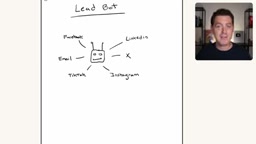
Berman considers the "family bot" his biggest time-saver. Anyone with kids knows the relentless stream of lengthy emails from schools and sports clubs. This bot monitors emails from specific senders, generates ultra-concise summaries pushed to a family Telegram group, auto-archives the original emails, and adds any events mentioned in those emails directly to the family calendar — with an invite sent to his spouse.
A real example: his son had a weekend soccer game. The day before, the bot proactively reminded the family of the game time, location, and "home team wears red," while also remembering that Berman was on snack duty that week — and asked whether it should place a DoorDash order. This kind of cross-platform integration — bridging calendar, email, and food delivery — saves roughly 30 minutes in a single interaction.
The "daily briefing bot" works similarly, with separate work and family versions. Each weekday morning it aggregates calendar events, emails, and to-do lists, prioritizing items that require action. The Prompt includes a rule: "stay silent when there are no urgent matters or meetings," preventing information overload.
Closing the Loop on Meetings and To-Dos
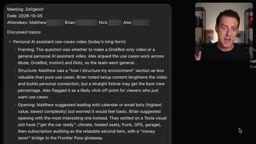
The meeting notes bot works in tandem with Fathom: after a meeting ends, the AI identifies it via calendar, calls the Fathom API to retrieve the transcript, and generates a summary including key decisions, action items, and owners.
The real highlight is that it extracts action items directly from the transcript — if you say during a meeting "I'll send you the proposal by Monday," the AI automatically adds that to the to-do list and may even proactively ask if you want help drafting the proposal.
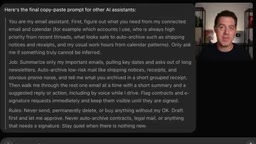
Berman weaves a critical mechanism through all his bots: having Grokbot continuously reference his Todoist list. Whenever the AI reads emails, checks the calendar, or processes meeting notes, it cross-references the to-do list to decide whether to check off or add tasks — creating a dynamically maintained list through human-AI collaboration.
The email triage bot uses a three-tier approach: low-risk emails (shipping notifications, receipts, promotions) are auto-archived with a brief acknowledgment; medium-risk emails get a draft reply generated for confirmation; high-risk emails get supporting documents prepared, with Berman doing a final review before sending.
Bill Optimization and Service Automation
The most immediately tangible money-saver is the "PG&E bill bot" (targeting California's electric utility — but the logic applies to any utility provider). It logs into the account, analyzes 12 months of usage data, compares all eligible rate plans, identifies a plan that saves $1,000 per year, and completes the switch once Berman confirms.
The calendar assistant syncs work, personal, and family calendars into a single bot that can automatically detect conflicts (e.g., a son's soccer game overlapping with a planned movie) and suggest reschedules, while also helping book appointments like dentist visits or haircuts by finding available time slots.
Finally, the Uber and DoorDash bots do exactly what you'd expect — hailing rides and reordering food. Because they're packaged as standalone bots, every other agent can call them. This leads to moments like the daily briefing bot noticing a one-hour gap between Monday meetings and proactively asking if you'd like lunch delivered during that window. That's the essence of the entire system: sufficient context + the ability to act in the real world = highly personalized, automated execution.
The Real Barriers to This Approach
It's worth being clear-eyed: the video is fundamentally a piece of sponsored content (featuring Eight Sleep, Box, and Berman's own Frontier Pass membership), and all use cases are based on a single creator's demos without independent verification.
From a technical standpoint, these scenarios aren't magic. The core requirements are three things: a personal AI assistant that supports MCP/API integration, official APIs from each service, and carefully designed Prompt boundaries. The real barrier is setup cost — connecting APIs, obtaining keys, and debugging Prompts requires a meaningful technical threshold, and account authorization raises legitimate privacy and security considerations. The "draft first, let me approve" principle Berman repeatedly emphasizes is itself a tacit acknowledgment that automation involving sending, payment, or deletion — irreversible actions — still requires human backup. For everyday users, this is better viewed as a capability map worth referencing than an out-of-the-box solution.
MCP (Model Context Protocol) is an open protocol released by Anthropic in late 2024, designed to give AI assistants a standardized "tool-calling" interface. It allows them to connect to calendars, email, databases, and external APIs in a unified way, without needing custom integration code for each service. Think of it as a "USB port" for AI — as long as a service implements an MCP server, any MCP-compatible AI client can call it directly. Products like Grokbot and Claude Desktop now support MCP natively, which is the underlying infrastructure that enables the multi-platform integrations described in this article — Gmail, Todoist, Fathom, Tesla Fleet API, and more. For everyday users, MCP significantly lowers the technical barrier to multi-service integration, though whether each service offers a compliant API remains a key constraint.
Related articles

STEPX Launches STEPX Neo, the First LLM-Native Agent Phone
STEPX (Jieyue Terminal) launches STEPX Neo, its first LLM-native agent phone, featuring an LLM-native architecture and agent interaction paradigm. This article covers its positioning, industry significance, and points to watch.

UK Per Capita Electricity Generation Falls Below 1970s Levels: The Deeper Signal Behind a Massive Energy Shift
UK per capita electricity generation has fallen below 1970s levels. This analysis examines how deindustrialization, efficiency gains, and energy transition are suppressing per capita power consumption, and what it means for future electrification trends.

Ai2 Olmo-core 3: The Secret Behind 2.7x MoE Training Throughput
Ai2 open-sources Olmo-core 3, replacing FSDP with DDP to eliminate the MoE capacity tax. Expert pool grows 8→128 with only 5% throughput loss; 47B model hits 2.7x the old implementation.