STEPX Launches STEPX Neo, the First LLM-Native Agent Phone

STEPX launches STEPX Neo, the first LLM-native agent phone, highlighting system-level agent interaction.
STEPX (Jieyue Terminal) officially launched STEPX Neo, its first LLM-native agent phone, on October 13, 2026. Unlike traditional "AI phones" that stack features, it emphasizes an "LLM-native" architecture — with the large model at the system's foundation rather than as an add-on — and an "agent" interaction paradigm where the device autonomously perceives, decides, and executes complex tasks. The article suggests this could shift phone interaction from "open an app to complete a task" to "describe your intent and let the agent handle it," requiring synchronized restructuring of the OS, app ecosystem, and privacy models. However, official details on hardware, LLM capabilities, task scope, and developer ecosystem remain undisclosed, so actual competitiveness is still to be determined.
STEPX Launches STEPX Neo, the First LLM-Native Agent Phone
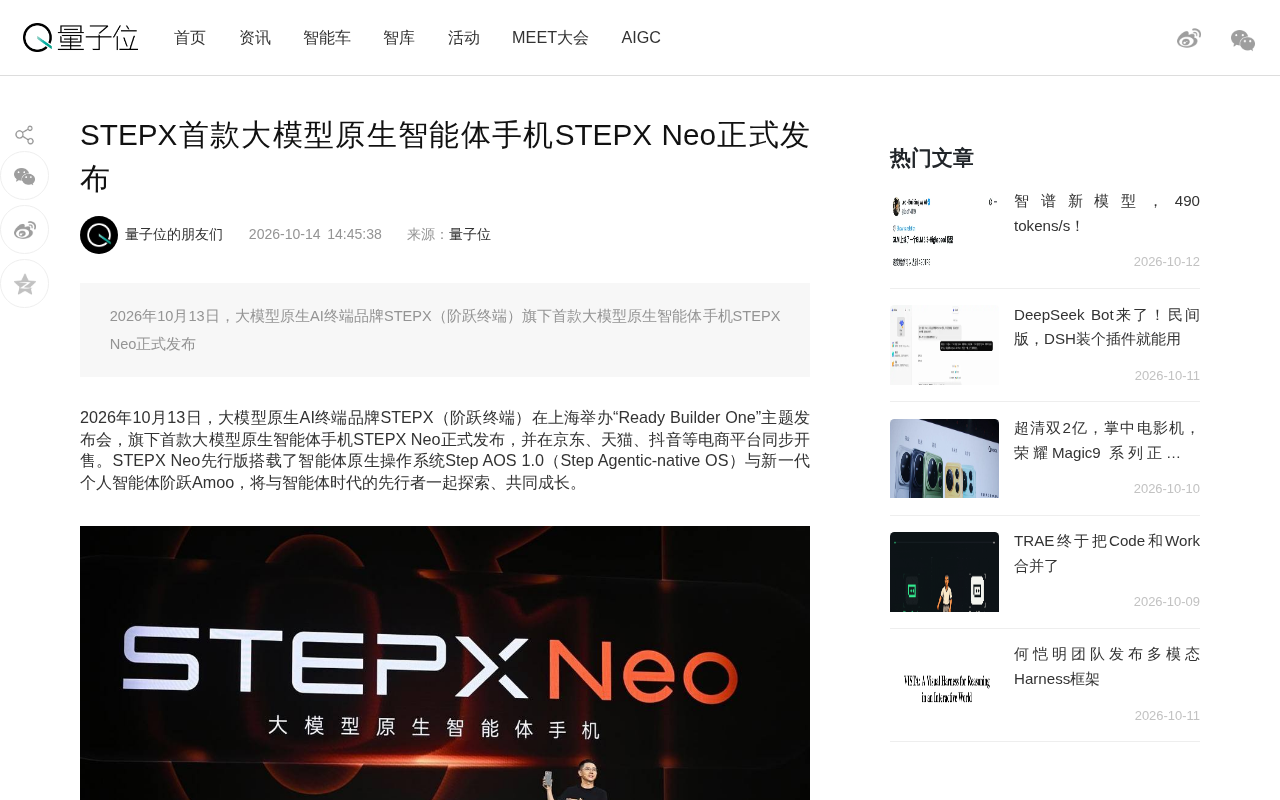
STEPX (Jieyue Terminal), an LLM-native AI device brand, has officially unveiled STEPX Neo, its first LLM-native agent phone. The launch marks a new direction for the deep integration of smartphones and LLM-powered agents.
What Is an "LLM-Native Agent Phone"
Unlike the "AI phones" commonly seen on the market, STEPX Neo emphasizes two core concepts: "LLM-native" and "agent."
"LLM-native" means the large model is not embedded into the system as an add-on feature, but rather the entire architecture is designed from the ground up around LLM capabilities. "Agent" refers to an AI system capable of autonomous perception, decision-making, and execution — able to proactively complete complex tasks assigned by the user, rather than merely responding passively to single-turn commands.
This product positioning aligns with the current trend of AI devices moving from "feature stacking" toward "system reconstruction." As a brand focused on LLM-native AI devices, STEPX (Jieyue Terminal) chose the phone as its first form factor, targeting the computing device users interact with most frequently in daily life.
The Significance of STEPX Neo's Launch
According to official information, STEPX Neo was officially launched on October 13, 2026.
From an industry perspective, the "LLM-native agent phone" category is still in an early exploratory stage. Traditional phone manufacturers typically use large models to upgrade specific scenarios such as voice assistants, image processing, and text summarization. STEPX Neo takes a more radical stance — treating the agent as the core interaction paradigm of the phone.
This means the interaction logic between users and devices may undergo a fundamental shift: from "open an app to complete a task" to "describe your intent and let the agent handle it." If this paradigm takes hold, the phone's OS layer, app ecosystem, and even privacy and security models will all need to be restructured accordingly.
However, publicly available information has not yet disclosed STEPX Neo's specific hardware specifications, details of its LLM capabilities, the scope of tasks the agent can execute, or developer ecosystem plans. These will be key to judging the product's actual competitiveness.
Interaction Paradigm refers to the fundamental mode by which users exchange information with a device. For the past fifteen years, the dominant paradigm for smartphones has been "graphical interface + app icons," where users complete tasks within specific apps through taps and swipes. The agent paradigm attempts to replace app-layer operations with natural language intent descriptions, theoretically reducing the cognitive load of cross-app tasks. But paradigm shifts face real resistance: the existing app ecosystem treats individual apps as commercial units, and cross-app orchestration by agents may touch on data permissions and commercial interest distribution. At the same time, building user trust in "black-box execution" takes time. Therefore, whether agent phones can achieve widespread adoption depends not only on model capabilities but also on the synchronized evolution of ecosystem rules and user habits.
Known Information and Points to Watch
Based on currently available public information, the confirmed facts are relatively limited:
- Brand: STEPX (Jieyue Terminal), positioned as an LLM-native AI device brand
- Product: STEPX Neo, the first LLM-native agent phone
- Launch date: October 13, 2026
Areas worth watching going forward include: the degree of task autonomy the agent achieves, whether the underlying LLM is self-developed or partnered, how privacy is balanced with cloud inference, and how third-party apps will integrate with the agent ecosystem. The answers to these questions will determine whether STEPX Neo is a conceptual innovation or a scalable product direction.
For readers following the evolution of AI devices, STEPX Neo's launch provides a sample for observing how the "LLM-native" concept can be realized in a phone. Its subsequent real-world experience and ecosystem development are worth continued tracking.
Background
LLM-native is a relatively new product design philosophy, with its core distinction lying in where the large model sits within the system. In traditional "AI phones," the large model is typically integrated via SDK or cloud services to enhance an existing feature (such as photo album search or call summaries), without changing the system architecture itself. "LLM-native," by contrast, requires the operating system to be redesigned from task scheduling, memory management, and permission models to interaction entry points — all based on the reasoning and planning capabilities of the large model. The large model acts as the system's "central hub" rather than a "plugin." The direct change this design brings: apps no longer need to individually implement AI capabilities; instead, the system uniformly orchestrates model resources, reducing redundant development and improving cross-app task coordination efficiency.
Agent in the AI field refers to a system capable of perceiving its environment, autonomously planning, and invoking tools to execute multi-step tasks. Unlike single-turn Q&A AI, an agent's typical capabilities include task decomposition, tool invocation (such as calling maps, payment, or calendar), memory management, and self-correction. In a phone context, this means a user could say "book me a high-speed train to Shanghai on Friday and arrange a pickup," and the agent would need to break this down into multiple sub-tasks — checking train schedules, comparing prices, placing the order, and notifying the pickup — executing them across apps. Current technical bottlenecks for agents lie mainly in the stability of long-task planning, obtaining cross-app permissions, and recovery mechanisms after execution errors. These are also key dimensions for evaluating STEPX Neo's actual experience.
One-line Summary
STEPX launches STEPX Neo, the first LLM-native agent phone, featuring system-level agent interaction.
Paragraph Summary
STEPX (Jieyue Terminal) has officially launched STEPX Neo, its first LLM-native agent phone, on October 13, 2026. Unlike traditional "AI phones" that stack features, the product emphasizes an "LLM-native" architecture — where the large model operates from the system's foundation rather than as an add-on — and an "agent" interaction paradigm — where the device autonomously perceives, decides, and executes complex tasks. The article notes this could shift phone interaction from "open an app to complete a task" to "describe your intent and let the agent handle it," requiring synchronized restructuring of the OS, app ecosystem, and privacy models. However, official details on hardware specs, LLM capabilities, task scope, and developer ecosystem have not yet been disclosed, so actual competitiveness remains to be seen.
Related articles

Behind Google's Agent Engine Launch: The 50-Millisecond Lifeline for Real-Time AI Agent Control
Google launched Agent Compute Engine and expanded agent governance, but community says the core gap is runtime per-call policy enforcement. We analyze the 50ms blast radius window, identity provisioning vs. call control, and practitioner paths across infrastructure and SDK layers.

Fall 2026 Earnings Preview: AI Hype and Robot Promises Put to the Test
Fall 2026 earnings season: as every company claims to be an AI company, compute becomes an asset, and robot promises return, we outline three dimensions—AI revenue realization, compute CapEx, and robot deliveries—to help you separate narrative from reality on investor calls.

AI Serving Harness: The Next Competitive Advantage for Enterprise AI
Enterprise AI competitive advantage is shifting from model selection to serving harness construction. This article analyzes why models are no longer the sole moat and offers design principles for a long-term evolvable AI serving harness: unified abstraction layer, observability, governance security, and elastic scheduling.