12k-Star Open-Source Tool free-claude-code: Connecting Free Models to the Claude Client

Open-source project FCC uses a reverse proxy to connect free models to the Claude client, balancing experience and cost.
free-claude-code (FCC) is an open-source project with 12,000 stars on GitHub. It uses a local reverse proxy layer to translate free model output into the protocol recognized by the official Claude client, preserving the official interaction experience while bypassing high token costs. Its workflow has three steps: intercepting the Agent's toolchain and thought stream, using the RTK engine to compress about 90% of context and complete protocol transfer, and maintaining service stability through intelligent circuit breaking and multi-key rotation. Deployment requires just one command to spin up the workspace, supports hardware acceleration and local DeepSeek reverse proxy, and has integrated 61 model sources. Benchmarks show concurrent throughput exceeding 100,000 and memory usage reduced by 78%, but free models still lag behind official ones in capability, and proxy stability is constrained by underlying services.
Why free-claude-code Is Worth Your Attention
The official Claude client has an excellent reputation for coding capabilities, but high token costs and network rate limits deter many developers. An open-source project called free-claude-code (FCC), shared on Bilibili, has already racked up 12,000 stars on GitHub. It uses a reverse proxy layer to let free models masquerade as the official protocol and connect to the Claude client, thereby bypassing billing pressure.
FCC's core idea is not cracking but "protocol translation": it sets up a compatibility layer locally that converts the output of free models into a format the official client can recognize. This preserves the official client's interaction experience while dramatically reducing usage costs.
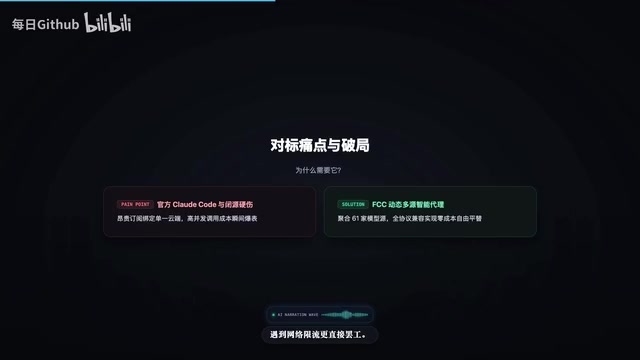
Reverse proxy and protocol compatibility layer: A reverse proxy is an intermediary server between the client and the target service. The client believes it is directly accessing the target service, but requests actually pass through the proxy first. FCC exploits this architecture to set up a local proxy that translates Anthropic-protocol requests from the Claude client into a format free models can understand, then translates responses back into Anthropic protocol format. This differs fundamentally from "cracking": it does not tamper with the official client or forge authentication—it merely swaps the backend model source. As a result, client-side interaction logic such as tool calls, streaming output, and chain-of-thought display is preserved intact. Similar approaches are not new in the open-source community—projects like one-api and LiteLLM for the OpenAI API have unified multi-model protocols—but FCC's distinction is that it specifically adapts to the private protocol details of the Claude client.
FCC's Three-Step Workflow
According to the video author's breakdown, FCC's mechanism can be summarized in three steps:
Step 1: Intercept the Agent's Native Toolchain and Thought Stream
FCC intercepts tool calls and thought stream data emitted by the Claude client, which is the foundation of compatibility. Only after capturing these raw requests can subsequent protocol conversion take place.
Step 2: Compress Context with the RTK Engine and Transfer Protocol
This is FCC's technical core. The RTK engine can compress up to 90% of context while completing protocol transfer. Context compression is especially important for free models—they typically have stricter context window limits, and compression allows them to handle longer conversations.
Context window and context compression: The context window refers to the total number of tokens a model can process in a single inference, including system prompts, historical dialogue, and tool return results. Official Claude models can reach context windows of 200K tokens, while most free models range from 8K to 128K, and are billed per token or rate-limited. The RTK engine's compression approach typically includes: summarizing historical dialogue, removing redundant tool output, structurally trimming code files, and retaining the original text of the most recent few turns. Compressing 90% means a 100K-token request can be reduced to around 10K, enabling free models to handle long conversations. The cost is information loss—key details may be lost in complex tasks, which is one of the fundamental reasons proxy solutions are less capable than native official models.
Step 3: Trigger Intelligent Circuit Breaking and Multi-Key Rotation
Free model services frequently encounter rate limits or temporary unavailability. FCC has built-in intelligent circuit breaking and multi-key rotation strategies, automatically switching to the next key when one fails, thereby keeping the service online.
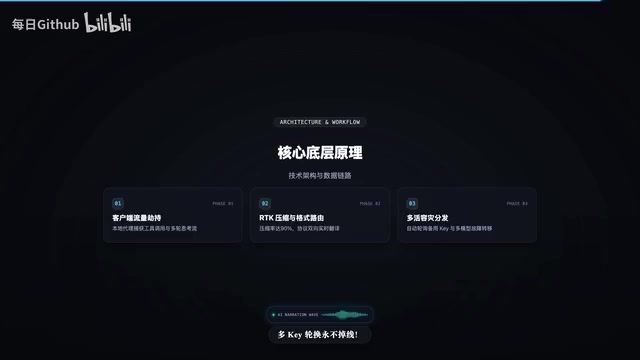
Circuit breaker pattern and multi-key rotation: The circuit breaker is a fault-tolerance pattern in distributed systems. When a backend fails continuously beyond a threshold, the system "trips" and pauses requests to it, switching to a backup path to avoid avalanche-style retries that drag down the whole system. FCC layers multi-key rotation on top: it maintains a pool of API keys scheduled by round-robin or health, automatically removing and switching when a single key triggers rate limiting (e.g., a 429 response). This is similar to health checks in load balancing, but focuses more on handling the high-frequency rate limiting of free services. The limitation is that if all keys come from the same provider and are globally rate-limited, circuit breaking can only delay the failure, not eliminate it.
Deployment Experience: One Command to Spin Up a Workspace
The video emphasizes that FCC's deployment is "extremely elegant": a single command spins up the complete workspace, automatically enables hardware acceleration, and supports one-click connection to a locally deployed DeepSeekAd reverse proxy service. This means if users have a local DeepSeek instance, they can use it directly as the backend model for fully local operation at zero API cost.
This flexibility is one of FCC's advantages over other proxy solutions. It is not tied to a specific model source—the video mentions it has already integrated 61 model sources, allowing users to switch freely based on their needs and availability.
Performance Benchmarks: Throughput, Latency, and Memory
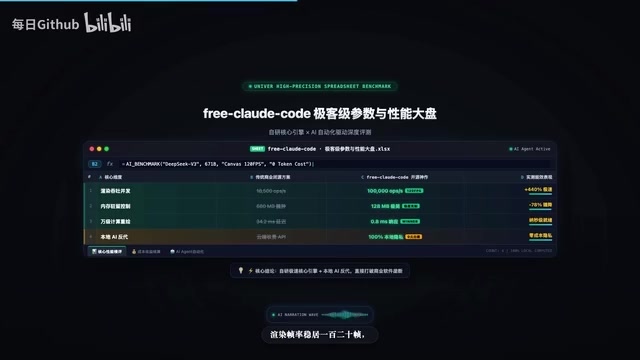
The video provides several hard benchmark data points:
- Throughput concurrency exceeds 100,000: Demonstrates high processing capability under concurrent scenarios.
- Rendering frame rate holds steady at 120 FPS: The client interface remains smooth.
- Memory usage drops by 78%: Resource consumption is significantly reduced compared to unoptimized solutions.
These figures come from the video author's test environment; actual performance will vary with hardware configuration and model source, but the overall trend shows FCC has done considerable work on performance optimization.
Real-World Use Cases: From Terminal to Mobile Voice
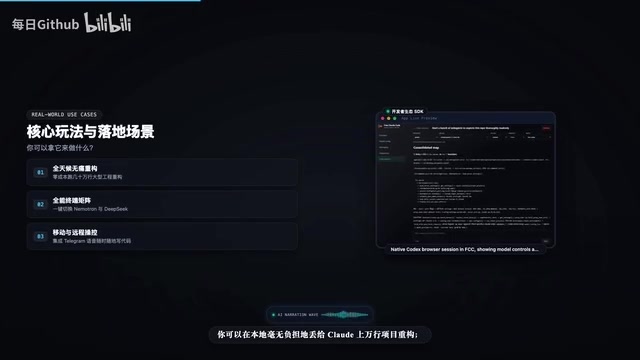
FCC supports quickly switching between different model sources in the terminal. The video demonstrates switching between "Neimi Rouchuang" (transliteration, possibly referring to a model service) and DeepSeek in seconds. In addition, it supports remotely commanding the Agent to write code via Telegram voice on a phone, opening up possibilities for development assistance in mobile scenarios.
For developers handling large projects, FCC allows the Agent to process codebases of tens of thousands of lines locally without worrying about token consumption. The video author believes this model delivers a "dimensionality reduction strike" against commercial closed-source solutions, especially regarding private data security.
An Objective View: Strengths and Limitations
FCC's highlights are its open-source nature, free model integration, multi-source switching, and performance optimization. But it should be viewed rationally:
- Free models are generally less capable than official Claude models, and may lag on complex tasks.
- The proxy layer's stability depends on the availability of the underlying free services; circuit breaking can only mitigate, not eliminate, rate-limiting issues.
- The performance data in the video are test results from a specific environment; actual experience needs to be verified independently.
Overall, free-claude-code offers a viable option for developers with limited budgets who want to experience the Claude client. The project is fully open-source—if interested, go give it a star on GitHub and try it out yourself.
Related articles

Russian Handwritten Math Dataset: 50 Free Sample Problems and a $45,000 Commercial Version
A new Russian handwritten math dataset on Hugging Face offers a free 50-problem sample covering 19 math branches, with handwritten pages and LaTeX/Word solutions. The full commercial version has 1,740 problems for $45,000.

Terminal Borders That Don't Cost a Cell: A Low-Cost Rendering Technique Explained
Explore techniques for drawing terminal borders that don't occupy character cells, using background colors and half-block characters for compact layouts, with analysis of principles, compatibility trade-offs, and implications for terminal UI development.
Tech Giants Are Redefining Privacy Again—What's Different This Time?
Tech companies are once again trying to reshape the concept of privacy. This article analyzes common paths: from 'not collecting' to 'transparent collection,' from 'control' to 'management tools,' from product attribute to brand label, and explores how users and the industry should respond to privacy semantic drift.