15 Most Recommended WorkBuddy Skills: Full Coverage of Writing, Design, and Development

WorkBuddy adds 15 vertical-scenario skills covering writing, design, development, and more
Bilibili creator "Programmer Xiaohui" recommended 15 new skills recently emerging in the WorkBuddy skill marketplace, all from GitHub open-source repositories and covering five major domains: content creation, visual design, personal growth, developer tools, and information gathering. Content creation skills include Humanizer VH for removing AI writing traces, Writing DNA for extracting an author's style, and Chinese Novelist Skill for solving inconsistencies in long-form fiction; design skills include UI UX FromX, social media card generation, and XHS Product Picker; developer skills are represented by Vasa Skill and Hengmu Skill, embodying the engineering mindset of "think clearly before writing code"; Xiaomu SEO includes GEO in its webpage inspection scope. The creator advises installing on demand, because the skill ecosystem is shifting from general capabilities to vertical scenario segmentation, and what you don't use is just noise.
Skill Ecosystem Explosion: Why These 15 New Skills Are Worth Your Attention
WorkBuddyAd's skill marketplace is expanding rapidly, but the more skills there are, the higher the cost of filtering them. Bilibili creator "Programmer Xiaohui" already did two rounds of recommendations in August and September, and recently a batch of new skills has emerged in the ecosystem. This time he picked out 15 skills covering five domains: content creation, visual design, personal growth, developer tools, and information gathering. All come from GitHub open-source repositories — just send the address to WorkBuddy and you can install them directly.
What these skills have in common is that they solve specific problems rather than vaguely "boosting efficiency." Below is a breakdown by domain, focusing on the highlights.
Content Creation: From Removing AI Flavor to Style Replication
Humanizer VH: The "Beautician" That Removes AI Writing Traces
This skill identifies 24 common AI expression problems — such as overuse of "first/second/finally," abuse of parallel sentence structures, and mechanical transitional words — then rewrites the content to sound more natural while preserving the original viewpoints and structure as much as possible. For creators who need to output large amounts of text, this is a quick tool for lowering "AI concentration," suitable for the polishing stage after a first draft is completed.
What Exactly Is "AI Flavor"
"AI flavor" refers to a series of statistical features that repeatedly appear in text generated by large language models. Common manifestations include: overuse of three-part structural words like "first/second/finally," overly symmetrical parallel sentences, mechanical progression in the form of "not only… but also…," piled-up adjectives, vague generalities without specific details, and a rhythm with highly uniform sentence lengths. These features stem from the model's tendency to imitate "excellent sample essays" during training, leading to convergent output. After prolonged exposure, readers develop fatigue and can even intuitively tell that content was produced by AI. Removing AI flavor does not mean deleting or altering viewpoints; it means breaking up sentence patterns, introducing colloquial pauses, and adding specific details and personal tone so the text regains the irregularity of human writing. The 24 issues that Humanizer VH checks are essentially a checklist of these statistical features.
Writing DNA: Enabling AI to Reliably Replicate a Person's Writing Style
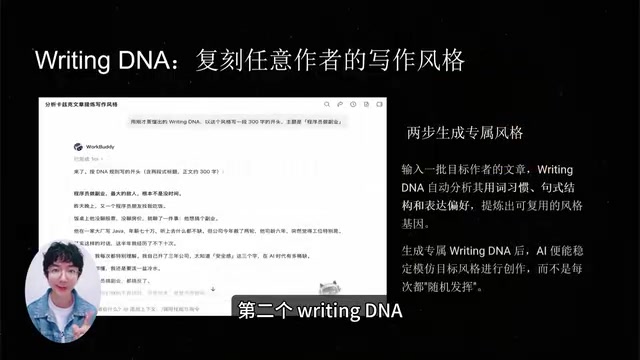
Writing DNA goes deeper than "polishing": it analyzes a batch of articles by one author, extracts word preferences, sentence habits, structural patterns, and expressive characteristics, and distills them into a reusable Writing DNA. After that, AI can consistently output according to this set of style parameters rather than going off track with each "imitation." For creators who need to produce personal-style content at scale, this skill saves the trouble of repeatedly tuning prompts.
Chinese Novelist Skill: Solving Inconsistencies in AI-Written Long-Form Fiction
A skill specifically for writing Chinese long-form novels, it automatically maintains character settings, foreshadowing, and chapter summaries. The biggest pain point of AI writing long-form content is that partway through, character personalities change, foreshadowing is forgotten, and settings collapse. This skill avoids these problems by maintaining a "story state table," and its writing approach is more focused than general-purpose writing skills.
Cangjie Skill: Distilling Methodologies into Callable Skills
Directly "distills" the methodology from a video, a speech, or an episode of a podcast into a new Skill, essentially transforming knowledge into a capability AI can call directly. This idea is worth noting: it is not about taking notes, but about packaging knowledge into an executable workflow.
Design and Product: Produce Complete Solutions Without Knowing Design
UI UX FromX: Generate a Design System from One Sentence
Describe your needs in one sentence, and it generates a complete design system, including color schemes, font choices, component libraries, and UX specifications. For developers who don't know design but want to build a website or app, this skill lowers the barrier of the "design" step to nearly zero.
Social Media Card Standards: Stable Visual Output Without Relying on Image Generation Models
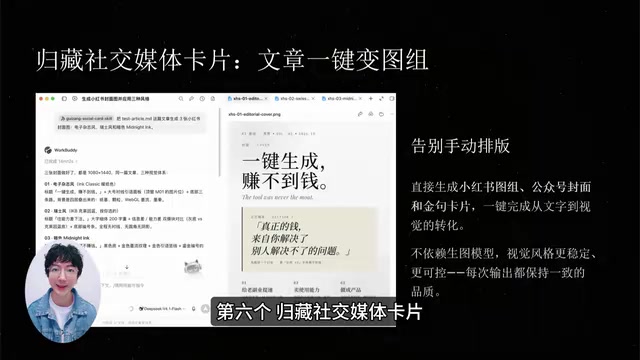
It directly turns an article into Xiaohongshu image sets, WeChat official account covers, and quote cards. The key is that it does not rely on image generation models, so the visual style is stable and controllable and won't have the problem common in AI image generation where "every image looks different."
XHS Product Picker: Mine Monetization Directions from Personal Experience
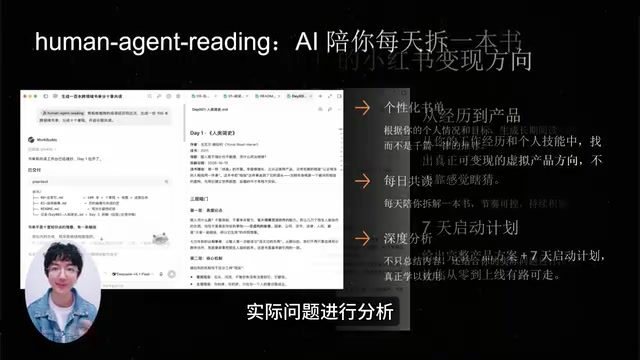
Want to create virtual products for Xiaohongshu but don't know what to sell? This skill mines monetizable directions from your work experience and personal skills and provides a complete product plan and a 7-day launch plan. Essentially, it performs a structured alignment between "what I can do" and "what the market lacks."
PM Skills: 68 Product Skills + 42 Workflows
Built in with 68 product skills and 42 workflows, covering scenarios such as writing PRDs, prioritizing requirements, setting OKRs, and designing experiments. For product managers and indie developers, this is equivalent to turning daily repetitive work into structured processes.
Developer Tools: Think Clearly Before Writing Code
Vasa Skill: A Skill Pack for Engineering Thinking
A set of engineering skills open-sourced by developer TM93, with the core idea of "think clearly before writing code." Specifically, it includes clarifying requirements, troubleshooting bugs, checking code quality, and formulating development plans. This philosophy aligns with the current trend in AI programming that emphasizes "plan before code."
Why "Plan Before Code" Has Become the Mainstream Paradigm in AI Programming
"Plan before code" is a consensus that has formed in the AI programming tool space over the past two years. A typical problem in early AI programming was: the user gives a vague requirement, and the model immediately starts generating code, resulting in a wrong direction and high rework costs. Plan before code splits the process into two steps — first have the model clarify requirements, break down tasks, and confirm boundaries and dependencies, then move into code generation. The advantage of this approach is that errors can be corrected at low cost during the planning stage, whereas once you enter the coding stage, modification costs rise exponentially. Representative examples include Claude's thinking mode, Cursor's Plan Mode, and various "spec-driven development" tools. Vasa Skill productizes this concept, covering the early development stage through four steps: clarifying requirements, troubleshooting bugs, quality checks, and making plans. Essentially, it codifies the habit of senior engineers to "think clearly before acting" into steps AI can execute.
Hengmu Skill: Architecture Reviews Must Have Code Evidence
A skill specifically for project architecture review, characterized by the requirement that every conclusion must be supported by real code as evidence, outputting architectural risks and specific remediation plans. Compared with general "code suggestions," review conclusions backed by code evidence are more actionable.
Beautify GitHub Readme: Make Open-Source Homepages More Professional
Reorganizes the structure of a GitHub Readme and can also generate a custom SVG banner, making an open-source project homepage look more professional. For open-source maintainers, this is a direct "storefront" tool.
Xiaomu SEO: Inspect Webpages Like a Consultant
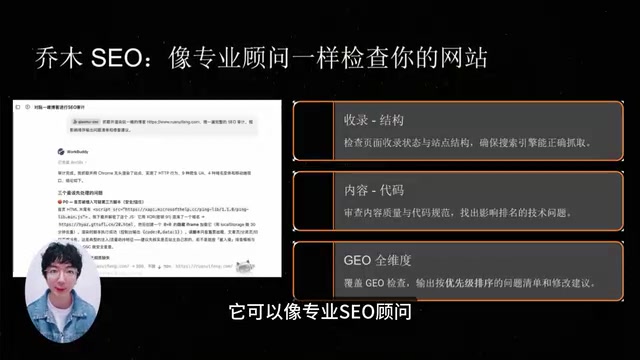
Inspects webpages like a professional SEO consultant, covering indexing, structure, content, code, and GEO, and finally provides a prioritized list of issues and revision suggestions. You may not have noticed that it also includes GEO (Generative Engine Optimization) in its inspection scope, which is not yet common in traditional SEO tools.
The Difference Between GEO (Generative Engine Optimization) and Traditional SEO
GEO stands for Generative Engine Optimization, an optimization method for AI search and generative answer scenarios. The goal of traditional SEO is to make webpages rank higher in retrieval results on Google, Bilibili, Baidu, and other platforms, with core metrics being click-through rate and keyword ranking; the goal of GEO is to make content easier for large language models (such as ChatGPT, Perplexity, and Google AI Overviews) to crawl, understand, and directly cite in generative answers. The methods overlap — structured data, clear information hierarchy, authoritative citations — but GEO places more emphasis on: content paragraphs that can be extracted independently, clear factual statements, high semantic density, and verifiable sources. As more users directly ask AI questions instead of searching webpages, the entry point for web traffic is shifting from "search results pages" to "AI answers." Xiaomu SEO's inclusion of GEO means it evaluates not only traditional crawling and ranking factors but also the citability of content in generative engines.
Personal Growth and Information Gathering
Interview Prep: Generate an Interview Plan from Resume + Job Description
Give it your resume and the job description, and it analyzes job fit, predicts interview questions, and generates a complete interview preparation plan.
Human Agent Reading: AI Accompanies You in Long-Term Reading
Generates a long-term reading list based on your personal situation and accompanies you in breaking down one book each day. It is not just a content summary; it also analyzes based on your actual problems. This skill is positioned as a "reading companion" rather than a "book summarizer."
Follow Builders: Automatic Briefings on Frontier AI Developments
Tracks the latest updates from frontier AI developers' blogs, X, YouTube, and official blogs, automatically organizes them into briefings, and can be set to push periodically.
How to Choose: Install on Demand, Don't Be Greedy
The 15 skills cover several directions: writing, design, workplace, development, and information gathering. Creator Xiaohui's advice is: pick a few that truly match your needs and try installing them first. No matter how many skills there are, the ones you don't use are just noise.
From this batch of skills, a trend in the WorkBuddy ecosystem is visible: from general capabilities to segmentation by vertical scenarios. Whether it's removing AI flavor, replicating writing style, or architecture review with code evidence, everything is moving in the direction of "solving one specific problem."
Which WorkBuddy skills are you currently using? What pitfalls have you run into? Feel free to share in the comments.
One-line Summary
WorkBuddy adds 15 vertical-scenario skills covering writing, design, development, and more
Paragraph Summary
Bilibili creator "Programmer Xiaohui" recommended 15 new skills that recently emerged in the WorkBuddy skill marketplace, all from GitHub open-source repositories and covering five major domains: content creation, visual design, personal growth, developer tools, and information gathering. Content creation skills include Humanizer VH for removing AI writing traces, Writing DNA for extracting an author's style, and Chinese Novelist Skill for solving inconsistencies in long-form fiction; design skills include UI UX FromX, social media card generation, and XHS Product Picker; developer skills are represented by Vasa Skill and Hengmu Skill, embodying the engineering mindset of "think clearly before writing code"; Xiaomu SEO includes GEO in its webpage inspection scope. The creator advises installing on demand, because the skill ecosystem is shifting from general capabilities to vertical scenario segmentation, and what you don't use is just noise.
Related articles

Workbuddy for Absolute Beginners: How a Desktop AI Agent Fits Into Real Workflows
A beginner's guide to the Workbuddy desktop AI agent: installation, claiming credits, file management, and building automated workflows—compared with CodeX for fit and cost, helping professionals shift from AI question-askers to AI managers.

OpenAI's New Agent Stack: Computer Use, Decisions API, and Ultra-Fast Workflows
OpenAI Dev Day unveiled a new agent stack: Computer Use outperforms humans, Decisions API delivers ultra-low-latency classification via Luna, Agents API opens the same Computer Use capabilities, and GPT-6.1 Sol costs only one-seventh of Astra. Core updates, benchmark data, and developer insights.

Liang Wenfeng Open-Sources DeepInfo Inference Framework, Takes On U.S. Ban
DeepSeek open-sources its DeepInfo inference framework after its models, featuring GPU/CPU cross-pipelining, small-model prediction with large-model verification, and full Huawei Ascend and NVIDIA chip support—facing the U.S. federal ban head-on. This article analyzes its significance for AI deployment and open-source strategy.