$15,000 Open Source Grant Program: How to Apply and Nominate

A $15K grant program allows open source developers to self-nominate or nominate others for funding.
A new open source grant program offering up to $15,000 is gaining attention in the developer community. The program features an open nomination system where developers can either apply for their own projects or nominate others. The article explores why such funding matters for open source sustainability, highlights the risks of underfunded infrastructure, and provides guidance on how to participate.
A New Funding Opportunity for the Open Source Ecosystem
Open source software is the cornerstone of today's technology world. From operating systems to development frameworks, countless critical projects are maintained by community volunteers. Yet for years, open source developers have faced a common dilemma: investing enormous time and energy maintaining projects while often lacking sustainable financial returns.
This dilemma traces back to the early days of the free software movement. When Richard Stallman launched the GNU Project in 1983, he advocated for software freedom rather than free-of-cost software, but in practice "free as in freedom" was often misread as "free as in beer." As Linux, Apache, and other projects gained widespread commercial adoption, a paradox gradually emerged: enterprises extracted enormous commercial value from open source software, but little of that value flowed back to maintainers. Nadia Eghbal described this phenomenon in her book Working in Public as a digital replication of the "tragedy of the commons" — everyone uses the public resource, but few are willing to pay for its maintenance.
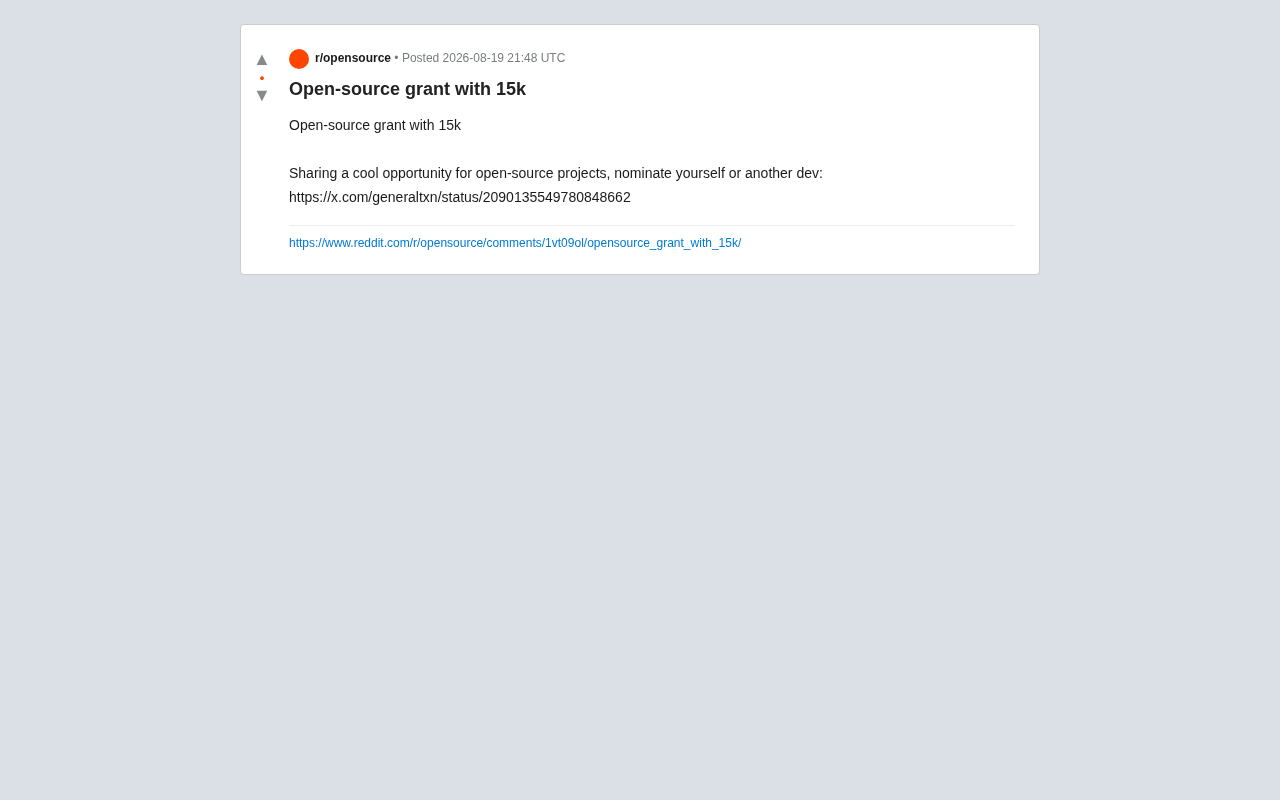
Recently, a grant program targeting open source projects has caught the attention of the developer community — offering up to $15,000 (15k) in funding, with developers allowed to nominate themselves or others.
The emergence of such grant programs reflects the industry's growing attention to open source sustainability. Compared to traditional corporate sponsorship or foundation grants, this lightweight, community-driven nomination mechanism lowers the application barrier, giving more small-to-medium but valuable projects a chance to receive support.
Core Mechanics of the Grant Program
According to the source information, the key feature of this grant program is its open nomination system. Unlike traditional grants that require complex application materials, this program allows two forms of participation:
Traditional research funding (such as NSF, DARPA) typically requires lengthy proposal writing, peer review, and strict milestone reporting — processes friendly to academic institutions but posing significant barriers for independent open source developers. The innovation of the nomination system lies in borrowing from the community's Web of Trust concept — identifying valuable projects through mutual recognition among community members rather than relying on bureaucratic review processes. This mechanism aligns closely with the collaborative culture of the open source community itself.
Self-Nomination: Advocating for Your Own Project
Developers can directly apply for grants for open source projects they maintain. This is especially friendly to independent developers who have long been contributing "for the love of it" — they understand their project's value, user base, and maintenance difficulty best, and can advocate for resources firsthand.
Nominating Others: Discovering Overlooked Quality Projects
The program also encourages community members to nominate projects or developers they consider valuable. This "referral system" can uncover low-profile but critically important projects, especially those widely depended upon yet rarely known — the "invisible infrastructure."
So-called "invisible infrastructure" refers to foundational libraries indirectly depended upon by millions of projects but with extremely low public visibility. Typical examples include: OpenSSL (which had only one full-time maintainer before the Heartbleed vulnerability was exposed), core-js (depended upon by a massive number of JavaScript projects globally, whose maintainer publicly expressed financial difficulties), and curl (maintained almost single-handedly by Daniel Stenberg for over 25 years). These projects form the internet's "digital infrastructure," comparable in importance to public roads and bridges, yet chronically underfunded. Historically, maintainers of foundational libraries depended upon by millions of projects often number just one or two people with no financial support.
Why Open Source Funding Matters
The significance of open source funding goes far beyond simple monetary rewards. In recent years, multiple open source supply chain security incidents (such as the Log4j vulnerability and the xz-utils backdoor) have exposed a harsh reality: vast amounts of critical infrastructure depend on open source projects that lack resource guarantees.
The Log4j vulnerability (CVE-2021-44228, also known as Log4Shell) was disclosed in December 2021, affecting billions of devices worldwide, while the core team maintaining this widely-used Java logging library consisted of just a handful of volunteers. The xz-utils backdoor incident (March 2024) was even more alarming: attackers used long-term social engineering tactics, exploiting the original maintainer's burnout to gradually gain project control and implant backdoor code. This incident revealed a systemic risk — when maintainers become exhausted from lack of support, malicious actors can exploit the vulnerability, placing the entire software supply chain at risk. Both the US CISA and the EU's Cyber Resilience Act are attempting to address this challenge at the policy level.
When maintainers lack the energy due to insufficient funding — or abandon projects entirely — the entire technology ecosystem bears the risk. Therefore, while $15,000 may not seem like much in corporate budgets, for individual developers it can mean:
- More time to invest in ongoing project maintenance and security updates
- Relief from burnout, improving the project's long-term sustainability
- Sending a positive signal to the community — that open source contributions are recognized and respected
How to Participate in This Open Source Grant Program
For developers interested in participating, consider the following:
- Verify the information's authenticity: This grant information comes from a link shared on social media. Before participating, be sure to verify the organizer's background, grant terms, and fund disbursement mechanisms to avoid potential scams or data collection traps.
- Prepare project materials: Even for lightweight applications, clearly demonstrating your project's user base, activity level, maintenance history, and impact will improve your chances of selection.
- Proactively nominate quality projects: If you know of a developer or project that has been quietly contributing, consider nominating them — this in itself is a form of supporting the open source spirit.
The Future of Sustainable Open Source Development
The rise of open source grant programs is a healthy manifestation of the technology community's self-repair and self-motivation. Whether it's this specific $15,000 program or broader platforms like GitHub Sponsors and Open Collective, they're all attempting to solve the same core problem: how to make open source sustainable.
The current open source funding ecosystem has formed a multi-layered landscape: GitHub Sponsors allows users to make monthly donations directly to developers; Open Collective provides financially transparent collective fund management; the Linux Foundation and Apache Foundation support project operations through corporate membership fees; the Sovereign Tech Fund (established by the German government) specifically funds critical open source infrastructure; and Google's Summer of Code targets student developers. Additionally, Tidelift employs a commercial model, providing enterprise clients with maintenance guarantees for open source components while paying maintainers. Despite this increasingly rich ecosystem, it's estimated that fewer than 5% of active open source maintainers globally receive meaningful financial returns from their open source work.
For developers, this represents both an opportunity to seek returns and a moment for reflection — how can we collectively maintain this free and open ecosystem that underpins the modern software world? You may not have noticed, but since the information in this article comes from a single source (social media sharing only), readers should exercise caution and conduct independent verification before participating in any grant program.
Key Takeaways
Related articles

ChatGPT Space Launches: Team Collaboration and New Pages Features Explained
ChatGPT Space is OpenAI's new team collaboration feature with Pages, real-time collaboration, and Slack/Google Drive sync. We break down its privacy design, multi-platform integration, and the full workflow from conversation to document.

Migrating Apache Spark UDFs to GPU Acceleration with AI Agents
NVIDIA developer blog explains how AI Agents rewrite Apache Spark UDFs for GPU acceleration, covering migration criteria, agent rewriting and verification workflows, plus pitfalls like result consistency and CPU-GPU transfer overhead.
Zed Editor v0.40.4-rc2 Released: Usage Credits Now Available Without Upgrading
Zed editor releases v0.40.4-rc2, allowing users to use usage credits for AI features without upgrading to a paid plan, lowering the trial barrier.