16GB VRAM Is the Ceiling for Most People: The Reality and Future of Local LLMs

16GB VRAM is the true ceiling for most local LLM users — quantization helps, but architectural limits remain.
A Reddit user highlighted a reality often buried by high-end community discussions: for the vast majority of people worldwide, 16GB — or even 12GB — VRAM is the actual ceiling for running local LLMs, not the 24GB baseline that enthusiast forums suggest. The good news is that quantization techniques like 4-bit compression and more efficient mid-size models are closing the gap, with quantized Qwen 27B now capable of agentic coding on a 16GB GPU. However, smaller models face a hard ceiling on world knowledge that quantization cannot overcome, and the Transformer architecture's fundamental dependence on VRAM and bandwidth remains a structural barrier. Real democratization may require entirely new architectures beyond the Transformer.
The Real User Profile Hidden Behind High-End Builds
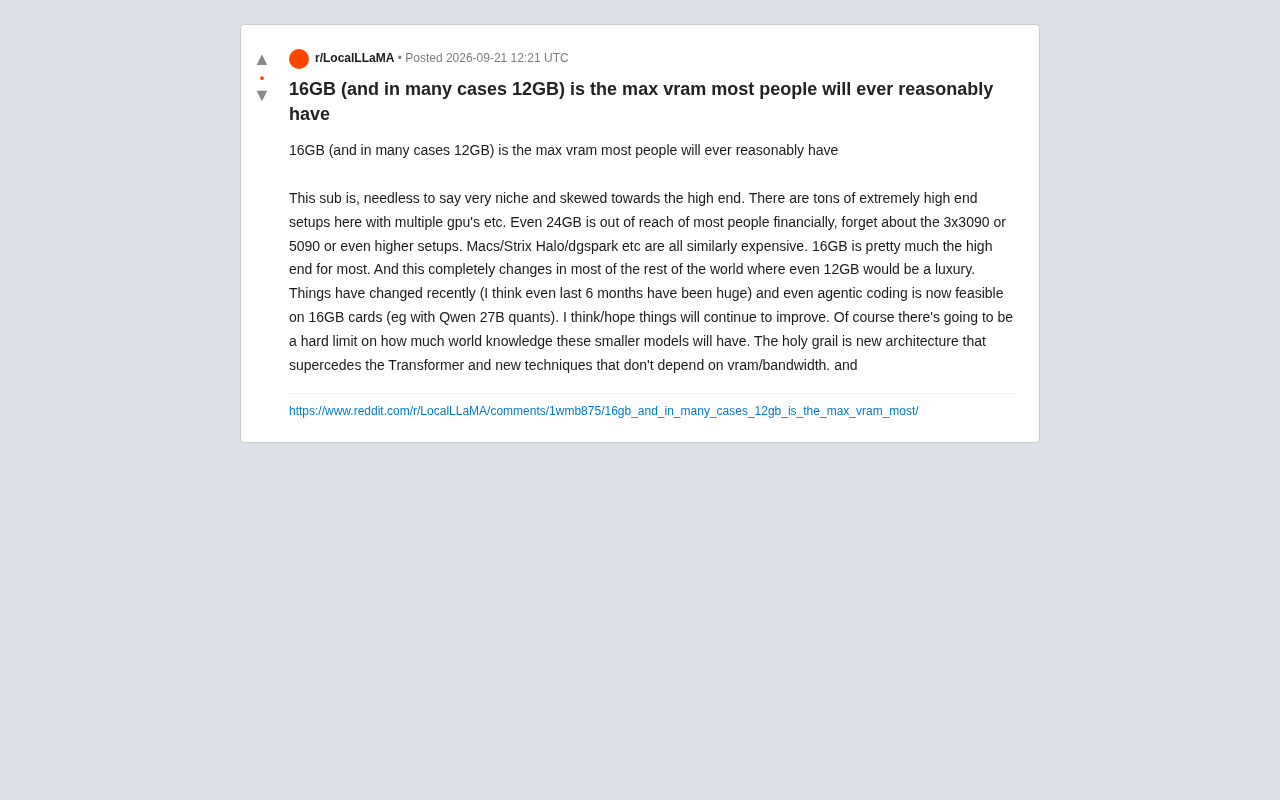
In local LLM communities, posts about multi-GPU setups, 3×3090 rigs, 5090s, and even more exotic configurations are everywhere — creating an easy illusion that 24GB VRAM is the baseline for running local models. But one Reddit user made a point that's far closer to reality: for the vast majority of people, 16GB — and in many cases even 12GB — is the actual VRAM ceiling.
This deserves serious consideration. The local AI community is highly niche and heavily skewed toward enthusiasts willing to spend big on hardware. But zoom out to the average consumer, and the picture looks completely different. A 24GB GPU is already financially out of reach for most people, let alone multi-card setups or equally expensive alternatives like Macs, Strix Halo, or DGX Spark.
12GB Is Still a Luxury in Most of the World
The original post highlighted a dimension that often gets overlooked: geographic disparity. In developed markets, 16GB might still be considered attainable "high-end" territory — but across much of the rest of the world, even 12GB VRAM qualifies as a luxury.
This is a reminder that technical discussions around local AI tend to rest on an unspoken assumption: that users have relatively generous hardware budgets. The actual global distribution of users is far more constrained than what community discussions suggest. Any vision of truly democratizing local AI must confront this hard reality — one drawn by VRAM capacity and price.
A Turning Point for Small VRAM: Agentic Coding Is Now Viable
The good news is that things are changing fast. The original author noted that just in the past six months, there's been a massive leap forward — even a 16GB GPU can now handle agentic coding tasks, using quantized versions of models like Qwen 27B.
This is a significant signal. It was once widely assumed that complex agentic workflows required large models and ample VRAM. Quantization techniques and more efficient mid-size models are breaking that assumption. When a 27B-parameter model, after quantization, fits inside 16GB of VRAM and can handle coding agent workloads, it means the practical barrier for local AI is genuinely coming down.
The Dual Push of Quantization and Model Efficiency
Behind this progress are two parallel technical threads: first, model quantization (e.g., 4-bit and more aggressive low-bit schemes) continuously compressing memory footprint while preserving capability; second, mid-size models becoming stronger through better training data and architectural refinements without increasing parameter count. Together, these trends are making "big tasks on small cards" a daily reality rather than a pipe dream.
Agentic coding refers to using a large model as an "autonomous agent" capable of decomposing tasks, calling tools (such as code executors, file systems, or search interfaces), iteratively refining results based on intermediate outputs, and ultimately completing complex multi-step programming goals. Unlike single-turn question-and-answer completions, agentic workflows require the model to maintain long context, perform multi-round reasoning, and process structured information returned by tools. These demands far exceed those of simple code completion, which is why agentic tasks were historically considered the exclusive domain of large-parameter models. Being able to handle them within 16GB VRAM marks an important practical threshold for quantized mid-size models.
Model quantization refers to compressing neural network weights from the high-precision floating-point numbers used during training (typically FP16 or BF16, at 2 bytes per parameter) into lower-bit representations. Common 4-bit quantization reduces each parameter to roughly 0.5 bytes of storage — theoretically fitting about 4× more parameters into the same VRAM. For example, a 27B-parameter model requires roughly 54GB of VRAM in FP16; after 4-bit quantization, it needs approximately 14–16GB, fitting on a single 16GB GPU. The tradeoff is a slight drop in output quality, but modern quantization formats like GGUF, GPTQ, and AWQ have brought this loss within acceptable bounds — especially for structured tasks like coding and reasoning.
The Unavoidable Hard Constraint: The World Knowledge Capacity Ceiling
Alongside the optimism, the original author stayed clear-eyed. He explicitly noted that smaller models will inevitably hit a hard ceiling on "world knowledge" capacity. Parameter count determines how much factual information a model can store — and that's a physical limitation no amount of quantization can circumvent.
In other words, quantization and efficiency gains can make smaller models shine on structured tasks like reasoning and coding, but in scenarios requiring broad factual knowledge, there will remain a gap between small and large models that's very difficult to close. This is also why simply compressing existing architectures can't fundamentally solve the problem.
The Real Holy Grail: New Architectures Beyond Transformer
The original post ultimately points toward a grander horizon: the real "holy grail" is a new architecture that transcends the Transformer, along with new techniques that no longer depend so heavily on VRAM and memory bandwidth.
This cuts to the heart of the current local AI dilemma. The Transformer architecture's appetite for VRAM and memory bandwidth is the root reason ordinary users keep hitting hardware walls. If a new paradigm emerges that's friendlier on compute and storage requirements, the entire "16GB ceiling" conversation may become irrelevant — because getting high-quality AI running on everyday devices may not require endlessly stacking VRAM, but rather a paradigm shift at the architectural level.
The Transformer architecture's high hardware demands stem from its core mechanism: the computational complexity of self-attention scales quadratically with sequence length, and during inference, all weights plus KV cache must reside in VRAM at all times. This makes VRAM capacity and memory bandwidth the dual bottlenecks constraining local deployment. Several alternative architectures are already attempting to break these limits: Mamba and other state space models (SSMs) process sequences with linear complexity; RetNet, RWKV, and similar approaches reformulate the Transformer as a recurrent model to reduce VRAM residency during inference. These architectures haven't yet surpassed the Transformer across the board on general capability, but their potential in edge-device and low-VRAM scenarios is precisely the direction the original post's "holy grail" points toward.
Conclusion: Bringing the Conversation Back to Most People
The value of this post isn't in the new data it provides — it's in how it recalibrates the entire community's perspective. While high-end enthusiasts immerse themselves in multi-GPU clusters, what actually determines whether local AI can go mainstream is the experience of the majority of users holding 16GB or even 12GB cards.
Quantization has delivered a meaningful capability leap for small-VRAM devices — the viability of agentic coding is proof of that. But the world knowledge capacity bottleneck, and the path dependency on the Transformer architecture, remain structural challenges that still stand in the way. The future of local AI depends both on continued engineering optimization and on whether we can wait for — or accelerate — a deeper architectural revolution.
Related articles

Workbuddy for Absolute Beginners: How a Desktop AI Agent Fits Into Real Workflows
A beginner's guide to the Workbuddy desktop AI agent: installation, claiming credits, file management, and building automated workflows—compared with CodeX for fit and cost, helping professionals shift from AI question-askers to AI managers.

OpenAI's New Agent Stack: Computer Use, Decisions API, and Ultra-Fast Workflows
OpenAI Dev Day unveiled a new agent stack: Computer Use outperforms humans, Decisions API delivers ultra-low-latency classification via Luna, Agents API opens the same Computer Use capabilities, and GPT-6.1 Sol costs only one-seventh of Astra. Core updates, benchmark data, and developer insights.

Liang Wenfeng Open-Sources DeepInfo Inference Framework, Takes On U.S. Ban
DeepSeek open-sources its DeepInfo inference framework after its models, featuring GPU/CPU cross-pipelining, small-model prediction with large-model verification, and full Huawei Ascend and NVIDIA chip support—facing the U.S. federal ban head-on. This article analyzes its significance for AI deployment and open-source strategy.