18 Models, 113 Coding Tasks: Smart Routing Can Push the Solve Rate to 97.6%

Smart routing across 18 models hits 97.6% solve rate at $1.88/task, crushing any single model.
A benchmark study testing 18 AI models on 113 DeepSWE coding tasks found that dynamically assigning each task to its optimal model yields a theoretical 97.6% solve rate at just $1.88 per task — compared to 74.1% and $6.52 for the best single model. The findings suggest that chasing a single "best" model is wasteful, since different tasks demand very different capabilities. The team concludes that the next frontier is a smart router: a system that classifies incoming tasks and dispatches them to the most suitable model — though real-world implementation must overcome challenges in task classification accuracy, prediction error, and scheduling latency.
A Benchmark Test Across 18 Models on Real Coding Tasks
A technical team ran a revealing experiment on the DeepSWE benchmark: they put 18 different models through 113 real-world coding tasks, then asked a simple but critical question — what if every task were assigned to the model best suited for it?
The answer was striking: this idealized "optimal task-to-model matching" achieved a 97.6% solve rate at just $1.88 per task. By comparison, the best-performing single model managed only a 74.1% solve rate — at a cost of $6.52 per task.
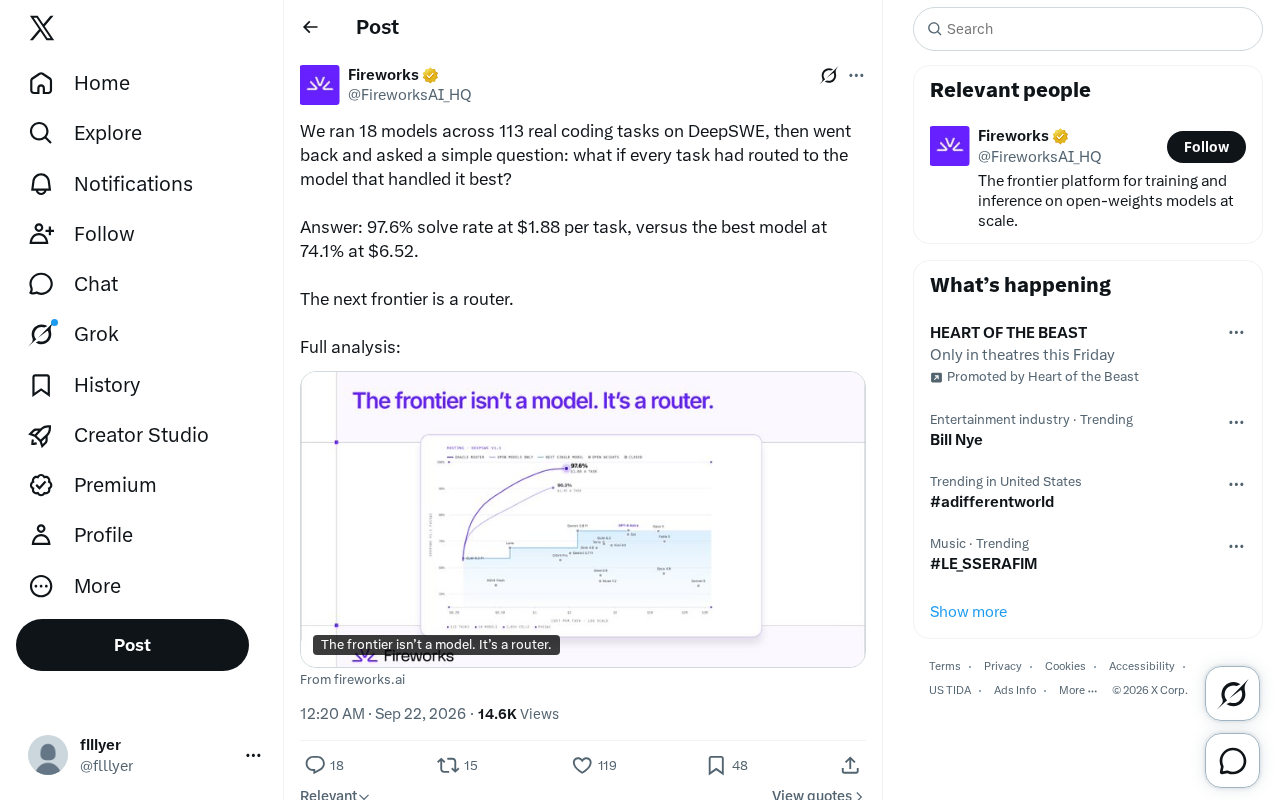
In other words, by selecting the right model for each task, the team not only boosted the solve rate by more than 23 percentage points, but also cut per-task costs to less than a third of what the top model required. These numbers reveal a truth that many overlook: no single model is the optimal choice across all coding tasks.
Why "One Best Model" Is a False Premise
The industry is obsessed with finding the "most powerful model" — as if identifying the one with the highest overall benchmark score would solve everything once and for all. But the data from this experiment tells a different story.
The best single model solved only 74.1% of tasks, meaning even the "strongest" model failed on more than one in four. Different tasks demand vastly different capabilities — some require long-context understanding, others complex logical reasoning, and still others prioritize code generation accuracy and speed. No single model is without weaknesses across all these dimensions.
The cost dimension is equally important. The most capable models are also typically the most expensive. Using them for every task is like using a sledgehammer for everything — wasteful in both directions. The $6.52 vs. $1.88 cost gap in this experiment is a direct reflection of the resource waste caused by a one-size-fits-all strategy.
DeepSWE is a coding benchmark specifically designed for software engineering scenarios. Its tasks are drawn from real GitHub issue resolution workflows, requiring models not just to generate code snippets, but to understand the codebase context, locate bugs, and submit working patches. Compared to classic benchmarks like HumanEval — which focus primarily on single-function completion — DeepSWE tasks more closely mirror real developer work and better expose differences in models' ability to handle long-context reasoning, multi-file coordination, and test validation. It is precisely because of this task diversity and complexity that capability gaps between models are so pronounced, making the gains from optimal model routing far greater than what simpler code generation benchmarks might suggest.
The Next Frontier: Smart Routers
The core conclusion of this analysis is clear — the next technical frontier is the router.
A router is a scheduling system that analyzes an incoming task, determines its nature, and automatically dispatches it to the most suitable and cost-effective model. The goal isn't to build a stronger monolithic model — it's to organize existing models into a coordinated ensemble where each one handles what it does best.
The data shows the potential upside is enormous: solve rates approaching 98% with significantly reduced costs. Of course, the 97.6% figure represents a theoretical upper bound — a kind of hindsight-perfect oracle that assumes you always know in advance which model will perform best on a given task. A real-world router must make accurate judgments before execution, which is itself a formidable challenge.
The Real Challenges Facing Routers
Bridging the gap between this theoretical ceiling and a practical system requires solving at least a few hard problems:
- Task classification accuracy: The router needs to assess a task's difficulty and type — without actually running it — in order to predict which model will perform best.
- The gap between prediction and actual performance: The 97.6% is a best-case ceiling. Real routing decisions will inevitably include mispredictions, and actual gains will be discounted accordingly.
- Balancing cost and latency: The routing decision itself carries computational overhead. Making good scheduling decisions without significantly increasing latency is a key engineering challenge.
The concept of a router isn't entirely new — in traditional software architecture, load balancers and API gateways have long handled analogous traffic distribution responsibilities. But AI routers face a fundamentally different challenge: traditional routing makes decisions based on quantifiable hardware metrics like CPU utilization and response time, whereas an AI router must understand the semantic nature of a task — is this an algorithmic reasoning problem or a code completion task? Does it involve long context? Does the output require extremely high precision? Early implementations are already emerging in the industry — for example, using small classifier models to pre-evaluate inputs (such as Meta's RouteLLM and Martian), or training routing policies on historical execution data. But these approaches commonly face a cold-start problem: without sufficient historical data, the router's own judgment quality is limited.
Implications for Developers and Teams
This data has direct practical value for teams building AI coding tools or agent systems. Rather than betting your entire budget on a single top-tier model, it's worth considering a multi-model architecture with a lightweight routing layer to dispatch tasks appropriately.
From a return-on-investment perspective, the appeal of routing lies in its ability to simultaneously optimize two goals that are typically in tension — quality and cost. Conventional wisdom holds that higher solve rates mean higher expenses, but this experiment suggests that with smart routing, you can have both.
One caveat: this analysis is based on 113 tasks from the DeepSWE benchmark, which is a limited sample size. The findings need validation at a larger scale before the conclusions can be considered universally applicable. But the direction it points to — shifting from "chasing the single strongest model" to "building intelligent multi-model scheduling systems" — is very likely to be a significant evolutionary path for AI-assisted coding in the near future. The full analysis has been published by the original team and is available for developers who want to dig deeper.
Related articles

ChatGPT Space Launches: Team Collaboration and New Pages Features Explained
ChatGPT Space is OpenAI's new team collaboration feature with Pages, real-time collaboration, and Slack/Google Drive sync. We break down its privacy design, multi-platform integration, and the full workflow from conversation to document.

Migrating Apache Spark UDFs to GPU Acceleration with AI Agents
NVIDIA developer blog explains how AI Agents rewrite Apache Spark UDFs for GPU acceleration, covering migration criteria, agent rewriting and verification workflows, plus pitfalls like result consistency and CPU-GPU transfer overhead.

Zed Editor v0.40.4-rc2 Released: Usage Credits Now Available Without Upgrading
Zed editor releases v0.40.4-rc2, allowing users to use usage credits for AI features without upgrading to a paid plan, lowering the trial barrier.