19-Year Game Vet Builds a Game End-to-End with Claude, Gets Post Removed by Community

A 19-year veteran used Claude Code and Unity MCP to build and ship a game on Steam in 5 weeks.
A developer with 19 years of experience used Claude Code to independently complete a small farming game in 5 weeks—from C# coding and art to marketing and a Steam launch. The core stack is Funplay MCP driving the Unity 6 editor, letting Claude inspect scenes, change values, screenshot, and playtest; art flows through Magnific, Tripo, and Blender with MCP scripts. A card-based runner automates nightly builds, tests, game-feel measurements, and gated merges, with marketing videos auto-captured and edited. The author stresses that design judgment stayed human, yet he was removed from several game dev communities for disclosing AI use.
A game developer with 19 years of experience recently shared on Reddit how he independently completed the entire pipeline of a small game in 5 weeks using Claude—from development and art to marketing and a Steam launch. But the post was removed from several game development subreddits because he proactively disclosed his use of AI.
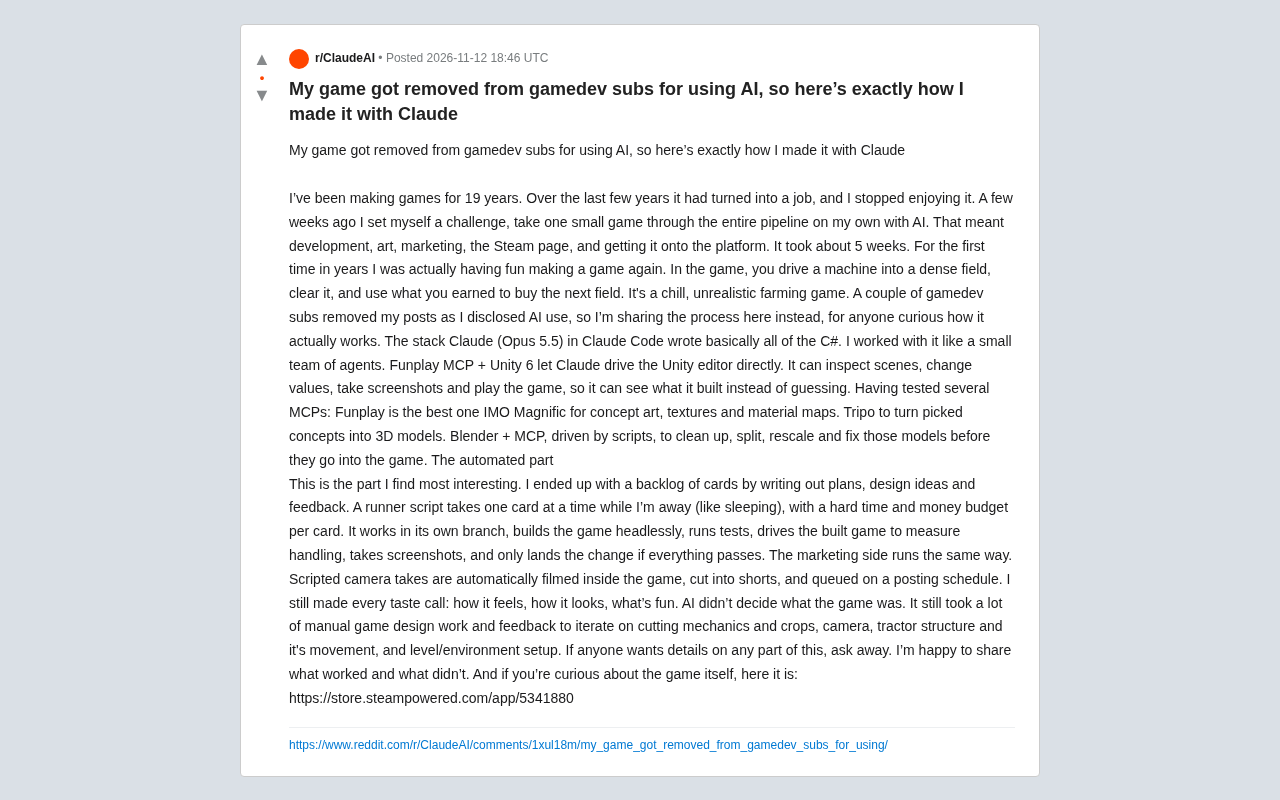
An Experiment to Rediscover the Fun
The developer admits that after nearly two decades of making games, the work gradually became a pure livelihood, and the fun had long since disappeared. A few weeks ago, he set himself a challenge: with the help of AI, take a small game through the entire pipeline solo.
The result is a chill, non-realistic farming game: players drive a machine into dense fields, clear crops, and use the earnings to buy the next plot of land. The whole project took about 5 weeks, and he says it's the first time in years he's genuinely enjoyed making a game.
The Tool Stack: Claude as Lead Programmer, MCP Connecting to the Engine
The core of the technical approach is Claude (Opus 5.5) in Claude Code, which handled almost all the C# code. The author compares his way of working to "commanding a small team of agents."
The key piece is Funplay MCP + Unity 6: Claude can directly drive the Unity editor—inspecting scenes, modifying values, taking screenshots, and even playtesting the game. This means it can "see" what it builds instead of guessing. After comparative testing of multiple MCPs, the author considers Funplay the best of them.
The art pipeline is equally automated end to end: Magnific handles concept art, textures, and material maps; Tripo converts selected concepts into 3D models; Blender paired with MCP uses scripts to clean up, split, scale, and fix assets before importing them into the game.
MCP (Model Context Protocol) is an open protocol introduced by Anthropic in late 2024 to establish standardized connections between AI models and external tools and data sources. You can think of MCP as "the USB-C port for AI": as long as an external system implements an MCP server, Claude can invoke its capabilities in a unified way without writing custom adapter code for each tool. In game development, an MCP server can expose the Unity editor's API—loading scenes, reading and modifying GameObject properties, triggering builds, capturing frames, and so on—and the model performs these operations through tool calls initiated over the protocol. This upgrades AI from "generating code text" to "directly operating the production environment," and it's the technical prerequisite for Claude being able to "see" its own build results in this story. Compared with the earlier approach of building custom plugins for each tool, MCP lowers integration costs and makes agentic workflows easier to reuse.
Automated Pipeline: The Game Iterates on Itself While You Sleep
The author considers automation the most interesting part. He writes plans, design ideas, and feedback onto cards in a backlog, and a runner script processes them one by one when he's away (such as while sleeping), with strict time and cost budgets set for each card.
Each card works on an independent branch: build the game in headless mode, run tests, drive the finished game to measure game feel, take screenshots—and only merge changes if everything passes. The marketing side follows the same philosophy—scripted in-game cameras automatically capture footage, which is edited into short videos and queued according to a publishing schedule.
"Headless mode" in this context means running Unity build artifacts or the editor via the command line without launching a graphical interface, commonly used in CI/CD pipelines. In headless mode, the program can still perform builds, load scenes, and run automated tests, but no window pops up occupying the desktop, making it suitable for unattended batch execution at night. Combined with the "independent branch" and "merge only if everything passes" gating strategy, this forms a typical continuous integration (CI) practice: each task card is equivalent to a commit, automated builds and tests act as quality gates, and AI changes are prevented from polluting the main branch without verification. Measuring "game feel" means quantifying subjective experience into comparable metrics (such as input latency, movement curves, and collision response), so automated scripts can make a pass or fail judgment.
AI Didn't Decide What the Game Is
The author emphasizes that all taste-level judgments were still his own: how it feels, how it looks, what's fun. AI did not determine the essence of the game. The cutting mechanic, crops, camera, tractor structure and movement, level and environment construction—all required substantial manual game design and feedback iteration.
That's the subtlety of the whole thing: AI took over execution, but design judgment remained human. And having his post removed by the community raises a question that has no answer yet—when disclosing AI use becomes grounds for expulsion, how should developers share an authentic account of their production process?
(See the original post link for the game's Steam page.)
Background
Claude Code is an agentic programming tool from Anthropic that runs in the terminal, capable of reading and writing project files, executing shell commands, running tests, and autonomously adjusting based on results. Unlike traditional code completion, it works in an "agent loop": receive a task → plan steps → call tools → observe output → continue correcting until the task is complete or a budget limit is reached. The metaphor of "commanding a small team of agents" in this story comes exactly from this—the developer provides high-level intent and constraints, and the agent breaks them down into concrete operations. The card-based backlog plus time and cost budgets effectively brings the agentic workflow into a project management framework, preventing any single task from ballooning indefinitely and making it easy to review the source and cost of each change afterward.
One-line Summary
A 19-year veteran developer used Claude Code and Unity MCP to independently build a game and ship it on Steam in 5 weeks.
Paragraph Summary
A game developer with 19 years of experience used Claude Code to independently complete a small farming game's entire pipeline in 5 weeks, from C# coding and art production to marketing and a Steam launch. The technical core is Funplay MCP driving the Unity 6 editor, letting Claude directly inspect scenes, change values, take screenshots, and playtest; on the art side, Magnific generates concepts and textures, Tripo converts them into 3D models, and Blender with MCP scripts handles fixes. He also designed a card-based runner script that automatically builds, tests, measures game feel at night, and merges branches only when everything passes, with marketing videos also auto-shot and edited from scripted footage. The author stresses that game feel and design judgment remained human, with AI only taking over execution. But he was removed from several game development communities for proactively disclosing AI use, sparking discussion about AI transparency and community acceptance.
Related articles

Abnormal Error Rate Spike in Claude Mythos 5.2 and Fable 5.2
Claude Mythos 5.2 and Claude Fable 5.2 show an abnormal spike in request error rates, marked as investigating on the official status page. This article covers the incident overview, practical impact on developers, and recommended responses.

ReAct Runtime Context Trimming: Why Claude Code Acts at 70%
A deep dive into ReAct runtime context trimming: why Claude Code compresses at ~70% usage, why tool calls dominate, why messages must be dropped in pairs, and why codebases don't need RAG.

AI Agent vs LLM: How Cursor and Claude Code Actually Work
An in-depth analysis of the essential difference between AI Agents and LLMs: LLMs generate code suggestions, while Agents modify files and run tests via tool calls. Using a Spring Boot bug fix as an example, it breaks down the workflows, permission control, and verification mechanisms of Cursor and Claude Code.