19-Year-Old AI Learner: How to Balance Passion and Employability?

How a 19-year-old AI enthusiast can balance deep learning passion with real-world employment pressure.
A 19-year-old who implemented a Transformer from scratch faces a classic dilemma: passion for deep learning and LLM architecture vs. the booming demand for AI Engineering roles. This article clarifies the difference between the two career paths, argues that deep research skills are actually more automation-proof, and offers a concrete one-month action plan for landing an internship without sacrificing long-term passion.
A Real Dilemma: When Passion Meets Reality
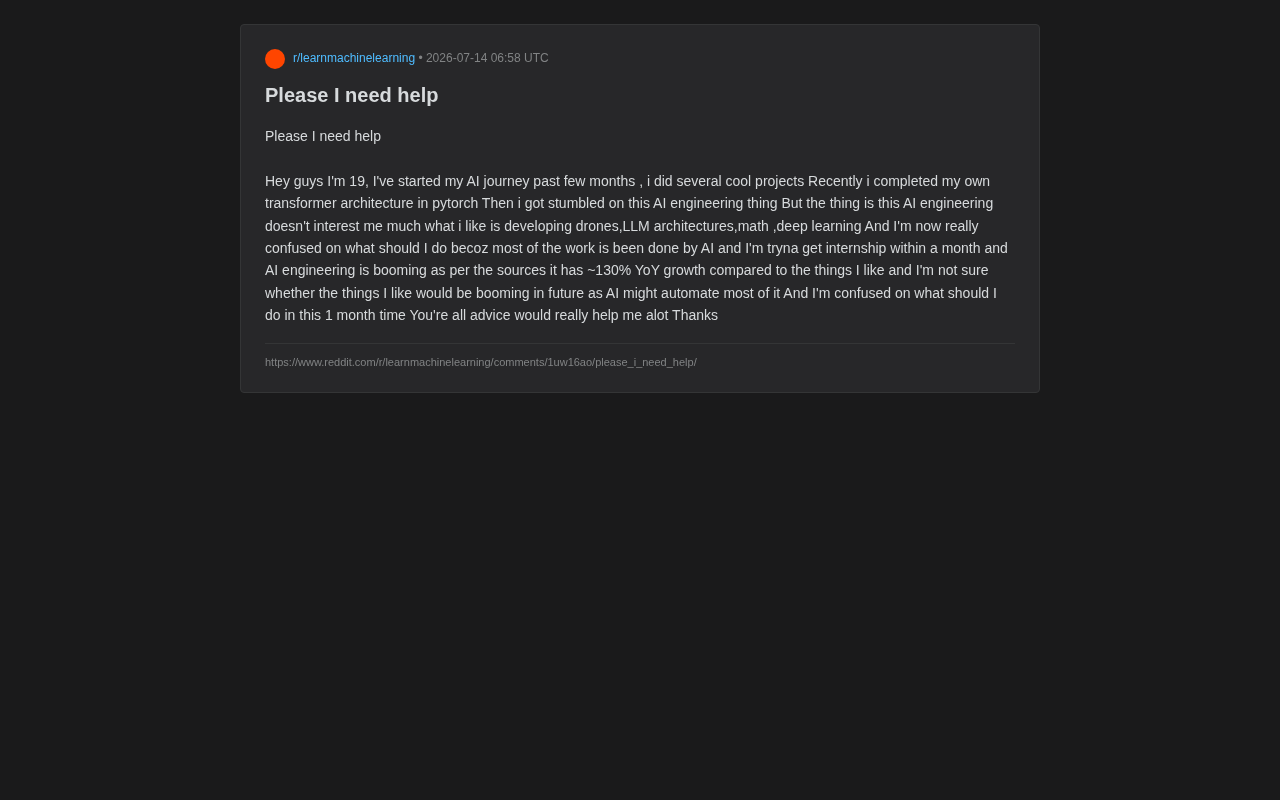
I recently came across a help post from a 19-year-old on Reddit. Short but remarkably relatable. Over the past few months, he had embarked on his AI learning journey, completed several solid projects, and even implemented his own Transformer architecture from scratch in PyTorch — quite impressive for someone just a few months in.
What does it mean to implement a Transformer from scratch? The Transformer is a deep learning architecture introduced by Google in the 2017 paper Attention Is All You Need, which revolutionized natural language processing. Its core innovation — the Self-Attention mechanism — allows the model to dynamically focus on different positions in a sequence, overcoming the vanishing gradient problems that plagued RNNs and LSTMs on long sequences. Implementing it from scratch in PyTorch means hand-coding multi-head attention, positional encoding, feed-forward networks, and other core components. This is crucial for understanding the inner workings of modern large language models like GPT and BERT — which is exactly why it's a highly valuable line on any résumé.
But he found himself caught in a classic dilemma: his true passions are drone development, LLM architecture design, mathematics, and deep learning — yet the job market is booming for "AI Engineering," reportedly growing at around 130% year-over-year. He worries that his preferred direction might eventually be automated away by AI, while simultaneously needing to land an internship within a month.
This question reflects an anxiety shared by countless job seekers in the AI era. This article breaks it down across three dimensions: career paths, skill value, and actionable strategy.
AI Engineering vs. Deep Learning Research: Understanding the Two Paths
Two Very Different Roads
Many beginners conflate "AI Engineering" with "AI Research/Modeling," but the day-to-day work is vastly different.
AI Engineering operates at the application layer: calling LLM APIs, building RAG systems, designing agent workflows, doing prompt engineering, and deploying and optimizing inference services. It demands strong systems engineering skills but relatively less grounding in underlying mathematics and model internals. The reason it's growing so fast is simple — countless companies need to actually ship AI into their products.
A deeper look at RAG systems: RAG (Retrieval-Augmented Generation) is one of the most widely adopted paradigms for enterprise AI deployment today. It combines an external knowledge base (storing semantic vector representations of text in a vector database) with a large language model, enabling the model to generate more accurate answers based on retrieved, relevant documents — effectively reducing LLM hallucinations. A typical AI engineering stack includes: LangChain/LlamaIndex (orchestration frameworks), Pinecone/Weaviate/Chroma (vector databases), vLLM/TGI (high-performance inference servers), and structured Prompt Engineering methodologies. Together, these tools form the "last mile" that converts raw model capabilities into real product features — relatively accessible to learn, yet in extremely high demand.
AI Research / Deep Learning Modeling, on the other hand, works at the foundational level: designing new model architectures, improving training methods, studying attention mechanisms, and optimizing loss functions. This path demands strong mathematical foundations and a deep understanding of model internals — which is exactly what this young person is genuinely excited about.
Deep Research Is Actually More "Automation-Proof"
Here's a paradox worth sitting with: this person worries that "LLM architecture, mathematics, and deep learning" will be automated away — but the reality is quite the opposite. The more a role demands deep creativity and fundamental breakthroughs, the harder it is to replace.
AI can help you write glue code that calls an API, but it can't design the next-generation Transformer replacement architecture for you. Take Mamba and RWKV as examples: Mamba (2023, Carnegie Mellon University) is based on State Space Models (SSMs) and reduces computational complexity from Transformer's O(n²) to near-linear on long-sequence tasks; RWKV fuses the linear inference efficiency of RNNs with the parallel training capability of Transformers. These kinds of architectural innovations require deep knowledge of linear algebra, differential equations, and information theory — the hallmark output of deep research, far beyond what API calls can touch. Genuine architectural innovation and mathematical modeling are the "high ground" that AI struggles most to reach. Ironically, it's the highly standardized, repetitive application-layer engineering that is more likely to be significantly accelerated — or partially replaced — by AI tooling in the future.
Breaking Through in Reality: How to Land an Internship in One Month
Passion and Employability Aren't Opposites
The most important advice for this young person: don't treat passion and employment as an either/or choice.
His core strengths — implementing a Transformer from scratch, solid mathematical foundations, and genuine enthusiasm for deep learning — are precisely the rare capabilities that many AI engineering roles desperately want. Someone who understands the fundamentals and can ship things in production is far more competitive than a pure "API glue engineer," and far harder to replace.
A Practical One-Month Game Plan
For the urgent goal of landing an internship within a month, here's a concrete approach:
First, polish your passion projects into portfolio pieces. A hand-coded Transformer is outstanding résumé material. Turn it into a complete open-source project with a clear README, training curves, and a technical blog post, then publish it on GitHub. That's far more persuasive than vaguely claiming you "know AI engineering."
Second, quickly fill in engineering gaps. Given the strong demand for AI engineering, it's worth learning a few practical skills alongside your research interests: LangChain/LlamaIndex, vector databases, model deployment (vLLM, ONNX), and basic full-stack skills. These let you "walk on two legs" in interviews.
Third, target hybrid roles. Don't only chase pure research positions (which typically require a master's or PhD). Instead, look for roles like "Research Engineer" and "Applied Scientist" — positions that bridge modeling and deployment.
What makes these roles special? Applied Scientists and Research Engineers are key roles that tech companies created to bridge the research-engineering gap. At companies like Amazon and Meta, Applied Scientists are expected to both publish papers and drive models into production; Research Engineers focus on translating cutting-edge algorithms into scalable systems — optimizing training infrastructure, implementing CUDA kernels for novel attention mechanisms, and so on. These roles sit mathematically between pure engineering and pure research, are often open to bachelor's-level candidates, and typically pay more than standard AI engineering roles. They're an ideal entry point for deep learning enthusiasts.
Drone and robotics companies hiring for perception/algorithm roles are also worth prioritizing — which aligns perfectly with his existing interest in drones.
Drones × Deep Learning: An underrated niche. The intersection of drone development and deep learning is a rapidly growing subfield, spanning computer vision (object detection and tracking), SLAM (Simultaneous Localization and Mapping), reinforcement learning (autonomous flight control), and edge inference optimization (deploying neural networks on resource-constrained flight control chips). Key application areas include military reconnaissance, agricultural monitoring, logistics delivery, and industrial inspection. Algorithm engineers in this space typically need both embedded systems knowledge and deep learning modeling ability — a classic "T-shaped" skill profile. Because such candidates are rare, competition is relatively mild, and the work is clearly differentiated from pure software AI engineering.
A Few Words for All AI Beginners
Don't Let "Growth Statistics" Dictate Your Career
"130% year-over-year growth in AI Engineering" sounds enticing, but career choices shouldn't just chase short-term trends. Trends shift; deep capability and genuine passion are long-term moats. People who lack enthusiasm for a field rarely reach the top of it — and top performers are always scarce, always in demand.
At 19, Time Is Your Greatest Asset
Finally, a word directly to this young person: you're 19, and you've already accomplished things that many four-year CS students haven't. The anxiety you feel right now is, in some ways, a good sign — it means you're thinking seriously about your future.
But remember: a career isn't a one-time bet, it's a continuously evolving journey. You can absolutely enter the field through an AI engineering role, build experience and connections, then gradually move toward the research direction you love. Or you can go deep in a cross-disciplinary space like drones or robotics and carve out a path no one can easily replicate.
There's more than one road — and you have the most valuable thing of all: time and passion. Don't let short-term employment anxiety extinguish the curiosity that will carry you furthest.
Key Takeaways
Related articles

Felix Rieseberg Personal Homepage
Felix Rieseberg's personal homepage sparks attention on Hacker News. This article covers the Slack engineer's technical background, the rise and fall of nativefier, and the value of a developer homepage as a tech calling card.

@ai-sdk/vue 3.0.306 Patch Release Syncs with [email protected] Update
@ai-sdk/vue 3.0.306 released, synced with [email protected]. A routine patch release for the Vercel AI SDK ecosystem with no public API changes; the Vue adapter layer stays version-aligned with the core package.

Gemini 4 Argon API Launches: The Era of Million-Token Output Begins
Google launches Gemini 4 Argon with sparse MoE architecture, up to 1M output tokens, and a 68.90% Vals Index score, available across API, AI Studio, and the Gemini app.