19-Year-Old Builds AI Video Editing SaaS With Zero Code, Hits $11K MRR

19-year-old with zero coding experience builds $11K/month SaaS with AI tools in 5 months.
This article tells how 19-year-old Vadim, with no programming experience, used AI coding tools like Lovable, Claude, and Codex to build AI video editing platform Vugola in about five months, reaching over $11,200 MRR with ~400 paying users. It breaks down three paths: his mindset shift and market opportunity discovery, his Vibe Coding tech stack evolution from Lovable to Codex, and his 45-minute daily Instagram strategy posting 3-6 pieces of content by replicating proven viral UGC formats with a $15/month ManyChat subscription. His core advice: simplify everything and cut at least half your effort.
A 19-year-old with no programming experience built a SaaS product with over $11,000 in monthly recurring revenue (MRR) in five months using AI tools. The protagonist of this story is Vadim, and his product Vugola is an AI video editing platform that automatically turns long videos into short clips optimized for social media distribution. In an interview with Starter Story, he broke down the entire journey from zero to five figures in monthly revenue.

From Selling Lemonade to Building SaaS: The Starting Point of a Serial Entrepreneur
Vadim's entrepreneurial drive didn't start with the AI wave. From selling lemonade and slime in elementary school to working at a local marketing startup in high school, he was always looking for ways to make money. At 17, he made a bold decision — he quit his job and went all-in on building web apps, even though he had no idea how to code at the time.
Behind that decision was a "burn the boats" mentality. Vadim admits he deliberately cut off his escape routes to force himself to keep going down the entrepreneurial path. What actually sparked the idea for Vugola was an everyday "doomscrolling" experience: he noticed that no matter how much he scrolled through social media, he kept seeing the same thing — podcast clips, gaming highlights, and livestream cutdowns. That observation made him realize that video editing and clip creation was already a proven, massive market that would only keep growing.
His reasoning was straightforward: since market demand was already validated, he only needed to capture a small slice of users to generate meaningful revenue. Rather than hesitate, he figured he should get in before the trend exploded even further.
MRR (Monthly Recurring Revenue) is one of the most core metrics in the SaaS industry. It refers to the total subscription revenue a product earns from all paying users in a given month that is expected to continue recurring. It differs from one-time transaction revenue or project-based revenue in that it emphasizes "repeatability" and "predictability." For subscription-based software products, the scale of MRR directly reflects product-market fit and the quality of user retention. Investors typically estimate SaaS company valuations as multiples of MRR, with early-stage projects commonly valued at 3 to 10 times annualized revenue. Vadim's product reaching $11,200 MRR means an annual recurring revenue (ARR) of approximately $134,000, which has crossed the threshold of "initial market validation" — an important reason why this case is considered worth studying.
Zero-Code Development With AI Tools: The Tech Stack From Lovable to Codex
Vadim's development path perfectly embodies the typical characteristics of "Vibe Coding." He initially used Lovable — a platform best understood as a code wrapper — and spent about four months trying to build Vugola. Along the way, he learned how to build products by watching YouTube tutorials and asking Claude questions, and he discovered tools like GitHub and Supabase.

His tech stack migration path was: starting with Lovable, moving to Claude, and finally landing on Codex. Vugola currently runs on Codex, GitHub, Supabase, Vercel, Cloudflare, PostHog, DataFast, and AWS. AWS plays the core infrastructure role for video rendering.
The overall development timeline was roughly: product idea in October, four months of building, and launch to market about five to six months ago. This combination shows that today's AI coding tools have dramatically lowered the barrier to "who can be a Builder" — even without a traditional programming background, you can complete product development with AI assistance.
"Vibe Coding" was coined by AI researcher Andrej Karpathy in early 2025. It refers to a way of working where developers describe requirements to large language models in natural language, and the AI generates code, with the developer primarily playing the role of "describing intent — validating results" rather than writing code line by line. Typical tools in this category include platforms like Lovable, Bolt, and v0 that can directly generate working front-end applications, as well as general-purpose code generation models like Claude, GPT, and Codex. The rise of this paradigm has significantly lowered the barrier to entry for software development, enabling people without computer science backgrounds to build and launch products. But it also has clear boundaries: debugging complex logic, handling concurrency and security, and controlling infrastructure costs still require strong engineering judgment. Therefore, Vibe Coding reduces the cost of going "from idea to working prototype" rather than fully replacing engineering capability.
Growth Secrets: A 45-Minute Daily Instagram Content Strategy
Vadim's most notable growth methodology is neither paid advertising nor sophisticated technical growth hacking — it's an extremely simple content operation process. He breaks this method down into five steps:
Step one: Create a brand-new Instagram account paired with a ManyChat subscription (about $15/month). Step two: Spend an entire day deep-diving into "scrolling," systematically analyzing competitors' viral formats, UGC ad campaigns, and collaborating creators. Step three: Break down and replicate these proven content formats — including hook duration (3 seconds or 4 seconds), demo length, CTA pacing, and the audio and transition effects used. He films himself on camera, applying the exact same templates and just swapping in content for his own product.
Step four: Post 3 to 6 pieces of content on Instagram every day. His new UGC account accumulated over 10,000 followers within a few months, with individual video views ranging from 18,000 to 132,000. Step five: Keep scrolling to track new content trends, and immediately pivot to the next hot format once one gets oversaturated.
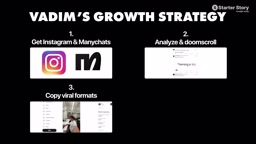
One detail worth noting: the core insight of this method is that the demo and CTA of viral UGC formats can be almost entirely reused — the only things that truly need to change are the hook and the audio. Once you find a proven hook format, you can mass-produce content around it until that format saturates.
Vadim emphasizes that for consumer-facing (B2C) founders, this strategy costs almost nothing. Aside from the $15 ManyChat subscription, filming, editing, and posting are all free. Rather than spending money on various subscription tools, he advocates that founders create content themselves, batching it daily in just 30 to 45 minutes.
UGC (User-Generated Content) ads in the context of short-video advertising specifically refers to product showcase or recommendation videos filmed by non-professional actors from a "regular person's perspective." Compared to traditional polished ads, UGC content tends to have higher completion rates and click-through rates because it feels closer to real user experience, making it the mainstream creative format for DTC brands and consumer apps during the cold-start phase. ManyChat is an automated chatbot tool built on platforms like Instagram and WhatsApp. Creators commonly use it to automatically convert comment keywords into DM replies with product links attached, thereby funneling public content traffic into private-domain leads. This is precisely the key to how Vadim runs the "content exposure — DM outreach — registration conversion" funnel for just $15/month.
The Product Itself: How AI Video Editing Works
Vugola's product logic isn't complicated. After users paste a YouTube link into the dashboard, the system automatically pulls the video and generates clips. Users can choose different subtitle styles and aspect ratios (the most commonly used being the 9:16 vertical format), then start editing. Once processing is complete, the videos appear in a list.

Vugola is currently testing a Beta version of an agentic video editor that allows users to complete end-to-end video editing directly within the platform. Vadim positions Vugola as a combination of "editing tool + AI editor," targeting editors, content creators, marketing agencies, and long-form video brands. According to him, the product has accumulated tens of thousands of registered users over the past four to several weeks, with about 400 paying users contributing approximately $11,200 in monthly recurring revenue.
The 9:16 vertical format is the default display ratio for mainstream short-video platforms like Douyin, TikTok, Instagram Reels, and YouTube Shorts, and it's the core aspect ratio for content distribution today. Compared to the traditional 16:9 horizontal format, vertical video better fits the viewing habits of one-handed phone use and can drive higher completion rates. For tools like Vugola that automatically cut long videos into short clips, outputting 9:16 isn't just about cropping the frame — it also involves technical challenges like intelligently tracking the speaker, dynamic reframing, and avoiding subtitle safe zones. Subtitle styles (font, stroke, word-by-word highlighting) are also proven retention variables, so products typically offer multiple templates for users to choose from to match different creators' content styles.
Minimalist Philosophy: Core Advice as a Solo Founder
At the end of the interview, Vadim gave his most important advice: simplify everything. Whether it's writing code, building products, or doing marketing, he believes you can cut at least half of the time and effort you put in.
His logic: in the AI era, a solo founder's greatest asset is time. The simpler and more understandable the product, the easier it is for users to grasp, and the higher the revenue. This philosophy runs through his entire entrepreneurial journey — build products with the simplest tools, acquire users in the most straightforward way, and maintain operations with minimal spending.
From a broader perspective, Vadim's case reflects a structural shift that is currently underway: AI coding tools are redefining "who can be a Builder." If you're a marketer, or someone with a non-technical background who has always wanted to build a software product, AI has made it entirely feasible. And the fact that Vadim leverages 45 minutes of daily content operations into five-figure monthly revenue also shows that in today's landscape, execution — not resources — may be the scarcest element in early-stage growth.
One-line Summary
A 19-year-old with zero coding experience used AI tools to build a $11K/month SaaS product in 5 months.
Paragraph Summary
This article tells the story of 19-year-old Vadim, who — with no programming experience whatsoever — used AI coding tools like Lovable, Claude, and Codex to build an AI video editing platform called Vugola in about five months, reaching over $11,200 in monthly recurring revenue with roughly 400 paying users. The article breaks down three key paths: first, his mindset shift from selling lemonade to going all-in on entrepreneurship, and the market opportunity he spotted from the everyday observation that "social media is all clips"; second, his "Vibe Coding" tech stack evolution from Lovable to Codex, built on infrastructure like GitHub, Supabase, Vercel, and AWS; third, his strategy of spending 45 minutes daily posting 3 to 6 pieces of content on Instagram, replicating competitors' proven viral UGC formats and leveraging a $15/month ManyChat subscription to drive organic traffic. He concludes with his core advice for solo founders: simplify everything and cut at least half of your effort.
Related articles

How Big Can Stars Really Get? The Physical Limits of the Largest Stars
Red supergiants are the largest stars by volume, with radii up to 2,000 times the Sun, engulfing the inner solar system. But there is no precise upper limit on stellar size—models predict up to 15,000 solar radii. The most massive blue stars are far smaller than red supergiants—biggest and heaviest are two different things.

Apple HomeView Smart Display Full Feature Breakdown: Wall-Mount or Desktop, $299
Apple launches HomeView, a $299 smart display with wall-mount and desktop options, 12MP camera for facial recognition, smart home control, music playback, and recipe step-by-step cooking. Full breakdown of watch faces, apps, privacy, and cooking integration.

Where Did the Promised New Studio Go? Craft Computing Answers After Five Years
Craft Computing's host responds to viewer questions: the new studio promised five years ago was shelved as construction costs soared from $30,000 to $75,000, and was replaced by a 168-square-foot garage conversion.