195M-Step CS:GO Multi-Agent Dataset Open-Sourced: A New Testbed for Imitation Learning

195M-step CS:GO 10-agent dataset open-sourced for imitation learning and multi-agent research.
cs-5v5-bots is a large-scale game behavior dataset designed for reinforcement and imitation learning research, containing 195M timesteps across 9,515 CS:GO bot matches (~3,958 hours). Sampled at 16 Hz, each timestep records actions, state, and who-hit-whom damage labels; 14% of matches include per-frame aligned first-person video from all ten agents. The deliberately narrow setup — expert bots, single map, pistols only — prioritizes algorithmic benchmarking over human gameplay realism. Data is provided in Parquet and webdataset formats on Hugging Face under CC BY-NC 4.0.
A Dataset Built for Imitation Learning and Multi-Agent Research
A core pain point in reinforcement learning and imitation learning research has long been the lack of behavioral data that is large enough in scale, complete enough in annotation, and controllable enough in noise. Recently, a new dataset called cs-5v5-bots was published on Reddit's reinforcement learning community, aiming to fill this gap. The dataset contains 195 million timesteps of 10-agent CS:GO state-action data, complete with damage labels, and is freely available for research use.
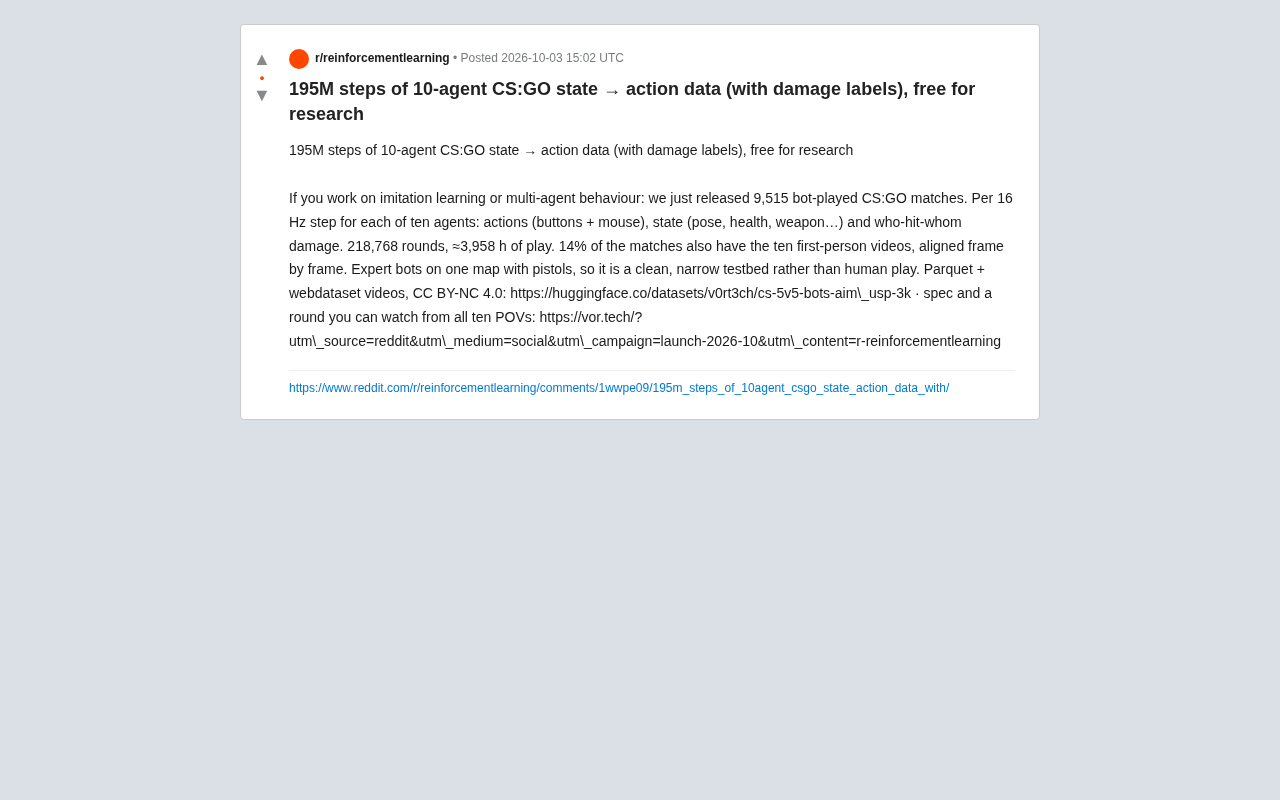
The publisher, v0rt3ch, positions it as a clean, narrow testbed rather than a faithful recreation of human gameplay. This framing itself reveals the design intent — rather than capturing the complexity and unpredictability of real player behavior, it provides a controlled, reproducible environment where researchers can focus on the algorithms themselves.
Data Scale and Collection Details
The dataset is substantial in size. Key figures include:
- 9,515 bot matches
- 218,768 rounds
- Approximately 3,958 hours of gameplay
- Each agent sampled at 16 Hz
For each of the ten agents, every timestep records three types of information: actions (key inputs + mouse movement), state (pose, health, weapon, etc.), and who-hit-whom damage labels. This fine-grained damage attribution annotation is uncommon among similar game behavior datasets, and it provides direct supervisory signals for studying adversarial multi-agent interactions, credit assignment, and related problems.
Notably, 14% of matches also include ten first-person perspective videos with per-frame alignment. This means researchers have access not only to structured state-action data, but can also correlate it with raw visual input — offering rare multimodal material for visual imitation learning, end-to-end training from pixels to actions, and similar directions.
Credit Assignment is a classic challenge in multi-agent reinforcement learning: when multiple agents collaborate to complete a task, how do you decompose and attribute the final team reward to the specific actions of each individual? For example, in a coordinated team kill, does the agent that initiated the push deserve more credit, or the one that provided cover? Traditional methods often rely on global reward signals for vague attribution, leading to low training efficiency. The who-hit-whom damage labels directly provide fine-grained individual behavioral outcomes — every attack by every agent has a clearly recorded consequence — offering a natural supervisory signal for credit assignment that can significantly reduce variance in multi-agent training and accelerate policy convergence.
Why "Narrow Domain" Instead of Real Matches
The dataset's collection setup is explicit: expert bots, a single map, pistols only. This deliberately narrowed configuration is an important design decision.
Human match data may be more representative of real-world applications, but it is often full of hard-to-model noise — fluctuating skill levels, irrational decisions, network latency. Expert bots operating under fixed rules behave more consistently and predictably, making the dataset an ideal algorithmic benchmarking environment. Researchers can validate the effectiveness of imitation learning or multi-agent collaboration algorithms in a relatively controlled setting before generalizing to more complex scenarios.
This trade-off also means users need to be clear about its boundaries: models trained on this data are bounded by the behavioral patterns of expert bots, not the creative strategies of human players. It is better suited as a "clean test range" for methodological validation than as a training set for direct transfer to production AI.
Behavior Cloning is the most fundamental approach in imitation learning: treating expert demonstrations as a supervised learning problem, training a policy network directly with states as input and actions as labels. Its core weakness is "compounding errors" — once an agent deviates from the training distribution, subsequent errors accumulate and amplify. Inverse Reinforcement Learning (IRL) takes a different path: instead of directly copying actions, it infers the underlying reward function from expert behavior, then optimizes a policy based on that reward function — theoretically offering stronger generalization. Both approaches are highly sensitive to data quality. Noisy human match data causes behavior cloning to learn incorrect patterns and prevents IRL from accurately reconstructing reward signals. The value of a narrow-domain bot dataset lies precisely in its highly consistent behavior and controllable noise sources, allowing researchers to cleanly separate algorithmic flaws from interference caused by data noise.
Data Format and Open License
On the engineering side, the dataset has also been designed with usability in mind. Structured data is provided in Parquet format for efficient reading and large-scale processing; videos use webdataset format, compatible with modern deep learning data loading pipelines.
The dataset is licensed under CC BY-NC 4.0 — attribution required, non-commercial use only. This license is quite friendly for academic research and non-commercial experimentation, though those with commercial applications should be mindful of its restrictions. The dataset is hosted on Hugging Face (v0rt3ch/cs-5v5-bots-aim_usp-3k), and the publisher also provides full specifications and a round example viewable from all ten perspectives at vor.tech.
Parquet is an open-source columnar storage format maintained by the Apache Foundation. Compared to traditional row-oriented formats like CSV, columnar storage only needs to scan the relevant columns when reading specific fields, dramatically reducing I/O overhead, and it features built-in efficient compression — making it ideal for storing time-series state-action data with a fixed number of columns and an extremely large number of rows. webdataset is a data format designed for large-scale deep learning training, packing large numbers of small files into tar archive streams that support streaming reads and deep integration with PyTorch DataLoader, enabling efficient loading of video frame sequences in multi-GPU distributed training scenarios while avoiding filesystem bottlenecks caused by massive numbers of small files. The choice of these two formats together reflects careful consideration of engineering practice.
Research Directions It Can Support
Overall, the value of this dataset is most apparent across several research directions:
Imitation Learning: Large-scale, high-frequency trajectory data with complete action annotations is precisely the core resource needed for behavior cloning and inverse reinforcement learning.
Multi-Agent Behavior Modeling: Ten agents competing on the same map, combined with damage attribution labels, provides structured samples for studying collaboration, adversarial dynamics, and interaction between agents.
Multimodal Learning: The 14% subset with per-frame aligned video makes end-to-end learning from visual input to control actions possible.
Of course, the dataset's limitations are equally clear — its narrow-domain design means it leans toward method validation rather than general capability training. But for researchers who need a clean, large-scale, fully annotated benchmarking platform, it offers a compelling starting point.
Related articles

Chain of Thought Isn't Just for AI: How Humans Can Use CoT to Improve Thinking Quality
Chain of Thought isn't just a prompt trick for large models. Starting from a Hacker News discussion, this article analyzes why CoT works for human thinking too, breaks down actionable ways to transfer it, and highlights the key differences between human CoT and machine CoT.
Cloudflare Teams Up with OpenAI: Closi…
Cloudflare Teams Up with OpenAI: Closing the Loop from Vulnerability Discovery to Defense with AI
Cloudflare uses OpenAI Daybreak to investigate security vulnerabilities and generate reviewable remediation plans, while developers use Codex to boost coding efficiency and quality.

Orca Multi-Agent Orchestration in Practice: A Guide to Parallel Collaboration with Claude and Codex
Orca is Stable AI's free open-source agent workbench supporting 34 agents like Claude Code and Codex in parallel. Learn its Git worktree isolation, multi-model orchestration, and mobile management.