1X NEO Robotic Hand and GPT-5.6: A Full Breakdown of Dual Breakthroughs in Robot Hardware and Software

1X's new NEO robotic hand and OpenAI's GPT-5.6 signal synchronized breakthroughs in robot hardware and AI software.
1X unveiled a tendon-driven robotic hand for its NEO humanoid with 25 DOF, force transparency, and tactile skin that self-labels manipulation data—cutting embodied AI's costliest bottleneck. OpenAI simultaneously launched the three-tier GPT-5.6 (Saw, Terra, Luna), improving coding and cost-per-dollar intelligence. Hardware and AI brains are evolving in tandem.
1X Releases New Hand for the NEO Robot: Redefining Mechanical Dexterity
Recently, One X Technologies (1X) unveiled a new robotic hand for its NEO humanoid robot, which the company calls "the most advanced robotic hand ever made." Behind this claim lies a systematic breakthrough addressing longstanding bottlenecks in traditional robotic hand design.
The new hand employs a tendon-driven design—a mechanical architecture that mimics how biological tendons transmit force, pulling joints via thin wires, steel cables, or artificial tendons from motors located at a distance. The history of tendon-driven design traces back to biomimetic robotics research in the 1980s: early researchers at Stanford University and MIT, inspired by human anatomy, discovered that human hands achieve both strength and fine control precisely because the muscles controlling the fingers are mostly located in the forearm, driving the fingers remotely through tendons spanning tens of centimeters. This "remote motor" design fundamentally solves the problem of an overly heavy end effector.
Understanding the engineering challenges of tendon drives requires appreciating the inherent trade-offs between its two main implementation approaches. The cable-and-pulley approach is compact and has high force density, but the Coulomb friction of the pulley system accumulates with the wrapping angle, and steel wire suffers from metal fatigue under repeated bending, causing transmission precision to gradually drift over long-term use. The artificial muscle approach (such as pneumatic McKibben contractile muscles) inherently possesses elastic compliance, with a force output curve closer to biological muscle, but the volume constraints and nonlinear control of compressed gas make it difficult to integrate into lightweight commercial platforms. Compared with direct gear drive, tendon drives concentrate motor mass at the wrist or forearm, drastically reducing inertia at the hand's extremities, making movements lighter and faster. Earlier research systems such as the Shadow Robot and MIT Dexterous Hand adopted similar principles, but were mostly confined to the lab. The core obstacle lay in the engineering contradiction between tendon durability and millimeter-level transmission precision—the thinner and more flexible the tendon, the better the precision but the shorter the lifespan; thickening the tendon introduces excessive backlash. By pushing tendon drive into commercial mass production, 1X signals a key engineering breakthrough in resolving this contradiction, marking an important milestone for this technical approach.
The hand boasts 25 Degrees of Freedom (DOF), with 22 distributed across the fingers and palm and 3 in the wrist. DOF is a core metric measuring the independent dimensions of motion in a mechanical structure—the human hand has about 27 DOF, while traditional industrial robot grippers typically have only 1-2 DOF, capable of picking up objects but not performing fine manipulation. A design with 25 DOF approaches that of a human hand, but the key is not just the number—it's whether each DOF can be accurately sensed and independently controlled. 1X claims its dexterity can "meet or exceed human-level performance," but the real highlight is not the number of joints, but what these joints can actually "sense."
From "Command Output" to "Force Transparency"
Most traditional robotic hands have only command output—after a command is issued, the hand executes the motion but cannot provide feedback on grip force or information about the object being touched. This is largely a byproduct of the gear ratio: typical robotic hands use gear ratios of 100:1 or even higher, and friction absorbs the contact force before it can be transmitted back to the motor.
Understanding this requires knowing the physics of gear ratios. The gear ratio determines the trade-off between the amplification of motor output torque and the speed of motion. A high gear ratio of 100:1 means the motor must turn 100 times to drive the joint through one rotation; torque is amplified 100-fold, but so is friction, making it nearly impossible for externally applied force to transmit back to the motor—this is known as being "non-backdrivable." The result is a hand like one wearing a thick glove: able to push objects but unable to sense feedback from them.
The 1X hand reduces the gear ratio to roughly 5:1 to 15:1—low enough that every joint can be backdriven. From the perspective of control theory, this falls under Impedance Control—a concept introduced by MIT's Neville Hogan in 1985: traditional position-controlled robots respond to external disturbances with "infinite stiffness" (i.e., resisting any force that deviates from the target position), whereas impedance control models the robot's end effector as a spring-mass-damper system with adjustable stiffness, damping, and inertia, allowing the robot to dynamically switch between "compliant" and "rigid" as the task demands.
From a physical mechanism standpoint, there are two paths to achieving impedance control: the Series Elastic Actuator (SEA) inserts an elastic element between the motor and joint, inferring torque by measuring elastic deformation, trading some bandwidth for precise force sensing; while low-gear-ratio direct drive relies directly on a highly efficient transmission chain, reflecting end-effector forces as motor current changes with almost no loss. In high-gear-ratio systems, excessive friction "drowns out" the torque signal within the transmission chain's friction, making it unable to faithfully reflect end-effector forces; in low-gear-ratio systems, the high transmission efficiency allows the torque signal to reach the motor with virtually no loss, making fine impedance control possible. This also explains why the new generation of robots—such as Boston Dynamics' Atlas and MIT's Mini Cheetah—can fall on complex terrain without damaging their joints: compliant impedance control lets them "overcome hardness with softness." 1X calls this property "Force Transparency." Beyond this, each joint continuously tracks its own position, enabling what is called "proprioception"—the hand can sense its own posture without any camera.
Tactile Skin Fills the Visual Blind Spot
On top of joint sensing, the hand's tactile skin provides another layer of perception. Tactile sensing is widely recognized in robotics as "one of the hardest human senses to replicate"—human skin has roughly 2,500 receptors per square centimeter, divided into four types: Meissner's corpuscles (sensing light touch and texture), Merkel discs (sensing sustained pressure and fine shapes), Pacinian corpuscles (sensing vibration), and Ruffini endings (sensing skin stretch). This multimodal system allows humans to distinguish silk from sandpaper without looking at their hand.
Current engineering implementations mainly follow three approaches, each with its own trade-offs: piezoresistive sensing uses conductive rubber or carbon nanotube composites, mapping force to resistance changes under pressure; it is the cheapest and can cover large areas, but suffers from noticeable hysteresis and creep, with zero drift accumulating over long-term use. Capacitive sensing measures capacitance via changes in the spacing between conductive layers, offering fast response and high sensitivity, but it coexists with the robot's motors and drive circuitry in a dense electromagnetic environment, making shielding design extremely complex. Optical tactile sensing (such as MIT's GelSight series) places a transparent elastic gel over a camera, reconstructing 3D contact topography from changes in light reflection on the gel surface; it achieves sub-millimeter spatial resolution, but the sensor's size and weight limit its integration density at the fingertip.
The fingertip sensors can measure force, contact location, and shear force—shear force refers to force parallel to the contact surface, which together with perpendicular pressure (normal force) constitutes complete contact information. When a finger grips an object, shear force reflects the object's tendency to slide relative to the finger surface, serving as a key signal for judging "about to drop." Meissner's corpuscles in human skin sense such rapidly changing tactile information, enabling us to hold objects stably without looking at our hand. 1X claims its sensors are sensitive enough to react before an object begins to slip and fall—this requires millisecond-level response speed and awaits independent third-party verification.
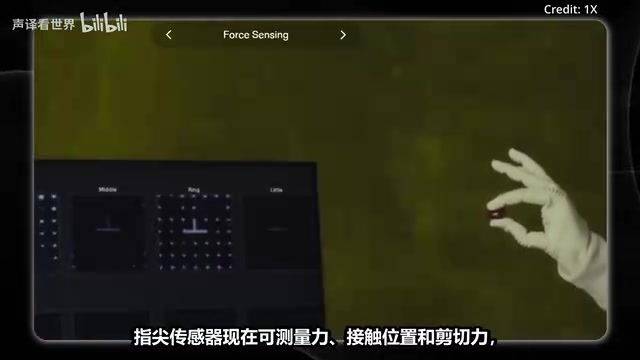
This is significant. Vision alone struggles with small, transparent, or deformable objects—research such as GelSight has demonstrated that tactile sensing can effectively supplement vision's shortcomings in handling challenging objects like transparent glass and liquid bags—and touch fills precisely the blind spots that cameras cannot cover. The combination of multi-layered perception is a crucial step toward truly practical robots.
Self-Labeling Data: Solving the Cost Pain Point of Embodied Intelligence
The deepest value of the new hand lies in its impact on the cost of training data. One of the core bottlenecks in training Embodied AI is the scarcity and expense of physical-world interaction data. Language models can learn self-supervised from vast amounts of internet text, but robot manipulation data must be collected in real physical environments, where each hour of high-quality demonstration data can cost thousands of dollars, and traditional methods further require manual annotation of information like force and position in each frame.
But a robotic hand that can report the force and position of each joint in real time will label every grasping action by itself. This idea has a dedicated term in the field of robot learning: Self-supervised Imitation Learning. Understanding this concept requires revisiting the limitations of Behavior Cloning: in the classic DAgger (Dataset Aggregation) framework, a human demonstrator operates the robot to complete a task, after which professional annotators must label each frame with structured information such as end-effector pose, grip force, and contact state. Annotation costs are typically 3-5 times the collection cost, and differing interpretations of "correct demonstration" among annotators introduce systematic noise, causing unstable policy learning. When the hand itself can output precise joint torque and position information in real time, every manipulation action itself constitutes a fully labeled training sample—equivalent to "embedding" structured labels within the action itself, echoing the "self-supervised learning" approach in language models.
Furthermore, when this self-labeling capability combines with the Data Flywheel effect, it produces exponential acceleration: the more robots deployed, the more labeled data collected, the stronger the model, which in turn attracts more deployment. Both Tesla's Optimus and Figure AI have listed this "deploy-as-collect" strategy as a core competitive moat, and 1X's sensor design lays precisely the hardware foundation for this strategy, dramatically reducing one of embodied AI's most expensive costs: the collection of physical interaction data.
Regarding hardware specifications, the figures 1X provides are quite convincing: peak thumb torque of 3.5 N·m and finger joint torque of 2.6 N·m, comparable to a strong human hand; peak wrist torque of 17.75 N·m, approaching the strong end of the human wrist; fingertip force reaching 45 N, enough to open a door or push a shopping cart, while maintaining a positioning precision of about 10.2 mm for small objects.
Demonstrated tasks include assembling Lego bricks, using a screwdriver, installing light bulbs, and sorting grapes by color—all fine manipulations. Because it is backdrivable at low gear ratios, the hand can also safely absorb impacts—1X demonstrated the hand compliantly yielding when struck by a hammer, while achieving IP68 waterproof rating and using food-grade materials.
Scale and Pricing
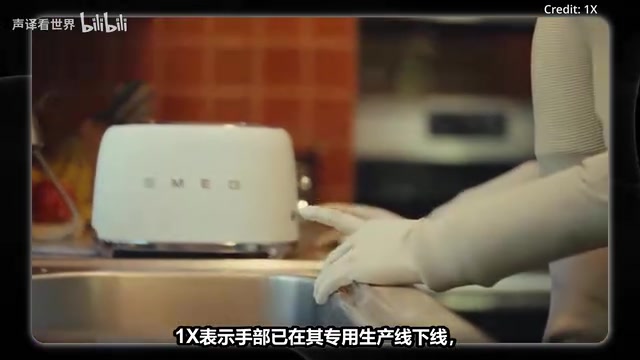
1X states that this hand has already rolled off its dedicated production line, with an annual capacity of up to 1,000 units, all manufactured in-house—covering mechanical parts, motors, skin, and sensor electronics. NEO is priced at $20,000, or $499 per month for lease.
Of course, whether this solution succeeds ultimately depends on real-world deployment—whether it genuinely solves the "last bottleneck" for ultra-dexterous humanoid robots, or is more of a marketing gimmick, remains to be tested by the market.
GPT-5.6 Released: Not Just Smarter, But More Cost-Effective
Just as 1X builds a "better hand" for robots, its backer OpenAI has also released a "matching new brain"—the GPT-5.6 series.
Unlike past launches of a single flagship model, OpenAI this time released three tiers, reflecting a deeper logical evolution in the commercialization of large AI models. Before 2023, most companies competed on performance with a single flagship model; starting in 2024, as techniques like model distillation, Mixture of Experts (MoE), and test-time compute matured, vendors gradually shifted toward a multi-point coverage strategy along the "performance-cost Pareto frontier."
The technical underpinnings of this strategy are worth understanding in depth. Knowledge Distillation, proposed by Hinton et al. in 2015, has a core insight: at inference time, a large model (the teacher model) outputs not just the highest-probability class, but a complete probability distribution covering all possible outputs—these "soft labels" contain the large model's implicit understanding of conceptual similarity. For example, "cat" is far more similar to "dog" than to "car," a relationship completely lost in hard labels (one-hot vectors). A small model (the student model) trained on soft labels learns not only "what the correct answer is" but also "the relational structure between different answers," thereby retaining most of the capability with drastically fewer parameters. Research shows that small models trained on data generated by GPT-4-level models far outperform directly pretrained models of the same scale on many tasks. Meanwhile, the Mixture of Experts (MoE) architecture solves the efficiency problem from another dimension: the model no longer activates all parameters to process each token, but instead uses a learnable router network to dynamically assign each input token to the most relevant "expert subnetwork" (typically 1/8 to 1/4 of the total parameters), processing the greater knowledge capacity brought by more parameters with less computation. This sparse activation mechanism allows an MoE model's inference computation (FLOPs) to be comparable to a small dense model while its knowledge capacity approaches that of a large model. Mistral's Mixtral and Google's Gemini 1.5 both adopt MoE architectures to achieve a balance of "large parameter count but low inference cost." Anthropic's Claude series (Haiku/Sonnet/Opus) and Google's Gemini series both adopt similar tiered architectures. This strategy essentially commercializes different compute-scale versions of the same research output simultaneously to maximize market coverage:
- Saw: The flagship, the most capable model in the series, designed for the most difficult reasoning, coding, and agentic tasks
- Terra: The mid-tier, a balanced choice for everyday use
- Luna: The cheapest and fastest entry-level option of the three
OpenAI emphasizes that GPT-5.6 is not just about raw intelligence, but about "how much intelligence you get per dollar."
The Showdown with Claude Fable 5
According to OpenAI's own data, on the "Agent's Last Exam" test, Saw scored 53.6, leading Claude Fable 5 by 13.1 points. Even at medium reasoning levels, Saw reportedly surpassed Fable 5 by 11.4 points at about a quarter of the cost, while Terra and Luna matched Fable 5 at about one-sixteenth the cost.
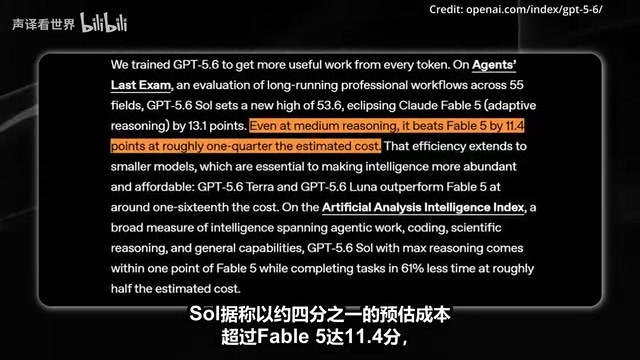
Interestingly, these are all OpenAI's own benchmark comparisons. The credibility of AI benchmarks has become an industry-wide concern, rooted in the concrete manifestation of Goodhart's Law in AI evaluation: this law, originally proposed by British economist Charles Goodhart in monetary policy research, was later summarized as "when a measure becomes a target, it ceases to be a good measure." In AI evaluation scenarios, once a benchmark (such as MMLU or HumanEval) becomes an industry-recognized ranking standard, vendors will deliberately include similar questions in their training data, or overfit to the benchmark's question characteristics, causing the correlation between benchmark scores and true capability to gradually break down. Additionally, the problem of Data Contamination is equally thorny: the pretraining data of modern large models comes from nearly the entire internet, and many academic benchmark questions themselves circulate publicly online, making it hard to distinguish whether a model "truly understands" or "memorized the answer." Researchers have detected contamination by comparing score differences between "verbatim" and "paraphrased" versions of benchmark questions, finding that some mainstream models perform significantly worse on paraphrased questions than on the originals, confirming the prevalence of the contamination problem.
To address this dilemma, the research community has developed various mitigation strategies: LMSYS Chatbot Arena uses real-user blind comparison voting to avoid optimization for specific question types; Artificial Analysis uses cross-benchmark aggregate scoring to reduce the misleading nature of a single metric; and there is the "dynamic benchmark" research direction, which periodically updates questions or even automatically generates new ones to prevent overfitting. Measurements from Artificial Analysis show the competition is actually much closer—Fable 5 slightly surpasses Saw in general intelligence, although Saw maintains a lead in dedicated coding tests. The discrepancy between official data and third-party data reminds us to remain cautious about vendor self-evaluated benchmarks and cross-check multiple independent data sources.
GPT-5.6's Coding and Productivity Upgrades
Regarding coding capability, according to Artificial Analysis's Coding Agent Index, Saw scored a record-breaking 80, 2.8 points higher than Fable 5, while cutting output tokens in half and reducing cost by about 1.3%. Terra also surpassed Fable 5, while Luna outperformed Claude Opus 4.8. Every model is faster and cheaper than its predecessor.
For heavier tasks, OpenAI also introduced a new Ultra parallel mode, which can run 4 independent agents simultaneously. This represents the evolution of AI inference architecture from "single-pass generation" to "multi-agent collaboration," falling under the category of Test-time Scaling. Understanding this paradigm requires distinguishing two paths to improving model capability: training-time scaling (increasing parameter count, data volume, and training compute) and inference-time scaling (improving answer quality by investing more computation during generation under fixed model weights). Ultra parallel mode is a "width-scaling" variant of the latter: running multiple instances in parallel, each independently exploring different solution paths, then selecting the best result through voting (majority vote) or a verifier. This traces the same lineage as traditional ensemble learning, but has unique advantages in the LLM scenario: generation paths under different random seeds explore different chains of thought (Chain-of-Thought), covering a broader solution space. Research shows that on verifiable tasks like programming and mathematics, the performance gain from parallel sampling followed by selection far exceeds single-pass generation, sometimes even outperforming larger base models—the underlying logic being "better to try multiple times to find the correct answer than to generate a potentially wrong answer in one pass." The cost is a multiplied token consumption, making it more suitable for high-value, low-frequency complex task scenarios.
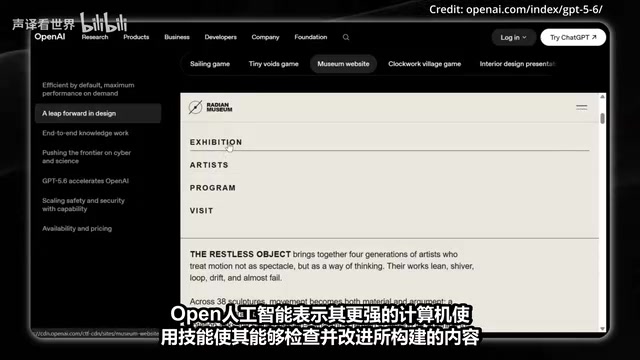
GPT-5.6 has also been enhanced in design and productivity scenarios. OpenAI states that stronger computer-use skills allow the model to inspect and improve what it builds—it not only generates code, but also test-runs it, visually reviews the results, and fixes problems. In knowledge work, GPT-5.6 can extract context from documents, Slack, Notion, and Google Drive to generate more accurate presentations, spreadsheets, and financial models.
Pricing and Availability
- Saw: $5 per million input tokens, $30 per million output tokens
- Terra: $2.5 per million input tokens, $15 per million output tokens
- Luna: $1 per million input tokens, $6 per million output tokens
All three models are accessible via ChatGPT, Codex, and the API. Free users can use Terra, paid users can unlock all three, and Pro and enterprise users also get access to the higher-compute Saw Pro option. Developers can call all three tiers directly through the API.
Conclusion: A Signal of Synchronized Hardware and Software Evolution
The simultaneous release of the 1X hand and GPT-5.6 forms an intriguing combination: one dedicated to giving robots a more sensitive "hand" capable of self-labeling data, the other a "brain" continuously driving down the cost of intelligence per dollar. When the cost of collecting physical data for embodied intelligence drops dramatically—thanks to sensors' self-labeling capabilities—and general model capability and cost-effectiveness continue to improve, the timeline for humanoid robots to move from demonstration to commercialization may be significantly compressed.
Whether it's NEO's $20,000 price tag or various companies' benchmark data, all still require real-world deployment for ultimate validation. But one thing is certain: robot hardware and AI software are accelerating in the same direction.
Key Takeaways
Key Takeaways
Key Takeaways
Related articles

Claude Reportedly Able to Hide Secret Messages in Benign Images
A Reddit post claims Claude Fable 5.1 can hide secret messages in benign images. This article reviews the background, image steganography principles, and potential security risks, and suggests a testing path from rumor to verification.

Federal Government Awards $85 Million; CFS to Develop Fusion-Specific Semiconductors
The federal government awards $85 million to Commonwealth Fusion Systems to develop conductors and power semiconductors for fusion plants. This article analyzes the significance of this funding for the fusion supply chain and commercialization path.

When Should AI Assistants Proactively Suggest? Timing Is Everything
When should AI assistants proactively suggest? Reddit discussion reveals: the same suggestion feels different at different times. This article analyzes the dual nature of proactive suggestions, the boundary of user expectations, and design principles, exploring how to balance automation and user control.