$20 AI Membership Hands-On Test: Gemini 4 Neon Has the Most Durable Quota, Claude Opus 5.5 Set for Cancellation

Four $20 AI memberships tested: Gemini most well-rounded, GPT best visuals but costliest quota, Claude set for cancellation.
Bilibili creator Roryworks paid out of pocket to subscribe to Gemini 4 Neon, Claude Opus 5.5, GPT-6.2 Astra, and Grok 4.7, completing five tasks with identical prompts while recording quota consumption. Gemini had the highest completion on video and 3D tasks with the most frugal quota (~40+ tasks per 5-hour window); GPT led in visual quality and code animation but dropped 53 points and bottomed out after ~9 tasks; Grok was fastest with durable quota but weaker at code; Claude can't draw images, needs paid third-party tools for video, and often takes 12 minutes on coding tasks. The creator plans to cancel Claude and warns about hidden pitfalls.
Four major AI memberships, the same $20 monthly fee, the same five tasks — just how big can the gap be? Bilibili creator Roryworks paid out of pocket to subscribe to Gemini 4 Neon, Claude Opus 5.5, GPT-6.2 Astra, and Grok 4.7, set thinking intensity uniformly to "high" (not the top tier), and compared them task by task with identical prompts. The conclusion is blunt: one crushes the video and 3D tasks, one has the highest visual quality ceiling but burns through quota fastest, one is astonishingly fast but weak at code, and one has been put on his cancellation list.
Test Design: Not Just Who's Smarter, But How Much Work $20 Buys
The creator's approach was clear: don't compare benchmarks, compare real-world cost of use. The five tasks covered a mini-game, a poster, a video, a 3D town, and a code-animated short film. Every task used the exact same prompt across all four, not a single word changed. More importantly, before and after each task he went to the backend usage page to record quota consumption.
"Others test who's smarter; I test how much work you actually get for this $20."
To rule out flukes, the mini-game task was asked again after all five tasks were done. The results: GPT took 1 minute 18 seconds the first time, then dragged out to 4.5 minutes the second; Claude took over 9 minutes the first time and over 6 the second; only Grok stayed around 1.5 minutes both times. Single-run timing has limited reference value, which was also factored into the quota calculations later.
Mini-Game and Poster: Claude Most Polished, Gemini Fastest to Output
The first task was a one-sentence prompt to build a clay cat catching fish while dodging bombs, requiring a score, three lives, increasing speed, and a "play again" option. Claude produced the most complete version: a start screen, full gameplay instructions, +5 points for goldfish, and a score multiplier that increases by 1 for every 5 consecutive catches — details that weren't even requested, which it added on its own, at the cost of grinding for over 9 minutes. GPT submitted in 1 minute 18 seconds with a clean look and a built-in high-score record; Gemini's pink palette was appealing, and Grok finished in just over a minute, but the cat was drawn as a round ball, with fish and bombs all rendered as tiny dots.

The second task, an opening poster, exposed a fatal weakness: Claude can't draw images, so it could only write code to assemble a cup of milk tea from color blocks — placed next to the other three real images, it looked like "an elementary school art class assignment colliding with professional design." Gemini output an image in 31 seconds, stuffing the frame with balloons, ribbons, and strawberries, with only the small English text in the corner garbled; Grok's looked most like a real shop poster, with store name and small-text texture; GPT's was the cleanest, ready to post straight to social media.
The 8-second video task of an orange cat stretching showed the biggest gap among the four. Gemini produced it in 57 seconds: the cat first lies down, slowly rises, extends its front paws forward and arches its back down, complete with rain streaks on glass and rain sounds, and the 10-second length exceeded the requirement; Grok was fastest at 46 seconds but output vertical video, with the cat mostly standing and turning; GPT ground away for 6 minutes, with correct animation-style motion but visuals that looked a generation behind; Claude replied in 21 seconds — but only to ask whether to connect a third-party tool called Vidya, which deducts credits by the second.
"I paid $20, and Claude can't make videos itself — if you want one, you have to pay extra."

The 3D town task maxed out the difficulty: walk with the keyboard, rotate the view with the mouse, houses, trees, streetlights, a small river, and streetlights must light up after dark. GPT's visuals were the best-looking — pointed church steeples, wooden houses, layered distant mountains — but it took over 8 minutes; Gemini was even slower at 12 minutes 46 seconds, the longest of all, yet the only one to complete the entire task — a wooden bridge over the river, streetlights that actually lit up after dark, with the light reflected in the water; Claude produced regular but crude blocky houses in just over 4 minutes; Grok was fastest at 1 minute 43 seconds, but after dark the screen went pitch black, making it impossible to tell whether the streetlights were on.
When Claude connects to a third-party tool (like the Vidya mentioned above), it uses the MCP (Model Context Protocol) mechanism. MCP is an open protocol proposed by Anthropic that lets Claude call external services, databases, or APIs, thereby breaking past its own boundary of only reading and writing text and code. The problem is that these third-party tools are usually billed separately — potentially deducting credits per call or per second — and are not included in the $20 monthly fee. More insidious: when a user makes a request Claude doesn't natively support (such as generating video), it may proactively call already-connected MCP tools, and users unfamiliar with the interface can easily incur extra charges without knowing. This is also why the creator warns: "Be sure to read carefully before clicking."
Code Animation: GPT a Cut Above, Grok Most Perfunctory
The final task, a code-animated short film: a 20-second rainy-night city shot pushing in from high above to a lit window, with an orange cat on the windowsill watching the rain, and the title "Rainy Day" emerging at the end. GPT brought out its best: neon reflected in puddles, the camera pushing in steadily, the cat watching rain under warm light, the title fading out — "it doesn't look at all like something written from a single sentence." Claude was more restrained, Gemini warmer, Grok most perfunctory — the cat reduced to a tiny shadow and the fish to a few colored dots — yet at 1 minute 10 seconds it was again the fastest; Claude came in last this time, grinding for a full 12 minutes.

The Quota Ledger: Same $20, Several Times the Difference in Work Done
Cumulative consumption across the five tasks (the page only shows whole percentages; the following are approximate): within the 5-hour window, GPT burned straight through 53 points, Claude used 18, and Gemini was most frugal at 11; for the weekly quota, GPT dropped 8 points, Claude and Grok 2 each, and Gemini only 1. Converted into actual task volume: in one 5-hour window GPT can roughly do only 9 similar tasks before calling it quits, Claude over 20, and Gemini over 40; on a weekly basis, GPT bottoms out at around 60 tasks, while the other three can each do several hundred.
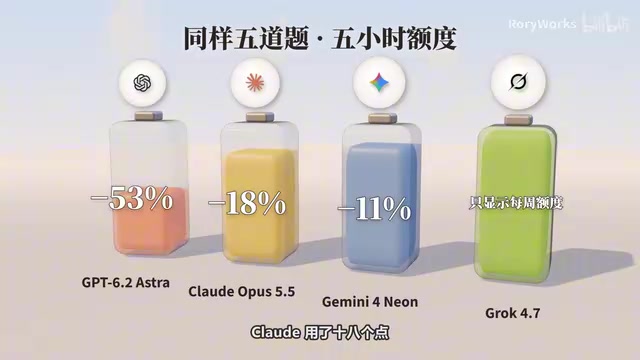
A difference of several times is real and tangible. GPT has the visual quality ceiling, but watching the quota drop every time you hit send really hurts.
Each provider uses rolling time-window rate limiting rather than a simple daily count. Take the 5-hour window: it means that within the continuous 5 hours starting from your first message, there's a cap on usable quota, which gradually resets after the window ends. The weekly quota is a longer overall constraint, and both limits apply simultaneously. Different vendors' "points" metrics aren't standardized: some convert input/output tokens, others apply extra weighting to image, video, code execution, and other tasks, so directly comparing percentage points can only reveal trends, not serve as a precise cross-platform equivalence. The creator's use of "how many points the same five tasks consume" for side-by-side comparison is effectively normalizing by a uniform task volume, which is closer to real usage cost than simply looking at remaining quota.
Hidden Pitfalls and Final Ranking
The creator also stepped on several pitfalls you must know before subscribing: Gemini, when starting a temporary chat to make a video, will play dumb and say it's a language model that can't do it, but switching back to a normal chat produces the same clip in 57 seconds; Claude, once connected to third-party tools, will call those potentially extra-charging tools when it can't handle a job itself — be sure to read carefully before clicking; GPT's Astra is only in Work mode and shares the same quota as Codex, so writing code by day and using Astra at night means both are deducted together; Grok's video output actually calls its own Imagine, not Grok 4.7 itself.
The final ranking falls into four tiers:
- Solid: Gemini — top-tier across image, video, and 3D, with the most durable quota; if you're buying only one, buy it with your eyes closed
- Top-tier: GPT — the visual quality ceiling, but the quota is frighteningly expensive; it can't even do 10 tasks in a 5-hour window
- Above average: Grok — fastest of all, good at images and video, durable quota, but noticeably weaker at coding and building things
- Bottom: Claude — can't draw images or make videos, often slow as a turtle on coding tasks; its mini-game was the most complete but it only suits people who write code every day
Claude is exactly who the creator plans to cancel. His summary is blunt: for images and video, choose Gemini or Grok; for the best-looking 3D and animation, go with GPT but use it sparingly; only consider Claude if you write code every day.
The Work mode and shared Codex quota mentioned in the article reflect a trend of subscription products allocating quota by "product line" rather than by "model." The same underlying model may serve multiple entry points — chat interface, coding assistant, agent workflows — and to control costs, vendors often merge usage across these entry points into a single quota. The impact on users: writing code with a coding tool by day and using Astra from the same subscription for 3D or animation at night means both draw from the same pool simultaneously, leaving far less usable capacity than using a single product line alone. Before subscribing, it's worth confirming which product line your main use falls under and whether there are cross-entry quota-sharing rules.
One-line Summary
Four $20 AI memberships tested on identical tasks: Gemini is the most well-rounded, GPT has the best visuals but burns quota fastest, and Claude is set for cancellation.
Paragraph Summary
Bilibili creator Roryworks paid out of pocket to subscribe to Gemini 4 Neon, Claude Opus 5.5, GPT-6.2 Astra, and Grok 4.7, completing five tasks — mini-game, poster, video, 3D town, and code animation — with identical prompts while recording quota consumption. Results: Gemini had the highest completion on video and 3D tasks and the most frugal quota, doing roughly 40+ similar tasks per 5-hour window; GPT led by a wide margin in visual quality and code animation, but dropped 53 points in a 5-hour window and bottomed out after about 9 tasks; Grok was fastest with durable quota but clearly lagged on code and complex tasks; Claude can't draw images and needs extra-paid third-party tools for video, often taking up to 12 minutes on coding tasks. The creator ultimately plans to cancel Claude and warns about hidden pitfalls like temporary chats and shared quotas.
Related articles

AI Role-Play in a Barbershop: How Veda Builds Immersion Through Dialogue
From a Bilibili Veda barbershop video, explore how AI role-play builds immersion through task dialogue, relationship maintenance, and improvisation.

Why Does Python Endure? A 20-Year Developer's Firsthand Account
A senior developer shares his journey from C, Java, and other languages to Python: convinced by its concise code in 2006, he asks himself every year whether to keep using Python, and the answer is always yes. Python's flexibility and versatility are the key to its enduring popularity.

Conductive Dye Turns Hair into EEG Electrodes, Opening a New Path for Wearable Brain-Computer Interfaces
Can conductive dye turn hair into EEG electrodes? This article explains the principles, potential applications, and deployment challenges of this new wearable brain-computer interface approach.