20-Year Software Veteran Builds Robot Dog with Claude: Single Leg Already Hops

20-year software engineer uses Claude to fill mechanical gaps, builds robot dog with single-leg hopping.
A software engineer with 20 years of experience decided to build his own robot dog, LocksleyFox, because commercial quadrupeds are pricey and have limited dev interfaces. Using Claude to cover his mechanical design gaps, he completed a single-leg build and hopping test within weeks and is iterating a second leg design, aiming for quadruped walking in one to two months. The article notes that coordinated control, center-of-mass transfer, and gait switching pose far harder challenges, and whether the timeline is realistic depends on the definition of "walking." The project shows how AI-assisted design is lowering the barrier for individuals entering hardware robotics.
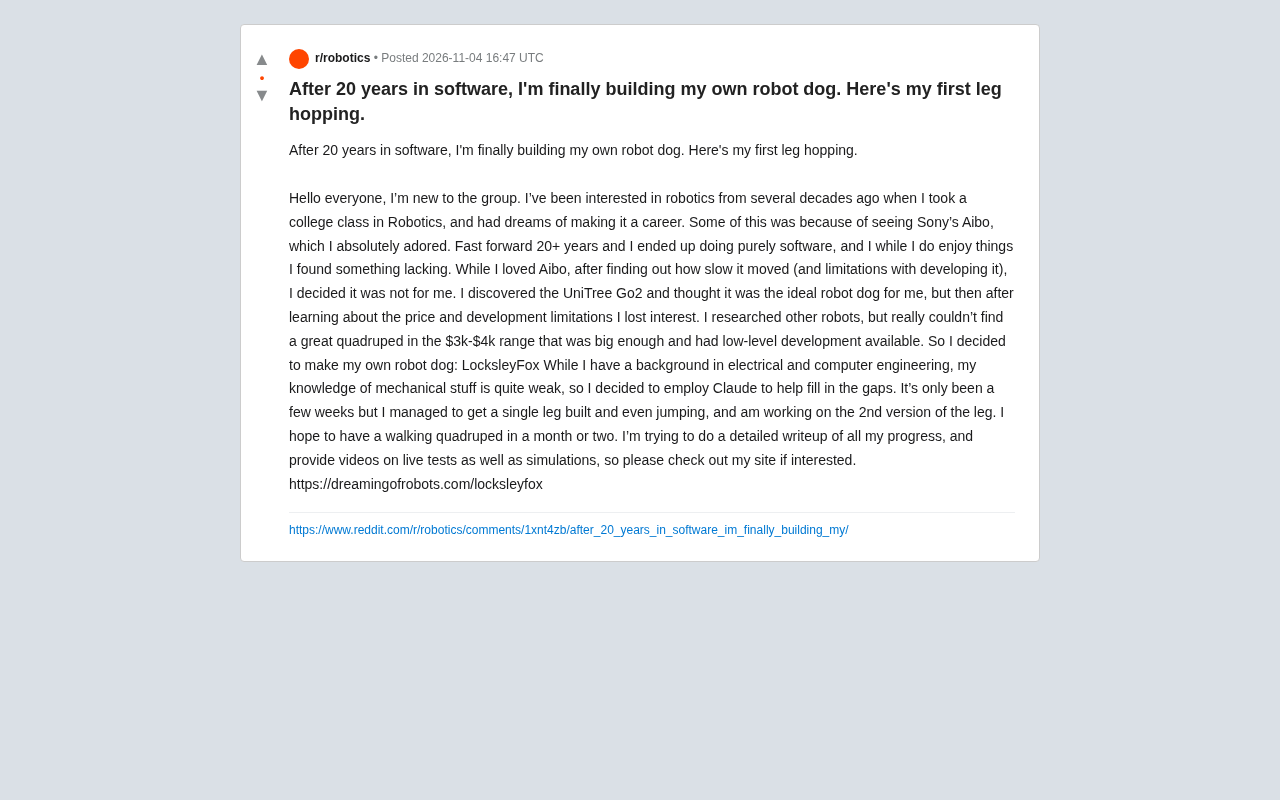
An engineer with over 20 years in the software industry recently shared his new project on Reddit: a fully self-developed quadruped robot dog called LocksleyFox. He has already completed the build and hopping test of a single leg, is iterating on a second version of the leg design, and aims to get the robot dog actually walking within one to two months.
From Aibo to Go2: Why He Ultimately Chose to Build His Own
The creator's robot obsession traces back to a robotics course in college, and Sony's Aibo was his original dream icon. But once he actually learned about Aibo's movement speed and development limitations, his enthusiasm gradually cooled. He later discovered Unitree's Go2 and at one point considered it the ideal robot dog choice, but price and limits on development freedom once again held him back.
He did a round of market research and found that in the $3,000 to $4,000 price range, it was hard to find a quadruped robot that was large enough in size while also opening up low-level development interfaces. This supply-demand gap became the direct motivation for his decision to build his own. With a background in electrical and computer engineering, hardware wasn't entirely unfamiliar to him, but mechanical structure design was an obvious weak spot.
Unitree's Go2 is one of the better-known products among consumer-grade quadruped robots, officially positioned for education, research, and developer scenarios, offering sensor configurations such as LiDAR and AI cameras along with optional SDK support. In actual development, however, the degree of openness that truly allows access to low-level joint control and gait planning interfaces is directly tied to the overall machine price, with high-spec versions typically costing far more than entry-level models. This is also why many developers feel torn during the research phase: entry-level price points buy smaller platforms, while models meeting payload, expandability, and interface openness requirements often blow past the budget. The $3,000–$4,000 range mentioned in the article sits right between "consumer-grade" and "development-grade," creating a supply gap.
Claude Fills the Mechanical Design Gap
The engineer admits his mechanical knowledge is "fairly weak," so he chose to use Claude to fill that gap. Judging by the results, this strategy was effective in the early stages: in just a few weeks, he completed the single-leg build and achieved a hopping motion.
What's interesting about this case is the division of labor—the human provides engineering judgment at the electronics and software levels, while AI fills in the knowledge gaps in mechanical design. For the many developers with software backgrounds who want to get into hardware but are blocked by the mechanical design threshold, this is a path worth watching. Of course, there's still considerable engineering distance between single-leg hopping and stable quadruped walking, and there's no answer yet as to how much Claude can support the subsequent dynamics tuning and structural optimization.
After Single-Leg Hopping, the Real Challenge Has Only Just Begun
Single-leg hopping is a milestone, but it's still far from a "robot dog." The core difficulty of quadruped robots lies in coordinated control: the phase relationships among four legs, center-of-mass transfer, gait switching across different terrains, and recovery ability after falling. These problems are far more complex than the periodic bouncing of a single leg.
The creator plans to achieve walking within one to two months. Whether this timeline is realistic depends on his definition of "walking." If he can accept a slow gait requiring manual intervention, progress may come faster; but to reach the smooth dynamic balance level of the Go2, the tuning workload required typically exceeds initial estimates.
He is keeping a detailed process log on his website, including real-machine test videos and simulation results. For readers interested in individual robot development, this kind of public record is more valuable for reference than the final product—it shows how a software engineer tackles the two hard nuts of mechanics and control step by step.
Quadruped robot gaits are generally divided into static gaits (such as crawl, where at least three legs are on the ground at any moment, offering high stability but slow speed) and dynamic gaits (such as trot, a diagonal gait, bound, where the front and rear pairs of legs alternate, and pace, where same-side legs move in sync). Trot is adopted as the default gait by most platforms due to its balance of energy efficiency and speed, but it requires strict phase coordination among all four legs and places high real-time demands on joint torque control and contact detection. In addition, center-of-mass transfer, foot slippage, and terrain height differences can all interfere with phase synchronization, typically requiring closed-loop correction using IMU feedback and state estimation. By comparison, single-leg periodic bouncing involves only one leg's trajectory and force control, with no multi-leg coupling or balance maintenance, so the engineering gap between single-leg and quadruped is often underestimated.
The core of dynamics tuning lies in joint-level control strategies, with common approaches including position control, torque control, and impedance control. To achieve compliant ground contact and dynamic balance, quadruped robots often require torque-based control or impedance control, with parameter searches first conducted in simulation environments (such as Isaac Sim, MuJoCo) and then transferred to the real machine. The sim-to-real gap mainly comes from motor latency, friction model errors, and structural flexibility, all of which require repeated correction using real measured data. For individual developers, the tuning workload is often not on the order of "a few weeks" but measured in months, which is also the key variable in judging whether the "walking in one to two months" timeline is realistic.
The Barrier to Entry for Individuals Building Robot Dogs Is Lowering
A few years ago, independently developing a quadruped robot as an individual was almost unimaginable. Structural part machining, motor selection, control algorithms—each link required professional accumulation. Now the situation is changing: open-source controller solutions, mature joint motor modules, plus AI-assisted design tools, have given individual developers with an engineering background the possibility of starting from scratch.
The LocksleyFox project is still at a very early stage, and there's still a considerable way to go from single-leg hopping to a usable quadruped platform. But it represents a growing phenomenon: software engineers extending into the hardware field with the help of AI tools, using software engineering methodologies to break down mechanical and control problems. How far this path can ultimately go is worth continued attention.
Project progress is published at dreamingofrobots.com/locksleyfox, including real-machine tests and simulation videos.
Joint motor modules are key hardware that has enabled individual quadruped projects to get off the ground in recent years. These modules typically integrate brushless motors, planetary or harmonic reducers, encoders, and drivers together, receiving commands via CAN bus or serial port, so developers can obtain controllable joint torque output without designing driver circuits and reduction structures themselves. Open-source controllers and simulation frameworks (such as open-source solutions derived from MIT Mini Cheetah, PyBullet, MuJoCo) provide a starting point for gait generation and simulation. Combined with AI-assisted structural design and code generation, the entry cost for individual developers has indeed dropped noticeably compared to a few years ago, but going from "can hop" to "stable walking" still requires extensive real-machine iteration.
One-line Summary
A 20-year software engineer used Claude to fill mechanical gaps and built a robot dog that has completed single-leg hopping.
Paragraph Summary
A engineer with 20 years of software experience decided to build his own robot dog, LocksleyFox, because commercial quadruped robots were expensive and had limited development interfaces. He used Claude to compensate for his weak mechanical design skills, completing the single-leg build and hopping test within weeks, and is now iterating on a second leg design with the goal of quadruped walking in one to two months. The article notes that between single-leg hopping and stable quadruped walking lie harder challenges such as coordinated control, center-of-mass transfer, and gait switching, and whether the timeline is realistic depends on the definition of "walking." The project reflects how AI-assisted design is lowering the barrier for individual developers entering hardware robotics.
Related articles

WorkBuddy in Practice: How Tencent's AI Agent Is Reshaping Office Workflows
An in-depth analysis of Tencent WorkBuddy AI agent: it reads local files, executes multi-step tasks, runs on schedules, and supports remote control—how is it fundamentally different from conversational AI? This article combines practical cases to help you understand its core capabilities and use cases.

Codex App Complete Guide: From Installation to Hands-On Practice — AI Automatically Organizes Files and Builds Reports
Codex App complete guide: install from the app store, configure everyday work mode, and use real coffee shop data to practice file organization, Excel reports, and visual dashboards. Learn Plan Mode and the little pet feature — master Codex's AI automation workflow in one episode.

Getting Started with Langfuse: Building a Financial Analysis Agent and Evaluation Platform
A Langfuse tutorial: explore the core capabilities and boundaries of this open-source AI Engineer platform, and learn how to build an enterprise-grade log tracing, evaluation, and observability platform for a Harness-architecture financial analysis multi-agent system, covering prompt management, token cost analysis, and integration with frameworks like LangChain.