200 Lines of Pure Jax Reimplements DeepSeek V3: Minimalist Open-Source Project Hits HN
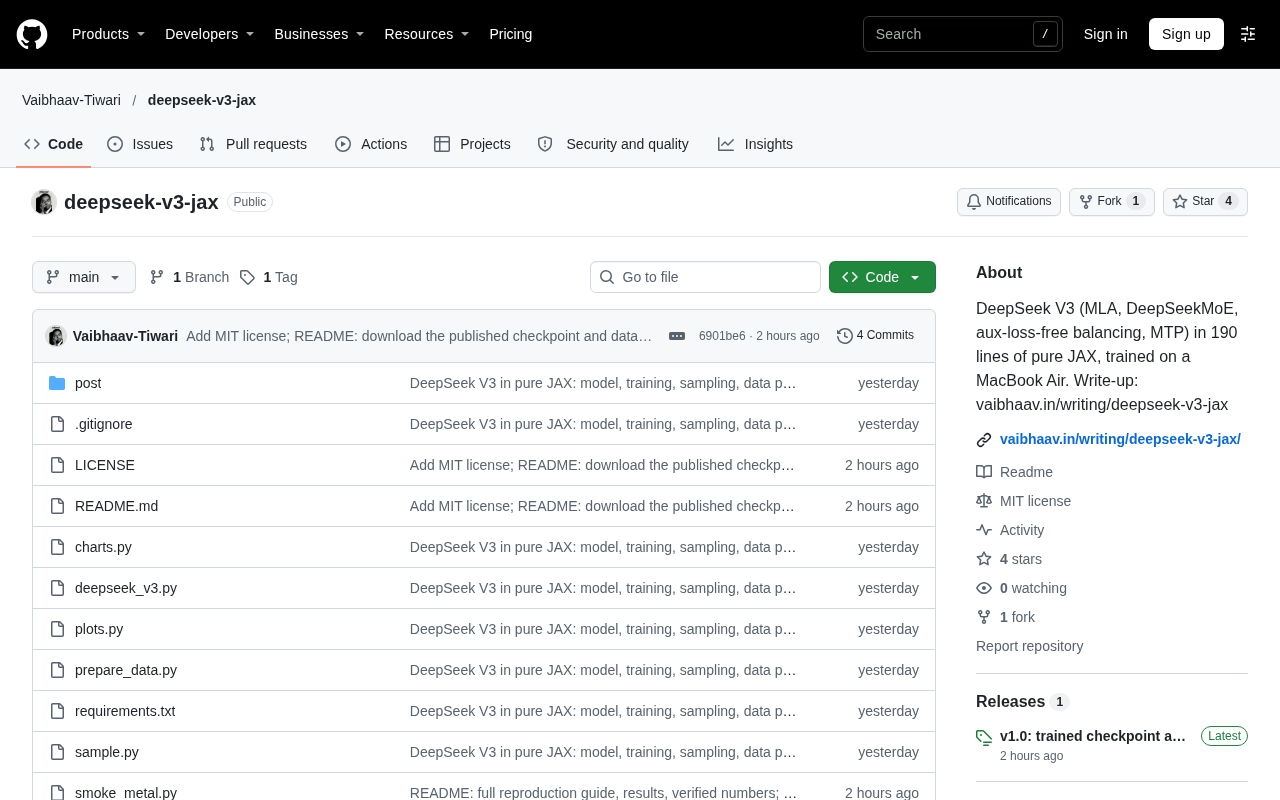
200 lines of Jax minimally reimplement DeepSeek V3, focusing on architecture understanding over production deployment.
A project on Hacker News implements DeepSeek V3's core inference logic in about 200 lines of pure Jax, drawing developer community attention. It strips the model structure from production frameworks to showcase the core computation graph minimally, helping researchers quickly grasp the architecture. Jax's functional style and autodiff suit Transformer computation flows. The minimalist implementation omits distributed parallelism, quantization, and KV Cache optimization, positioning itself as an 'architecture specification' rather than deployable code. The article argues such minimalist reimplementations offer higher value for teaching and research, suggesting learners compare with the official implementation and focus on key modules like attention mechanisms and MoE routing.
Understanding DeepSeek V3 Through 200 Lines of Code
A project titled "Show HN: DeepSeekAd V3 in ~200 lines of pure Jax" has appeared on Hacker News. The author implemented the core inference logic of DeepSeek V3 in approximately 200 lines of pure Jax code, drawing attention in a developer community that emphasizes engineering transparency.
DeepSeek V3 is a recently high-profile large model whose official implementation is typically massive in scale with numerous dependencies. The value of this project lies not in performance benchmarking, but in "stripping" the model structure out of production-grade frameworks and showcasing the core computation graph with minimal dependencies, allowing researchers to quickly understand the model's key design decisions.

Why Jax Is Well-Suited for This
Jax is centered on functional programming and automatic differentiation, making it naturally suited for expressing Transformer-style computation flows. Compared to PyTorch, Jax's purely functional style brings the code closer to mathematical definitions and makes it easier to perform jit compilation and hardware acceleration.
Reimplementing large models in Jax is not a new idea, but compressing DeepSeek V3 into 200 lines means the author must highly distill the model architecture—what are essential components and what are implementation details becomes immediately clear. For developers who want to learn the DeepSeek V3 architecture but are deterred by the scale of the official code, this is a good entry point.
Trade-offs of a Minimalist Implementation
200 lines of code cannot cover the full engineering of training and inference. Such projects typically implement only the core forward-pass path, omitting engineering modules like distributed parallelism, quantization, and KV Cache optimization. Readers need to understand: this is an "architecture specification," not deployable production code.
Core Mechanisms of Jax: Jax compiles pure functions into XLA computation graphs via jax.jit, enabling efficient execution on GPU/TPU; jax.grad provides automatic differentiation, and jax.vmap supports automatic vectorization. This combination of "function transformations" allows researchers to describe models in code that closely resembles mathematical formulas without managing complex module state. Unlike PyTorch's dynamic graphs, Jax adopts a functional style by default, requiring all parameters to be passed explicitly—this forces a clearer code structure and facilitates static analysis and optimization. For reimplementing large models, Jax's pjit also supports multi-device parallelism, but minimalist implementations typically use only basic forward computation.
KV Cache and Quantization: KV Cache is a technique for caching historical key-value pairs during autoregressive inference, avoiding redundant computation and significantly reducing latency, but it introduces memory management complexity. Quantization reduces memory footprint and accelerates computation by lowering the numerical precision of weights or activations (e.g., FP16, INT8), typically involving calibration and dequantization steps. Minimalist implementations often omit these engineering optimizations to keep the code concise, retaining only floating-point forward propagation. Readers should understand that these modules are critical for production deployment but not necessary for understanding the architecture.
Implications for Large Model Learners
The open-source ecosystem for large models is stratifying: one layer consists of directly deployable engineering implementations, and another is minimalist reimplementations aimed at understanding. The latter holds higher value for teaching and research. Similar projects tend to gain sustained attention in the community because they lower the cognitive barrier.
If you are studying the DeepSeek V3 architecture, consider reading through this 200-line implementation section by section—attention mechanisms, MoE routing, and other key modules—then compare with the official implementation to understand exactly where engineering optimizations have been added.
MoE Routing: DeepSeek V3 adopts a Mixture-of-Experts (MoE) architecture, whose core is a routing network that dynamically selects activated expert sub-networks based on input tokens. In typical implementations, routing assigns weights by computing similarity between token representations and expert weights (e.g., softmax gating), and may introduce load-balancing losses. Minimalist reimplementations typically retain the routing logic but simplify the number of experts and parallelism strategies. Understanding the routing mechanism is key to grasping the trade-off between computational efficiency and capacity in MoE models—reading alongside the official technical report is recommended.
Quick Start Suggestions
- Run the code first to confirm environment dependencies, then read line by line against the paper or official documentation
- Focus on the model structure definition section and ignore engineering glue code
- Try modifying hyperparameters and observe output changes to deepen your understanding of the architecture
This project currently has limited discussion, but the "minimalist reimplementation" approach it represents is worth watching. For AI learners and researchers, small and transparent implementations are often more inspiring than massive production code.
One-line Summary
200 lines of Jax minimally reimplement DeepSeek V3, focusing on architecture understanding rather than production deployment.
Paragraph Summary
A project implementing DeepSeek V3's core inference logic in approximately 200 lines of pure Jax code has appeared on Hacker News, drawing attention from the developer community. The project strips the model structure from production-grade frameworks and showcases the core computation graph in a minimalist way, aiming to help researchers quickly understand the architecture design. Jax's functional style and automatic differentiation features make it well-suited for expressing Transformer computation flows. The minimalist implementation omits engineering modules such as distributed parallelism, quantization, and KV Cache optimization, positioning itself as an "architecture specification" rather than deployable code. The article argues that such minimalist reimplementations hold higher value for teaching and research, and suggests learners compare against the official implementation while focusing on key modules like attention mechanisms and MoE routing.
Related articles
Anthropic Model Benchmarking: Fable 5 vs 5.1 vs 5.2 Comparison
Based on Reddit community comparison material, this analyzes benchmark differences among Anthropic models Fable 5, 5.1, and 5.2, and discusses the practical implications of version iterations for developers and model selection advice.

Jensen Huang Steps Down as Nvidia CEO, Asian Governments Scramble to Respond to Chip Supply Shifts
Jensen Huang's departure as Nvidia CEO triggers chain reactions across Asian governments: some confirm chip supply commitments, others monitor local AI project impacts and handle related investigations. This article analyzes supply chain stability, project risks, and compliance uncertainty.
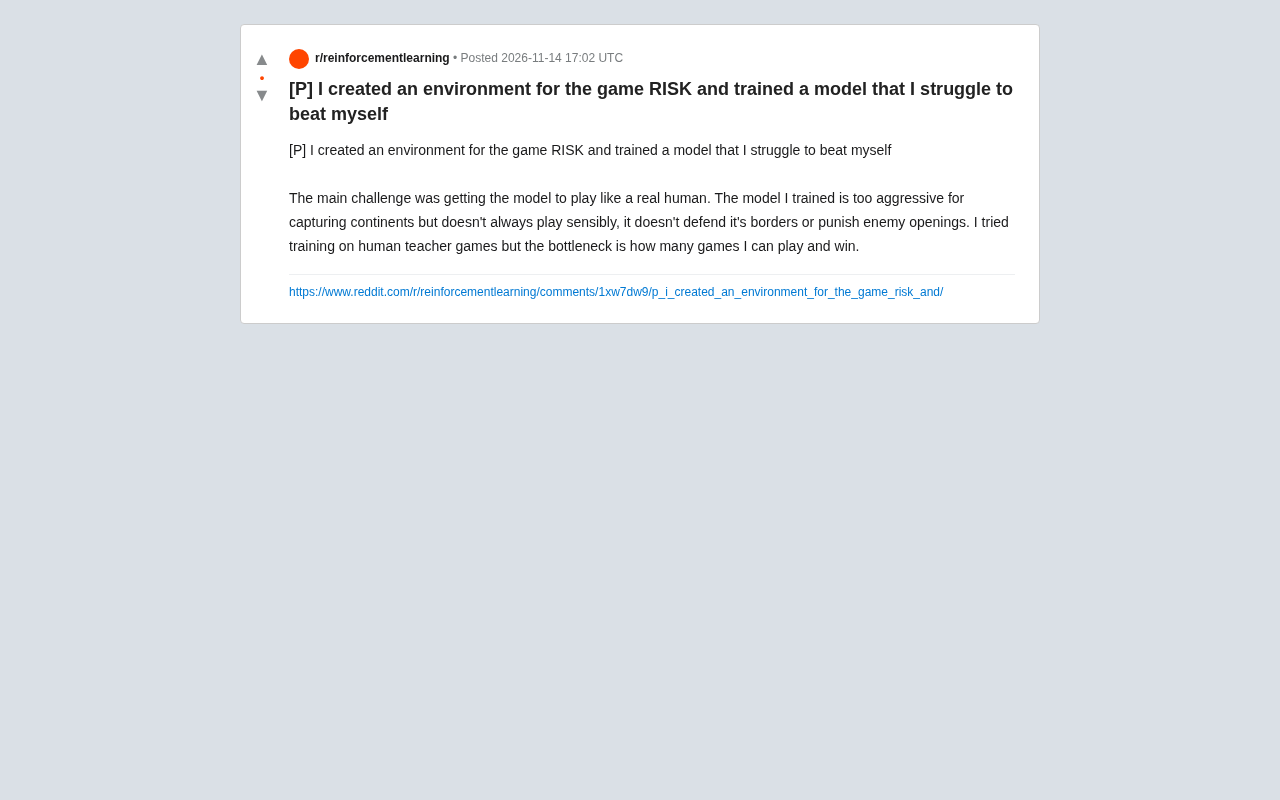
Reddit Player Builds RISK Game Environment and Trains an AI That's Nearly Impossible to Beat
Reddit player builds a RISK training environment and trains an aggressive AI model that's nearly unbeatable. Strong at expansion but weak at defense, the author hits a bottleneck trying human data training, revealing common game AI development challenges.