2025 Shanghai .NET Conference: Will AI Replace Programmers? A Complete Breakdown of .NET 10 and AI Agents

2025 Shanghai .NET Conference focuses on .NET 10 release and deep AI integration trends
The 2025 Shanghai .NET Conference centered on .NET 10 features and AI technology, with over half the sessions AI-related. Microsoft VP Scott remotely introduced .NET 10's core LTS upgrades. Expert Teacher Xiao argued that "AI won't replace programmers, but will replace those who don't use AI." Clean DDD + AI Agent emerged as a hot topic, representing the .NET ecosystem's evolution toward the AI Agent paradigm, urging developers to proactively embrace AI collaboration.
Conference Overview: Deep Integration of .NET 10 and AI
The 2025 Shanghai .NET Conference was held as scheduled. As the most influential annual event for the domestic .NET tech community, this year's conference was divided into morning and afternoon sessions, covering hot topics including .NET 10 new features, AI Agent development, deep technical architecture, and industry solutions.
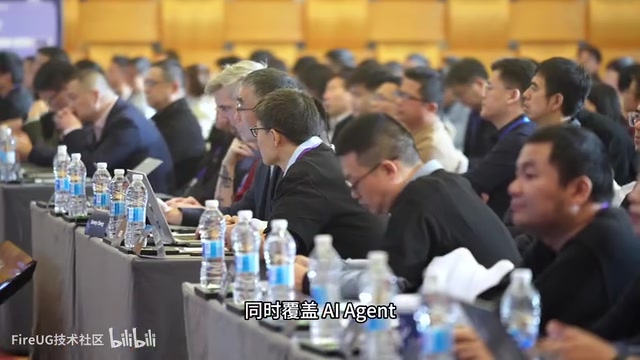
Looking at the agenda, the most anticipated highlight this year was undoubtedly the official debut of .NET 10. Meanwhile, the proportion of AI-related topics increased dramatically — with four parallel tracks running in the afternoon, more than half of the presentations were directly related to AI. This ratio speaks volumes about how rapidly AI technology is penetrating the .NET ecosystem, and signals a profound shift in the skill stack required of .NET developers.
Microsoft Executive Joins Remotely to Introduce .NET 10
The morning session kicked off with a remote appearance by Scott, Microsoft's Vice President of Developer Community, who gave attendees a grand introduction to the core features and direction of .NET 10.
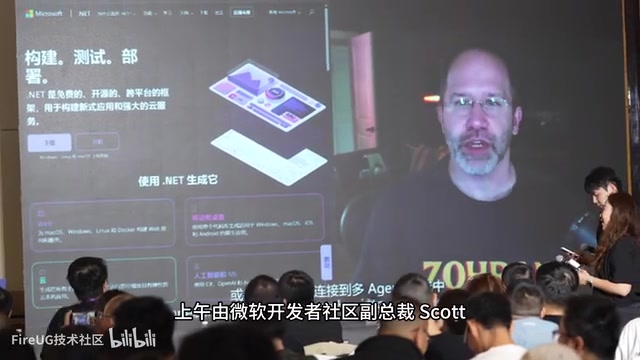
As the latest version of the .NET platform, .NET 10 continues Microsoft's sustained investment in cross-platform capabilities, high performance, and cloud-native development. It's worth noting that since .NET 5 in 2020, Microsoft unified the previously fragmented .NET Framework, .NET Core, and Xamarin into a single cross-platform runtime, releasing one major version per year. Even-numbered versions (such as .NET 6, .NET 8, and .NET 10) are designated as Long-Term Support (LTS) versions with three years of official maintenance. .NET 10 continues to advance in JIT compilation (RyuJIT), garbage collection (GC), and native AOT (Ahead-of-Time) compilation, aiming to push runtime performance closer to system-level languages while maintaining developer-friendliness. Scott's remote appearance not only demonstrated Microsoft headquarters' commitment to the Chinese .NET community but also set a high-profile tone for the conference. Based on the overall agenda, .NET 10 shows significant improvements in the following areas:
- AI Integration: Native support for AI model invocation and Agent orchestration at the framework level
- Performance Optimization: Continuous improvements to the runtime and JIT compiler
- Developer Experience: Cleaner API design and a more comprehensive toolchain
Hot Topic: Will AI Replace Programmers?
The most discussed topic at the conference was undoubtedly "Will AI replace programmers?" During the roundtable session, renowned tech expert Teacher Xiao offered a concise and insightful perspective:
AI won't replace programmers, but it will replace programmers who don't use AI.
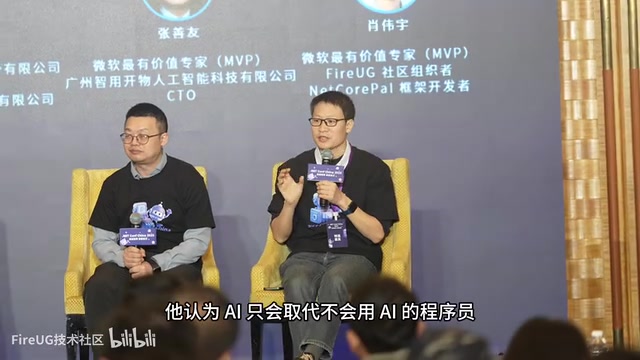
This viewpoint deserves deep consideration from every developer. Looking at the current state of AI programming tools, GitHub Copilot launched in 2021 as the first large-scale commercial AI code completion tool, powered by OpenAI's Codex model (a code-fine-tuned version of the GPT series). Since then, competitors like Cursor (an IDE based on GPT-4/Claude), JetBrains AI Assistant, and Amazon CodeWhisperer have emerged, forming a complete ecosystem for AI-assisted programming. The core capabilities of these tools include context-aware code completion, natural language to code (NL2Code), automatic unit test generation, and code explanation and refactoring suggestions. According to GitHub's 2024 survey data, developers using Copilot saw an average 55% improvement in coding speed for specific tasks. However, these tools serve more as "intelligent assistants" than "replacements" — real software engineering involves complex activities like requirements analysis, architecture design, team collaboration, and system maintenance. Human judgment remains irreplaceable for high-level tasks such as architectural decisions, security reviews, and cross-system integration.
However, Teacher Xiao's warning is also very pragmatic: If programmers refuse to embrace AI tools and cling to traditional development methods, they will inevitably be at a disadvantage in the efficiency competition. Future developers need the ability to collaborate with AI, using it as a lever to amplify their own capabilities rather than viewing it as a threat.
How Should Programmers Respond to the AI Wave?
Combining insights from the conference discussions and industry trends, here are some suggestions for .NET developers:
- Proactively learn AI programming tools: Master assistive tools like Copilot and Cursor, delegating repetitive coding tasks to AI
- Strengthen architecture design skills: AI excels at writing code snippets, but system-level architecture design still requires human leadership
- Develop an AI collaboration mindset: Learn to describe requirements precisely in natural language to improve the efficiency of AI interactions
Afternoon Tracks: AI Agents and Architecture Practices Take Center Stage
The four afternoon tracks were packed with content, with the two most popular topics being:
Clean DDD + AI Agent: Merging Architecture with Intelligence
Teacher Xiao's "Clean DDD + AI Agent" combined the clean architecture principles of Domain-Driven Design (DDD) with AI Agent technology, exploring how to fully leverage AI Agent capabilities to enhance application intelligence while maintaining clean code architecture.
To understand the value of this approach, two core concepts need to be explained. Domain-Driven Design (DDD) was systematically introduced by Eric Evans in 2003. Its core idea is organizing code around business domain models, making complex business logic explicit through patterns like Bounded Context, Aggregate Root, and Domain Events. Clean Architecture, proposed by Robert C. Martin (Uncle Bob), emphasizes that dependencies should always point inward toward the domain core, completely decoupling business logic from frameworks, databases, and UI.
AI Agent (intelligent agent) represents the cutting-edge paradigm for large language model applications — unlike traditional single-turn Q&A, Agents possess a "perceive—plan—act" closed-loop capability: they can invoke external tools (such as search engines, databases, code executors), decompose complex tasks into multiple sub-steps, and dynamically adjust strategies based on intermediate results. Microsoft's Semantic Kernel and AutoGen are the most representative Agent frameworks in the .NET ecosystem. Combining Clean DDD with AI Agents means that the Agent's "tool invocations" and "reasoning chains" must also follow the same dependency rules, preventing AI logic from polluting the domain model. This provides a referenceable architectural paradigm for enterprise-grade AI application deployment.
.NET Software Architecture Template Management Practices
Teacher Jerry's "How to Develop and Manage .NET Software Architecture Templates" focused on the engineering practice level, sharing how to improve team development efficiency and code quality through standardized architecture templates.
These two topics represent the two major areas of focus in the current .NET community: practical AI implementation and software engineering best practices. The two are not in opposition but complement each other — good architecture design provides a solid foundation for AI integration, while AI tools in turn drive the evolution of architectural patterns.
Trend Insights: The AI Transformation of the .NET Ecosystem
From the agenda of the 2025 Shanghai .NET Conference, it's clear that the .NET ecosystem is undergoing a profound AI transformation. Several trends worth noting:
- AI Agent as the New Paradigm: No longer limited to simple AI API calls, the ecosystem is evolving toward Agent patterns with autonomous decision-making and multi-step reasoning. The rise of the Agent paradigm marks a shift in AI applications from "passive response" to "proactive execution," and the Clean DDD + AI Agent combination is a typical manifestation of this trend.
- Democratization of AI Development: .NET 10 provides more comprehensive AI integration support at the framework level, significantly lowering the barrier for developers to build AI applications.
- From Tools to Mindset: As the roundtable discussion revealed, AI is not just an efficiency tool — it requires developers to make fundamental adjustments in their thinking, learning to collaborate deeply with AI.
For .NET developers, 2025 represents a critical turning point. Embracing AI, improving architecture skills, and maintaining continuous learning will be key to staying competitive in this rapidly changing era. Whether you're a newcomer or a seasoned veteran, now is the best time to take action.
Related articles
 Tech Frontiers
A Rare Quiet Day in AI: Recursive Self-Improvement Stirs Beneath the Surface
A rare quiet day in AI sees multiple sources go silent simultaneously. Behind the calm, Recursive Self-Improvement (RSI) research continues. What this means for the industry.
 Tech Frontiers
Reve 2 vs. Ideogram 4: A Deep Dive into Layout Control in AI Image Generation
A deep comparison of Reve 2 and Ideogram 4's layout control capabilities, covering technical approaches, real-world use cases, and industry trends for designers and creators.
 Tech Frontiers
In the Weights: Check Your Influence Score in the AI World
In the Weights is an AI influence search engine that quantifies your presence in the AI world with a score. Explore how it evaluates practitioners and what it means for digital identity.