2026 AI Large Language Model Learning Roadmap: Complete Guide from Zero to Agent Development
Systematic practice—not fragmented hoarding—is the right way to learn AI large models.
This article identifies three common traps AI learners fall into—information hoarding, perfectionism, and fragmented learning—and recommends a 42-episode AI full-stack tutorial covering foundation, advanced, and practical modules. It proposes three paths for AI deployment in 2026: customizing AI agents, building competitive moats in vertical domains with RAG, and iterating fast from imperfect starts, emphasizing that technology's value lies in solving real problems.
Why 90% of People Learning AI Are Stuck in Place
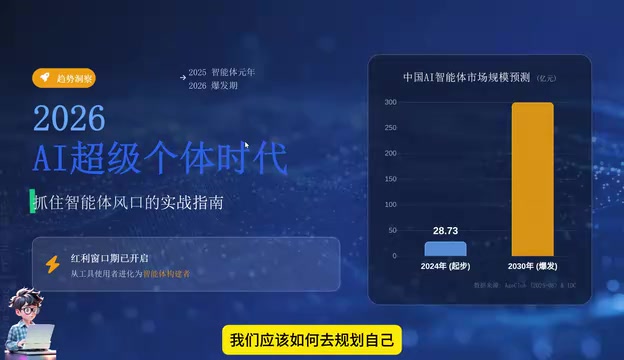
2025 was seen as the breakout year for AI large language models, while 2026 is the critical year for deep integration across industries and real-world deployment. Yet facing the endless stream of AI tools and technologies, most learners fall into the same trap—they've bookmarked countless resources, followed numerous influencers, and filled their phones with AI apps, but still can't build a single AI project that actually works.
Recently, a 42-episode AI Large Model Full-Stack Practical Tutorial launched on Bilibili, covering the complete pipeline from Python basics to Agent development, RAG, fine-tuning and deployment, all the way to enterprise-level projects. The core philosophy of this course has sparked widespread discussion: In the AI era, your true competitive edge isn't how much technology you've learned, but how many real problems you've solved with AI.
Three Types of AI Learners and Their Typical Struggles—Which One Are You?
The Information Hoarder: Bookmarks Overflowing, Project Experience Zero
The first type is the "information hoarder." Their bookmarks are stuffed with hundreds of articles, they spend an hour or two browsing tutorials every day, and their knowledge base appears impressively vast. They've studied prompt engineering, learned about RAG, and even looked into fine-tuning—but the moment they need to independently build a functional AI application, they have no idea where to start.
The root problem isn't insufficient learning—it's that there's no closed loop between knowledge and application. Continuous input without output is like constantly pouring water into a pool without ever opening the drain. Eventually it overflows rather than flows.
The Perfectionist: Always Preparing, Never Starting
The second type is the "perfectionist." They always feel they're not ready yet—not enough fundamentals, not enough resources, not enough technical depth. They endlessly refine their study plans, constantly compare tool performance, and wait for the "perfect moment" before taking action.
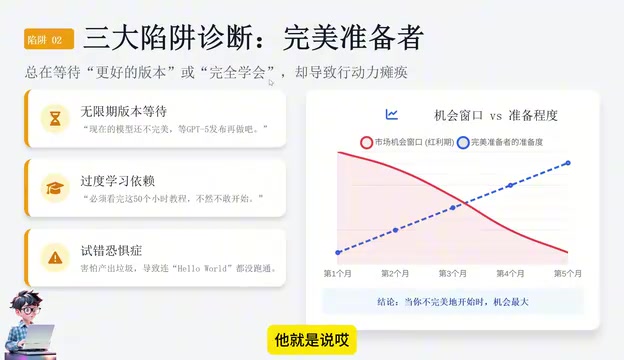
The reality is, while they're still researching which AI model performs better, others have already shipped AI applications and started iterating. This seemingly diligent preparation is essentially avoidance and procrastination. AI technology evolves daily—there's no such thing as "perfect preparation." True progress only comes through continuous correction in practice.
The Lone Explorer: Fragmented Learning Leading to Growing Confusion
The third type is the "lone explorer." They dabble here and there, searching for fragmented answers whenever they hit a problem. They've learned a bit of prompt engineering, read some about RAG, and explored fine-tuning, but can never string these pieces of knowledge into a complete solution.
It's like building a car—you've bought the wheels, steering wheel, and engine, but never assembled the vehicle. Without a systematic AI large model learning roadmap, fragmented knowledge only breeds deeper confusion.
42-Episode AI Large Model Tutorial: Three Modules Covering the Complete Learning Path
This 42-episode tutorial is designed specifically to address the pain points above, breaking the core LLM knowledge system into three progressive modules that help learners build complete capabilities from scratch.
Foundation Module: Quick Start for Absolute Beginners
The foundation module covers Python quick start, AI development environment setup, prompt engineering, and core LLM principles—including the Transformer architecture, pre-training, SFT (Supervised Fine-Tuning), RLHF (Reinforcement Learning from Human Feedback), and other key concepts. The goal is to help complete beginners cross the threshold into large language models in the most straightforward way possible.
The focus at this stage isn't turning you into an algorithm expert, but building a holistic understanding of the LLM tech stack to lay a solid foundation for hands-on development later.
Advanced Module: RAG Knowledge Base Construction, Agent Development & Fine-Tuning in Practice
The advanced module dives deep into practical technologies including RAG (Retrieval-Augmented Generation), Agent development, and the LangChain framework, with detailed coverage of LLM fine-tuning and private deployment workflows. It walks you through building external knowledge bases step by step. Combined with real enterprise scenarios—from choosing base models and processing datasets to implementing fine-tuning—it forms a complete technical closed loop.

Among these, RAG knowledge base construction is one of the hottest directions for enterprise AI deployment today. By combining private data with large language models, AI can deliver more precise and reliable answers in specific domains—a core capability that many companies are willing to pay for.
Practical Module: Enterprise-Level AI Projects from Zero to Launch
The practical module is the crown jewel of the entire course, guiding you through multiple enterprise-level projects:
- RAG Medical Q&A System: Professional domain Q&A based on retrieval-augmented generation, solving information accuracy challenges in medical scenarios
- Intelligent E-commerce Customer Service Agent: A customer service agent integrated with real business workflows, enabling automated customer service
- Digital Human Implementation: Complete workflow from technical setup to scenario application
- Education Industry Intelligent Teaching Assistant: A typical deployment case for vertical-domain AI applications
These projects directly mirror real business scenarios, helping you accumulate project experience worthy of your resume.
Three Practical Paths for AI Deployment in 2026
Learning the technology is only the first step—the key is transforming that technology into real value. The following three AI deployment paths have been validated and are suitable for learners at different stages.
Path One: Become an AI Agent Customizer
Many people think doing AI requires mastering a deep tech stack, but in reality, actual business needs are often not that complex. The key is to break down industry business requirements to the finest granularity, then analyze which steps can be replaced by AI.
Here's an example: A short-video e-commerce team writes 20+ pieces of copy daily, often working until 2 AM. If you can combine prompt engineering to customize a copywriting Agent for them, you've solved a real business pain point. This doesn't require complex technology—just deep understanding of product characteristics and business needs.
The market demand for this kind of AI agent customization service is growing rapidly, especially in e-commerce, education, and healthcare, where more and more companies are willing to pay for customized AI solutions.
Path Two: Go Deep in Vertical Domains, Build Competitive Moats with RAG and Agents
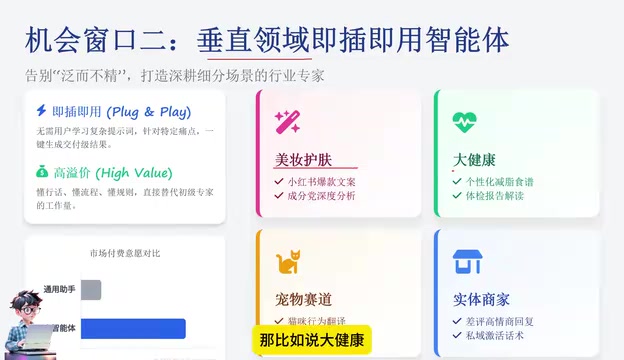
Competition in general-purpose AI applications has already reached a fever pitch. The real opportunity lies in deep focus on vertical domains. Whether it's beauty and skincare, health and wellness, or the pet industry, every niche has unique audience profiles, product characteristics, and business logic.
Take the pet industry as an example: What toys do cats like? What are common disease symptoms? What questions do pet owners care about most? When you've thoroughly understood these details and then combine RAG knowledge base construction and Agent development to build solutions, your competitive moat isn't just technology—it's deep industry understanding.
Core principle: Niche down, niche down, then niche down again. Cut into the deepest, most specific point in the industry and become the expert in that niche that others can't easily replace.
Path Three: Start Imperfect, Iterate Fast
The last and most important path: Take action immediately, start imperfect. Here are the specific steps:
- Choose a direction: Identify a specific vertical domain and business pain point
- Build a prototype: Build your first AI agent (it doesn't need to be perfect—just needs to run through the business workflow)
- Find users: Locate your first few seed users and run it in real business scenarios
- Iterate continuously: Gather feedback and optimize throughout the process
Only through practice can you get genuine feedback on your industry understanding. An imperfect product that's actually running is always more valuable than a perfect plan that only exists on paper.
Conclusion: Learning AI Large Models in 2026—Technology's Value Lies in Deployment
The AI dividend in 2026 can be summarized in one sentence: It's not about how much technology you know, but your ability to solve problems using AI. AI is always just a tool—what truly creates value is the ability to deeply integrate technology with business scenarios.
The value of this 42-episode AI large model tutorial lies not only in covering the complete knowledge system from Python basics to Agent development, but also in conveying an important learning philosophy—stop hoarding ineffectively and start practicing effectively.
Whether you're a complete beginner or a developer with some technical background, the most worthwhile thing to do right now is: identify a vertical domain, build your first agent, and get it running in a real scenario. That's the right way to learn AI large models in 2026.
Related articles
 Tutorials
ChatGPT Plus Subscription Guide: Are GPT-5.5, image-2, and Codex Worth the Upgrade?
A detailed look at ChatGPT Plus features — GPT-5.5, image-2, and Codex — with a Plus vs Pro comparison and a complete step-by-step subscription guide for users outside the US.
 Tutorials
Harness AI Engineering in Practice: Using Claude Code to Master Enterprise-Level E-Commerce Development
Deep dive into Harness AI Engineering: master enterprise e-commerce development with Claude Code using the Rules, Skills, Wiki, and Changes framework.
 Tutorials
Cursor + Codex Dual-IDE Collaboration: A Practical Methodology for Open-Source Project Customization
A complete methodology for open-source project customization based on real-world experience, detailing the Cursor+Codex dual-IDE workflow, seven-stage process, MVP validation, and AI source code reading techniques.