2026 Desktop Speaker Buying Guide: 24-Model Roundup and Pitfalls to Avoid

Roundup of 23 desktop speakers: filter by budget, space, and interfaces in three steps to avoid spec traps.
Based on a Bilibili roundup of 23 desktop speakers, this article outlines a buying thread by price tier. The author stresses that high power doesn't mean good sound and a newer Bluetooth version doesn't mean lower latency; before buying, confirm desktop depth, device interfaces, and budget. It analyzes representative products from under 100 yuan to over 3,000 yuan, noting 200–300 yuan is the most crowded segment and above 1,000 yuan shifts to desktop HiFi, where interface richness (optical, coaxial, HDMI ARC) is key. Virtual 7.1 is algorithmic, not physical multi-channel. Four reusable conclusions: measure space, count interfaces, recognize virtual surround, and assess whether extras justify the premium.
The logic behind choosing desktop speakers is quite different from buying headphones or a home theater system. It's constrained by desktop space, device interfaces, and daily usage scenarios—the "high power" or "new Bluetooth" on a spec sheet often doesn't translate directly into listening experience. This Bilibili roundup lays out 23 products by price tier, from under 100 yuan to desktop HiFi, which happens to help us clarify a main thread for choosing.
1. Set Your Budget and Form Factor First, Then Talk Specs
This content repeatedly emphasizes one point: high power doesn't mean good sound quality, and a newer Bluetooth version doesn't mean lower latency. Desktop speaker form factors have already diverged clearly—soundbars save space, separate 2.0 systems offer flexible placement, 2.1 systems have a dedicated subwoofer, and pixel-screen and lighting-effect products focus on atmosphere and playability.
Before buying, you need to confirm three things: whether your desktop depth is enough for a soundbar or subwoofer, whether your devices can connect (Bluetooth, AUX, USB sound card, optical/coaxial), and whether you value sound or atmosphere more within your budget. The author also mentions that discovering it blocks your monitor or that the interfaces don't match after buying is the most common failure scenario.
Frequency response range refers to the range of sound frequencies a speaker can reproduce, measured in hertz (Hz); the human hearing range is roughly 20Hz–20kHz. Parameters like "75Hz–20kHz" and "55Hz–20kHz" appearing in the text—the lower the lower limit, the better the bass extension usually is, but this value is affected by measurement conditions and attenuation standards (such as ±3dB), so different brands cannot be directly compared. Desktop small speakers are limited by cabinet volume, and their low-frequency lower limit is often 60–80Hz, which is also why 2.1 systems use a dedicated subwoofer to supplement bass.
Signal-to-noise ratio (SNR) is the power ratio of signal to noise, measured in decibels (dB); the higher the value, the lower the background noise and the cleaner the sound. The "≥100dB," "≥85dB," and "90dB" mentioned in the text all refer to this. Generally speaking, above 85dB is sufficient for daily use, and above 100dB is a relatively good level, but note that manufacturers' rated conditions (such as A-weighting) may not be consistent, and a high SNR doesn't mean good sound quality—it only means a "blacker" background when silent.
2. The Trade-off Logic Behind Three Recommended Picks
The author singles out three products as recommendations, covering different need directions.
The core selling point of the Huazai Pixelbar AI (reference price 599 yuan) is access to AI large models such as Doubao, allowing continuous conversation with context retention after one wake-up, plus QQ Music integration for voice song requests. The pixel screen supports custom text and even hand-drawn images; on the audio side it offers 15W continuous power, 30W peak power, and custom EQ. The author's attitude is clear: if you're purely after sound quality, there are plenty of options at this price, but if you want "music + pixel lighting + AI assistant" in one, it's worth a look. Note that AI features depend on internet connectivity, and QQ Music requires binding an account in advance.
The Huazai Pixel Bar Enhanced Edition (reference price 398.7 yuan) is a soundbar in the same series, with Bluetooth 6.0 plus wired, 7.5W+7.5W 2.0 channel, SNR ≥100dB, frequency response 75Hz–20kHz, abyss-mirror RGB lighting, and a pixel screen supporting nearly a hundred dynamic wallpapers and lyrics display. Compared with the AI version, it's over 200 yuan cheaper with similar sound parameters—suitable for users who don't need AI interaction.
The Colorful X9 Pro (reference price 253.9 yuan) takes the interface and power route: Bluetooth 6.0, AUX, U-disk and TF card playback, so you can listen without connecting to a computer; 4 active drivers plus 2 passive radiators, total output 18W, supporting algorithm-simulated virtual 7.1 sound effects. The author specifically clarifies that this is algorithmic surround rather than physical multi-channel, to avoid misunderstanding.
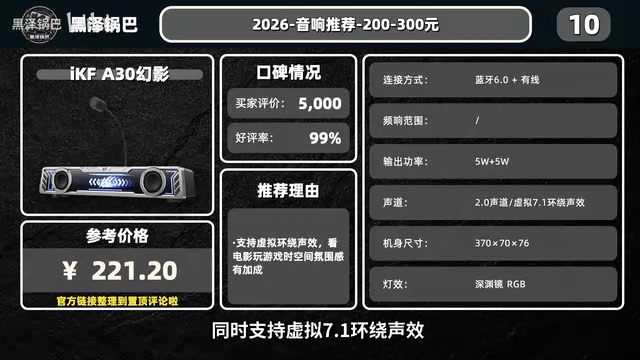
Virtual 7.1 surround uses algorithms to filter, delay, and crosstalk-process two-channel signals to simulate the subjective sensation of multi-channel speakers surrounding the listener—it does not actually place 7 satellite speakers and 1 subwoofer. It relies on psychoacoustic models such as head-related transfer functions (HRTF), which help with atmosphere for movies and games, but positioning accuracy is affected by individual ear-canal differences and it tends to lose some sound quality. The "virtual 7.1" of the Colorful X9 Pro and IKF A30 in the text both fall into this category; the author specifically reminds that it's "algorithmic surround rather than physical multi-channel" precisely to avoid confusing it with home theater multi-channel systems.
3. Under 100 Yuan and 100–200 Yuan: Good Enough for Entry
The three under-100-yuan products range from 68.99 to 89 yuan, all from Colorful. The CF100 (68.99 yuan) supports Bluetooth 5.3 and wired, 6W output, an integrated rainbow light strip at the bottom, and weighs 447g; the CF500 (87.78 yuan) has a slim design, 2.5W+2.5W, suitable for scenarios with tight depth under the monitor; the CF2000 (89 yuan) outputs 7.2W, with a light strip that can be switched on/off and adjusted—you can simply turn off the lighting if you don't want it.
The 100–200 yuan tier has two products. The Colorful CF700 (155 yuan) focuses on approximately 16.8 million-color RGB lighting with 3W×2 output; the Edifier G1200 (165 yuan) uses a separate dual-satellite design, with a translucent cyber-eye rainbow light ring on the front, supporting Bluetooth 5.4, USB, wired, and 3.5mm connections—as a product from a veteran audio manufacturer, three connection methods at the same price is fairly generous.
The core expectation for this price tier should be "it makes sound, connects conveniently, and looks decent"—don't expect too much in terms of soundstage and bass.
4. 200–300 Yuan: The Most Crowded Segment
This tier has 6 products, with noticeably more choice. The Edifier G1500Bar (208.99 yuan) is the brand's entry-level soundbar; the IKF A30 Phantom (221.2 yuan) offers 5W+5W output and virtual 7.1 surround sound effects; the Colorful CF3000 (239 yuan) upgrades to Bluetooth 6.0, with lighting effects that can change with the rhythm of the sound; the Huazai Halo Soundbar (242.1 yuan) continues the abyss-mirror RGB style.
The Misheng Xinghuo sound card speaker (249 yuan) is a rather special one in this price tier: it has a built-in independent sound card chip, and after connecting a 3.5mm headphone, you can adjust EQ through PC driver software; interfaces include two USB, two Type-C, a 3.5mm headphone jack, and an external microphone jack, supporting approximately 16.8 million-color RGB and 9 lighting effects, with the brand claiming about 20 hours of battery life. The author reminds of two details: the two USB ports are only usable when wired; and the brand's details also state that the speaker's external playback sense of direction is weaker than headphones—if you need precise positioning, it's recommended to plug in headphones.
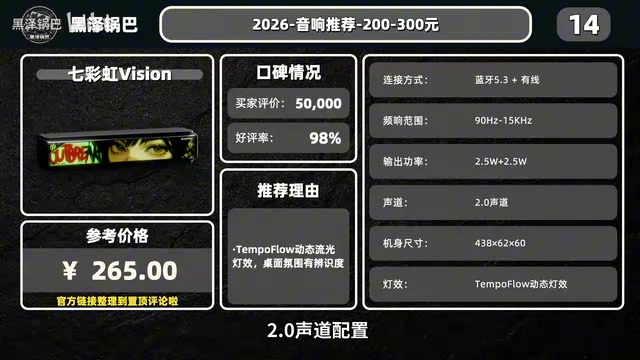
The Edifier G2500BAR (262 yuan) and Colorful Vision (265 yuan) focus respectively on virtual 7.1 surround and Tempo Flow dynamic lighting. The key at this tier is to clarify whether you rely more on the movie/gaming atmosphere brought by virtual surround, or value interfaces and lighting playability more.
5. 300–600 Yuan: Form Factors Begin to Diverge
The Dianyin Mini 2 (306.5 yuan) is a mini desktop pixel speaker, mono 5W, weighing only 201.8g, replacing traditional RGB with pixel-screen animation, positioning closer to a desktop ornament. The Edifier G1500 MAX (387 yuan) is a complete 2.1 separate system: 7.5W+7.5W for mid-high plus 15W for bass, totaling 30W, supporting Bluetooth 5.3, USB sound card, and AUX; the subwoofer can be placed under or beside the desk, suitable for users who want dedicated bass.
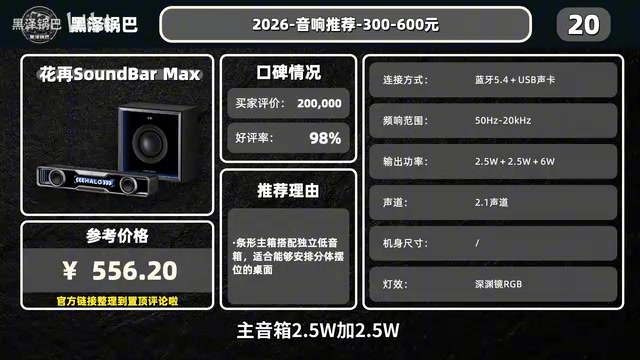
The Huazai Pixel Bar Enhanced Edition appears again in this price tier, repeated by price order. The Edifier CyberX (466 yuan) takes the single-unit route, 20W mono output, ring RGB lighting, suitable for scenarios with limited desktop space where you don't want to place a soundbar or separate system. The Huazai Halo 2.0 SE (549 yuan) is 15W per side, noticeably more powerful than the same brand's soundbar products; the Huazai Samba Max (556.2 yuan) consists of a soundbar main unit plus a separate bass unit, 2.1 channel totaling 11W, requiring space and power for both cabinets.
6. Above 1,000 Yuan: Desktop HiFi and Brand Classics
The Huazai Halo 2.0 (1,297 yuan) is a 2.0 separate system: 15W×2 for tweeters plus 20W×2 for mid-bass, 35W per cabinet, 70W total for the pair, weighing 5.3kg for the set, supporting Bluetooth 5.3, USB sound card, and Line in, SNR ≥85dB, frequency response 55Hz–20kHz.
The Harman Kardon SoundSticks 4 (1,753 yuan) is a 2.1 system, total output 140W, frequency response 40Hz–20kHz, with a highly recognizable transparent satellite design, a ring of blue indicator lights on the subwoofer, and overall restrained lighting that doesn't go the RGB route. The SoundSticks 5 (2,500 yuan) raises total power to 190W, upgrades Bluetooth to 5.4, and adds an HDMI ARC interface, allowing connection to ARC-compatible TVs or monitors for audio return; the subwoofer also adds a ring ambient light.
The highest-priced so-called minimax3 (3,682 yuan) takes the pure HiFi route with no RGB; each speaker has a built-in 3-inch coaxial driver and 3.5-inch bass driver, 160W total for the pair, SNR 90dB, and interfaces covering RCA, digital optical, coaxial, USB-C, and Bluetooth 5.0—digital optical and coaxial inputs mean it can connect to more types of audio sources, which is the key difference from consumer-grade products.
HDMI ARC (Audio Return Channel) is a feature introduced in HDMI 1.4 that allows a TV to send audio back to speakers or an amplifier over the same HDMI cable, eliminating the need for an extra optical or coaxial cable. For desktop scenarios, if the monitor or TV supports ARC, connecting the speaker to HDMI ARC lets you control volume in sync and transmit compressed multi-channel audio—tidier than AUX. The SoundSticks 5 adding this interface means it can more conveniently serve as external speakers for a TV or monitor.
Coaxial and optical inputs are both digital audio interfaces; the difference lies in the transmission medium: optical uses light signals, with strong resistance to electromagnetic interference but prone to jitter over long distances; coaxial uses a coaxial cable to transmit electrical signals, with good stability over short distances. Both support PCM stereo and compressed multi-channel bitstreams, and are common ways for desktop HiFi speakers to connect to CD players, DACs, or TVs. The minimax3 offers RCA (analog), optical, coaxial, USB-C, and Bluetooth 5.0 simultaneously, covering multiple audio sources from analog to digital and from wired to wireless—precisely reflecting its positioning as professional HiFi.
7. A Few Reusable Buying Conclusions
First, measure your desktop depth and monitor height before deciding between soundbar, separate, or 2.1—blocking the screen is the most frequent reason for returns. Second, count your audio source interfaces: devices with only Bluetooth don't need to pay for optical/coaxial, while those with TV or console needs should pay attention to HDMI ARC. Third, virtual 7.1 is algorithmic simulation, not physical multi-channel—it helps with atmosphere but don't expect true surround positioning. Fourth, for products with AI interaction, pixel screens, or custom EQ, whether the added value is worth the premium depends on whether you'll actually use it.
The value of this roundup isn't in giving a single answer, but in clearly breaking down the three variables of budget, interfaces, and placement. Screen through them in this order, and the range left to choose from actually isn't large.
One-line Summary
A roundup of 23 desktop speakers: filter in three steps—budget, space, interfaces—and avoid spec traps.
Paragraph Summary
Based on a Bilibili roundup of 23 desktop speakers, this article outlines a main thread for buying by price tier. The author emphasizes that high power doesn't equal good sound quality and a newer Bluetooth version doesn't equal lower latency; before buying, you need to confirm three prerequisites: desktop depth, device interfaces, and budget. The article analyzes representative products tier by tier from under 100 yuan to over 3,000 yuan, pointing out that 200–300 yuan is the most crowded segment and that above 1,000 yuan shifts to desktop HiFi, where interface richness (optical, coaxial, HDMI ARC) becomes a key differentiator. Virtual 7.1 is algorithmic simulation rather than physical multi-channel, and expectation mismatch should be avoided. Finally, it gives four reusable conclusions: measure space first, count interfaces, recognize virtual surround, and evaluate whether additional features are worth the premium.
Related articles

AI Product Manager Systematic Course for Beginners: Three Modules Explained with Pitfall Avoidance Guide
Breakdown of Bilibili's 100-episode AI product manager course: Foundation builds large model and Prompt cognition, Advanced tackles Agent workflows and RAG knowledge bases, Practice completes projects like personal knowledge bases and intelligent customer service. Includes learning roadmap and pitfall avoidance tips.

YOLO Object Detection for Absolute Beginners: Environment Setup and Core Concepts
Learn YOLO object detection from scratch: Python basics, VS Code, Miniconda environment setup. A Bilibili tutorial guides you step by step, with a desktop icon recognition project as your hands-on goal.
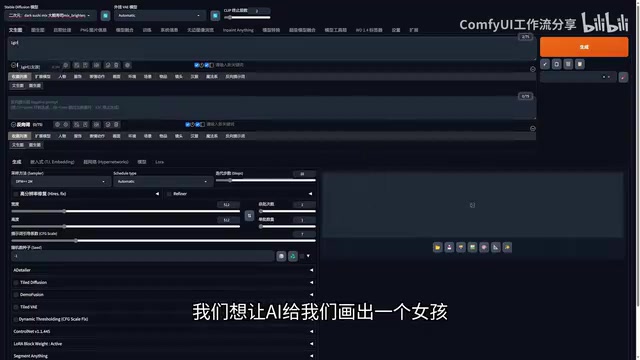
Akio SD Bundle 2026 Edition: One-Click Install & Zero-Basics Image Generation Tutorial
Akio Stable Diffusion bundle 2026 one-click install tutorial: text-to-image prompts, checkpoint and VAE selection, sampling parameters, seed reproduction, and ControlNet line-art repainting—generate images from zero basics.