AI Product Manager Systematic Course for Beginners: Three Modules Explained with Pitfall Avoidance Guide

Breakdown of Bilibili's 100-episode AI product manager course: three modules build a complete system from cognition to practice.
This article systematically breaks down the 100-episode AI product manager course launched by a Bilibili creator. Addressing the pain points of scattered and detached learning resources, the course adopts a progressive design of three modules: Foundation builds cognition of large model principles, Prompt engineering, and product thinking; Advanced focuses on core job capabilities such as requirements analysis, Agent workflows, intelligent agent design, and RAG knowledge bases; Practice closes the loop through three projects: personal knowledge base, intelligent customer service Agent, and automated office assistant. The article also evaluates the use of bonus materials such as the learning roadmap, and notes that the course suits zero-foundation transitioners, but the 100-episode volume requires a study plan. "Becoming a master in one week" is marketing rhetoric, and true capability improvement depends on hands-on practice and business understanding.
AI product managers are becoming a hot role in the era of large models, but learning resources on the market often have scattered knowledge points and lack systematic structure. This 100-episode systematic course launched by a Bilibili creator attempts to take zero-foundation learners from beginner to mastery in the "most original, most intuitive, and purest" way. Based on the course introduction and screenshots, this article breaks down its content architecture and design logic, and offers learning suggestions.
Why AI Product Manager Courses Need to Be "Systematic"
Current learning resources for AI product managers exist at two extremes: either they only cover large model principles and Agent concepts while detached from product implementation, or they only teach tool operations without underlying cognition. After surveying a large number of related tutorials on Bilibili, the creator found that very few truly guide learners step by step from zero. The starting point of this course is to abandon the "flashy" approach and use high-density substantive content to cover the complete knowledge chain.
The course took months to produce, combining real cases and project practice, with the goal of enabling learners to "learn and apply flexibly." From the screenshots, the creator emphasizes that "every lesson yields something," and whether this promise can be fulfilled depends on the rationality of the course structure—analyzed module by module below.

Breakdown of Three Modules: Progressive Design from Cognition to Practice
Foundation Module: Building the AI Cognitive Base
The foundation module addresses the problem of "not understanding and not being able to explain clearly." Content covers large model principles, Prompt engineering, product thinking, and mainstream AI tools. For zero-foundation learners, the value of this part lies in establishing a common language—without understanding the capability boundaries of large models, one cannot judge whether a requirement is feasible; without mastering Prompt engineering, it is difficult to evaluate the stability of AI output. The product thinking module maps AI capabilities to user value, avoiding falling into a purely technical perspective.
Prompt engineering refers to designing and optimizing the instructions input to large models to guide them to generate more accurate, stable, and expected outputs. It is not simply "questioning techniques" but a systematic methodology involving role setting, task decomposition, example provision (Few-shot), output format constraints, Chain-of-Thought guidance, and more. For AI product managers, Prompt engineering capability directly relates to rapid validation of product prototypes and controllability of AI output quality—under limited resources, excellent Prompt design can often replace part of model fine-tuning work and is a key skill for low-cost implementation.
Advanced Module: Mastering Core AI Product Capabilities
The advanced module focuses on core capabilities such as requirements analysis, Agent workflows, intelligent agent design, and RAG knowledge bases. These are precisely the keywords that appear frequently in current AI product manager job descriptions. RAG knowledge bases are particularly critical, as they determine whether AI applications can access enterprise private data and reduce hallucinations. The course lists RAG as an independent capability point, indicating that its design aligns with actual business scenarios rather than staying at concept popularization.
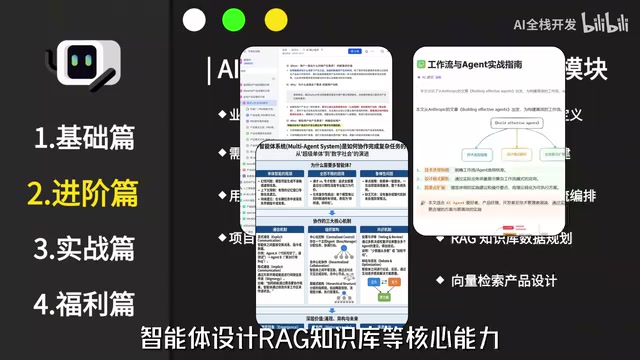
The combination of Agent workflows and intelligent agent design corresponds to the industry trend from "single-turn Q&A" to "task automation." Learners need to understand concepts such as workflow orchestration, tool calling, and state management. If this part is explained thoroughly, it will significantly enhance job-seeking competitiveness.
RAG (Retrieval-Augmented Generation) is a technical architecture that combines external knowledge retrieval with large model generation. Its basic process is: after a user asks a question, the system first retrieves relevant document fragments from the enterprise knowledge base, then injects the retrieval results as context into the Prompt, allowing the large model to generate answers based on these factual contents. The core value of RAG lies in solving the "hallucination" and knowledge timeliness problems of large models, enabling AI applications to access enterprise private data without retraining models. Product managers need to understand key aspects such as retrieval strategies, chunking methods, and recall quality evaluation to design truly usable knowledge base products.
Agent workflow refers to system design that uses large models as reasoning engines, orchestrating multiple steps (such as intent recognition, tool calling, and result integration) to complete complex tasks. Unlike single-turn Q&A, Agents need task planning, tool use, state management, and exception handling capabilities. Intelligent agent design focuses more on role definition, memory mechanisms, and autonomous decision-making logic. This combination represents the evolution direction of AI products from "passive response" to "proactive execution," and is also where the key differentiation of current AI product manager positions lies.
Practice Module: Closing the Loop with Real Projects
The practice module walks through multiple projects hand-by-hand, including a personal knowledge base, an intelligent customer service Agent, and an automated office assistant. These three projects cover three typical scenarios—knowledge management, customer service, and efficiency tools—with a reasonable progression in difficulty. The personal knowledge base is an introductory RAG practice, the intelligent customer service Agent tests multi-turn dialogue and workflow design, and the automated office assistant involves tool integration and task orchestration. Completing these projects will give learners the preliminary ability to independently advance AI projects.
Value and Usage Suggestions for Bonus Materials
The course provides materials such as a learning roadmap, course notes, project cases, product templates, and interview materials, which can be obtained for free by leaving a comment. From the screenshots, the learning roadmap is the core material, helping learners plan their learning sequence.
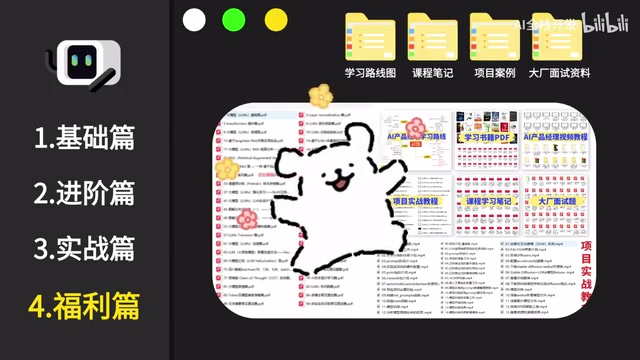
It should be noted that the value of the materials depends on how they are used. It is recommended to first go through the roadmap to clarify the dependencies between modules, and then proceed in the order of "Foundation → Advanced → Practice." Do not just read project cases without practicing—hands-on reproduction is the only way to expose blind spots in understanding. Interview materials can be used as staged self-assessment tools to test knowledge mastery.
Who It Suits, and What to Watch Out For
This course is positioned for zero-foundation learners and is suitable for product managers transitioning roles, technical professionals moving into product, and students who want to systematically understand AI product work. The 100-episode volume means high information density, but it also demands learning perseverance. It is recommended to set a weekly study plan to avoid stockpiling courses without studying.
The course's promotional claim of "from novice to master in one week" is marketing rhetoric; actual mastery depends on time invested and practice quality. The core competitiveness of AI product managers lies in understanding business scenarios and judging the match with AI capabilities. The course can provide a knowledge framework and project experience, but true product sense needs to be honed in real work. Treat the course as a systematic introductory map rather than a shortcut to quick success, and the gains will be more solid.
One-line Summary
Breakdown of Bilibili's 100-episode AI product manager course: three modules building a complete system from cognition to practice.
Paragraph Summary
This article systematically breaks down the 100-episode AI product manager course launched by a Bilibili creator. Addressing the pain points of scattered and detached learning resources, the course adopts a progressive design of three modules: Foundation, Advanced, and Practice. The Foundation module builds cognition of large model principles, Prompt engineering, and product thinking; the Advanced module focuses on core job capabilities such as requirements analysis, Agent workflows, intelligent agent design, and RAG knowledge bases; the Practice module closes the loop through three projects: personal knowledge base, intelligent customer service Agent, and automated office assistant. The article also evaluates the use of bonus materials such as the learning roadmap, and notes that the course suits zero-foundation transitioners, but the 100-episode volume requires a study plan. "Becoming a master in one week" is marketing rhetoric, and true capability improvement depends on hands-on practice and business understanding.
Related articles
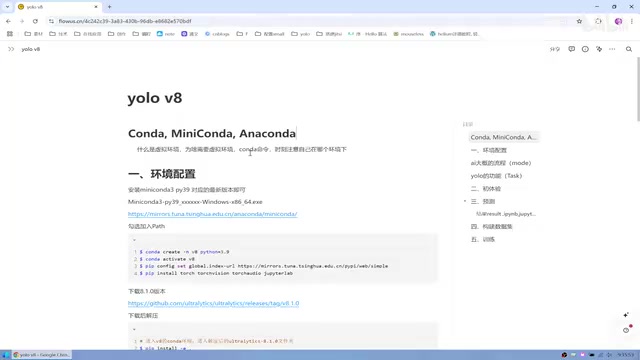
YOLO Object Detection for Absolute Beginners: Environment Setup and Core Concepts
Learn YOLO object detection from scratch: Python basics, VS Code, Miniconda environment setup. A Bilibili tutorial guides you step by step, with a desktop icon recognition project as your hands-on goal.

2026 Desktop Speaker Buying Guide: 24-Model Roundup and Pitfalls to Avoid
How to choose 2026 desktop speakers? Based on a Bilibili roundup of 23 products, this guide analyzes budget, interfaces, and placement by tier—under 100 yuan, 200–300, 300–600, and above 1,000—and reviews standouts like Huazai Pixelbar AI, Colorful X9 Pro, and Edifier G1500 MAX.
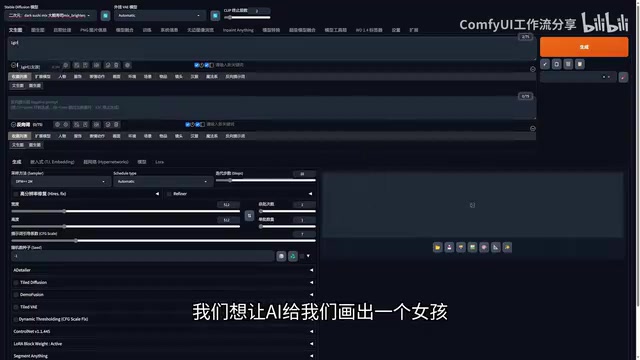
Akio SD Bundle 2026 Edition: One-Click Install & Zero-Basics Image Generation Tutorial
Akio Stable Diffusion bundle 2026 one-click install tutorial: text-to-image prompts, checkpoint and VAE selection, sampling parameters, seed reproduction, and ControlNet line-art repainting—generate images from zero basics.