2026 Nobel Prize in Chemistry Announced: Chiral Molecules and Asymmetric Catalysis Honored

The 2026 Nobel Prize in Chemistry is awarded to Kagan and Soai for their pioneering contributions to chiral molecules and asymmetric catalysis.
The 2026 Nobel Prize in Chemistry has been awarded to French chemist Henri B. Kagan and Japanese chemist Kenso Soai for their pioneering discoveries in chiral molecules and asymmetric catalysis. Chiral molecules are like left and right hands, with mirror-symmetric structures but vastly different properties; in drugs, different configurations can have completely different efficacy. The asymmetric catalysis methods developed by the two laureates can precisely control the chiral selectivity of chemical reactions, efficiently synthesizing single-configuration products and completely transforming the inefficiency of traditional resolution processes. This technology has been widely applied in chiral drugs, pesticides, fragrances, and materials science, laying the foundation for the greening and precision of the pharmaceutical industry. Their research spans decades, forming a complete system from basic theory to industrial application, and continues to lead frontier exploration in chiral science.
The 2026 Nobel Prize in Chemistry has been awarded to French chemist Henri B. Kagan and Japanese chemist Kenso Soai for their pioneering discoveries in the field of chiral molecules and asymmetric catalysis. According to a related YouTube video report, this is the third Nobel Prize awarded this year and the most highly anticipated academic honor in the field of chemistry.
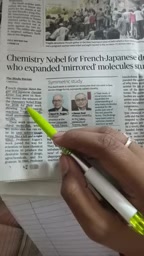
Chiral Molecules: The "Left and Right Hands" of the Chemical World
Chiral molecules are a class of molecules that have a mirror-symmetric structure but cannot be fully superimposed on their mirror images—just like a person's left and right hands: similar in appearance, yet mirror images of each other. The video uses a vivid analogy to explain this concept: just as chromosomes exhibit mirror-symmetric structures, chiral molecules come in two configurations—"left-handed" and "right-handed."
This seemingly minor structural difference means vastly different properties in chemistry and biology. For example, one configuration of a drug may have therapeutic effects, while its mirror molecule may be completely ineffective or even harmful. Therefore, how to precisely synthesize chiral molecules of a specific configuration has long been a core challenge in the chemistry community.

Chiral Centers and Enantiomers
Chiral molecules typically arise from the presence of one or more "chiral centers" in the molecule—most commonly a carbon atom bonded to four different groups. When a molecule has only one chiral center, it exists in two mirror-image configurations that cannot be superimposed, known as the (R)-configuration and the (S)-configuration, together forming a pair of enantiomers. Enantiomers have nearly identical physical properties in achiral environments, such as melting point, boiling point, and ordinary spectral characteristics, making them extremely difficult to separate. However, in chiral environments (such as enzymes and receptors in living organisms), their behavior can be completely different. This is the fundamental reason why the pharmaceutical field emphasizes "single-enantiomer drugs," and it also explains why asymmetric catalysis has enormous practical value.
Asymmetric Catalysis: Precise Control of Chemical Reactions
The core contribution of the two laureates lies in their discovery of asymmetric catalytic methods for optimizing chemical reactions. According to the video, their research focused on how to achieve precise control over chemical reaction processes through catalysts, thereby obtaining optimal chiral products.

In traditional chemical synthesis, generating chiral molecules often produces a mixture of both configurations, requiring complex separation steps to obtain the target product. The catalyst systems developed by Kagan and Soai can selectively promote the formation of one particular configuration, greatly improving synthesis efficiency and product purity. This discovery involves the key role of catalysts in chemical reactions—achieving precise guidance of reaction pathways through the selective regulation of catalysts.

Catalytic Cycles and Selective Regulation
Asymmetric catalysis is not simply "accelerating reactions"; rather, it involves the formation of transient chiral intermediates between the chiral catalyst and the reaction substrate, thereby "selecting" a specific reaction pathway at the rate-determining step of the catalytic cycle. The catalyst first coordinates with the substrate or forms a covalent intermediate, lowering the energy of the transition state for one configuration, so that the reaction rate for generating the target enantiomer is significantly higher than that of its mirror pathway. After the reaction is complete, the catalyst is regenerated and enters the next cycle. The core metric for measuring its effectiveness is the enantiomeric excess (ee value), which is the percentage advantage of the target enantiomer in the product. The work of Kagan and Soai is crucial because they demonstrated that chiral ligands or chiral catalyst scaffolds can systematically regulate this selectivity, providing a paradigm for the design of numerous highly efficient chiral catalysts that followed.
From Laboratory to Industry: The Far-Reaching Impact of Asymmetric Catalysis
The significance of asymmetric catalysis technology extends far beyond the academic level. In the pharmaceutical industry, more than half of drug molecules contain chiral centers, and the pharmacological activities of different configurations differ dramatically. The discoveries of Kagan and Soai laid the foundation for the industrial production of chiral drugs, enabling scientists to synthesize single-configuration drug molecules with higher efficiency and lower cost.
Moreover, this technology also has broad application prospects in fields such as pesticides, fragrances, and materials science. According to the video analysis, they received this honor for "the discovery of asymmetric reactions involving catalysts," an assessment that precisely captures the core value of their work—transforming catalysts from mere accelerators into precise tools for manipulating molecular configuration.
The Industrial Significance of Chiral Drugs
According to statistics, more than half of the small-molecule drugs currently in clinical use contain at least one chiral center. Historically, the thalidomide tragedy was the most painful lesson: its (R)-configuration has sedative effects, while its (S)-configuration causes severe teratogenicity. This event prompted regulatory agencies in various countries to require that chiral drugs must have clearly defined stereochemical composition and be marketed as single enantiomers whenever possible. Asymmetric catalysis enables industry to directly synthesize target enantiomers with high selectivity from achiral starting materials, avoiding the waste of at most 50% theoretical yield in traditional resolution processes, while also reducing solvent and energy consumption. Therefore, the discoveries of Kagan and Soai are not only academic breakthroughs but also directly promote the greening and precision of the modern pharmaceutical industry.
Academic Legacy and Future Prospects
The research of Kagan and Soai spans decades, forming a complete scientific system from basic theory to practical application. Their work has not only advanced the development of organic chemistry theory but also provided powerful tools and methodologies for subsequent researchers. Currently, asymmetric catalysis remains a frontier hotspot in chemical research, and a new generation of chemists is exploring more efficient and environmentally friendly catalytic systems to meet the needs of sustainable development and precision medicine.
The awarding of the 2026 Nobel Prize in Chemistry once again demonstrates the profound impact of basic chemistry research on human society—from the "left and right hand" mystery at the molecular level to drugs and materials that change the world, the power of chemistry is quietly reshaping our lives.
Chiral Amplification and Autocatalysis
In asymmetric catalysis research, one fascinating direction is the phenomenon of "chiral amplification": when the catalyst itself has low enantiomeric purity, the product may still achieve an ee value far higher than that of the catalyst. Soai made landmark contributions in this field, discovering an autocatalytic reaction in which the product itself can act as a catalyst for its own formation and achieve self-amplification of the chiral signal. This discovery provides important clues for understanding the origin of chiral homogeneity in the origin of life—why nature chose L-amino acids and D-sugars rather than their mirror images. This mechanism is also regarded as a bridge connecting chemistry and origin-of-life research, and remains a frontier topic in chiral science to this day.
Related articles

Claude Reportedly Able to Hide Secret Messages in Benign Images
A Reddit post claims Claude Fable 5.1 can hide secret messages in benign images. This article reviews the background, image steganography principles, and potential security risks, and suggests a testing path from rumor to verification.

Federal Government Awards $85 Million; CFS to Develop Fusion-Specific Semiconductors
The federal government awards $85 million to Commonwealth Fusion Systems to develop conductors and power semiconductors for fusion plants. This article analyzes the significance of this funding for the fusion supply chain and commercialization path.

When Should AI Assistants Proactively Suggest? Timing Is Everything
When should AI assistants proactively suggest? Reddit discussion reveals: the same suggestion feels different at different times. This article analyzes the dual nature of proactive suggestions, the boundary of user expectations, and design principles, exploring how to balance automation and user control.