2026 Nobel Prize in Chemistry Explained: How Molecules Choose Left or Right

2026 Nobel Prize in Chemistry awarded to Kagan and Soai for revealing how tiny biases in chiral molecules can be amplified by nonlinear effects and autocatalysis.
The 2026 Nobel Prize in Chemistry was awarded to French chemist Henri B. Kagan and Japanese chemist Kenso Soai for their discoveries concerning nonlinear effects and autocatalysis in asymmetric organic synthesis. Chiral molecules and their mirror images have different biological effects, and the origin of life's preference for specific configurations (homochirality) has long been a mystery. Kagan discovered that a small imbalance in catalyst chirality can produce a larger imbalance in the product (positive nonlinear effect), breaking the assumption of a simple proportional relationship between catalyst and product ee. Soai demonstrated asymmetric autocatalysis — chiral products can catalyze the formation of more products with the same chirality, achieving near single-enantiomer reaction results in 2003. These discoveries provide a chemical rationale for the origin of biological homochirality and are of great significance for designing efficient asymmetric catalytic systems in the pharmaceutical field.
2026 Nobel Prize in Chemistry Explained: How Molecules Choose Left or Right
Put your left hand in front of a mirror, and you will see a right hand. The two hands look almost identical — the same number of fingers, a similar shape, the same structural arrangement. But when you try to superimpose your left hand perfectly onto your right hand, you find they cannot overlap. They are mirror images of each other, yet not exactly the same.
This seemingly simple left-right distinction determines, in the chemical world, whether a drug is effective, how proteins fold, and perhaps even the origin of life itself. Many molecules exist in two mirror-image forms — they contain the same atoms, connected in the same order, but arranged differently in three-dimensional space. Chemists call this property chirality, and the two mirror forms are called enantiomers.
For over a century, scientists have been asking: if chemistry can produce both molecular mirror images, why does life overwhelmingly prefer one? Can chemists control which mirror image a reaction produces? The 2026 Nobel Prize in Chemistry was awarded to two scientists — French chemist Henri B. Kagan and Japanese chemist Kenso Soai — whose discoveries revealed a remarkable phenomenon: a tiny imbalance between two molecular mirror images can sometimes be amplified into an overwhelming preference for one; in certain reactions, molecules can even help produce more molecules with the same chirality.
Why Molecular Chirality Matters So Much
To understand this discovery, we must first understand why chirality is critical. Imagine two keys that look almost identical — one fits perfectly into a lock, the other does not. Now imagine that lock as a protein in your body. Proteins are three-dimensional structures whose binding sites have very specific shapes and chemical environments. A molecule that can fit into these sites may activate a receptor, inhibit an enzyme, or produce a therapeutic effect, but its mirror-image molecule interacts with the receptor in a completely different way.
Sometimes the biological effects of two enantiomers are similar; sometimes one is far more active than the other; sometimes their effects are entirely different. This has enormous significance in medicinal chemistry. When scientists develop chiral drugs, they usually need to understand the behavior of each enantiomer. Selectively producing the desired enantiomer can improve efficiency and reduce the need for complex separation steps.
Chirality is not limited to drugs. It is the foundation of life itself. Most amino acids incorporated into proteins by the ribosome are of the L-type, while the sugar components in DNA and RNA adopt the D-configuration. This consistent preference for a specific molecular configuration is called homochirality, and it raises a profound question: why should life prefer one molecular orientation over another?
Ordinary chemical laws do not automatically require a universal preference for one enantiomer. In many reactions that form chiral molecules from achiral starting materials, both mirror-image products can be produced in equal amounts, forming a racemic mixture — 50% each. So how does nature move from a nearly balanced mixture to the strong molecular preference characteristic of living organisms?
Enantiomeric excess (ee) is a quantitative measure of the excess of one enantiomer over the other in a chiral mixture. It is calculated as ee = |[R] − [S]| / ([R] + [S]) × 100%, where [R] and [S] represent the concentrations of the two enantiomers. When the two enantiomers are present in equal amounts, ee is 0%, and the mixture is called a racemate; when only a single enantiomer is present, ee is 100%. The ee value is one of the most central parameters in chiral synthesis and chiral drug quality control, because it directly reflects the stereoselectivity of a synthetic method or catalytic system. In the pharmaceutical industry, regulatory agencies such as the U.S. Food and Drug Administration (FDA) typically require chiral drugs to provide pharmacological and toxicological data for each enantiomer, and many single-enantiomer chiral drug products must achieve an ee above 99% to be approved for market. Therefore, developing catalytic systems that can efficiently increase product ee has long been a shared goal of both industry and academia.
From Pasteur to Asymmetric Catalysis
To answer this question, we need to go back more than 175 years. In 1848, a young French scientist, Louis Pasteur, was studying crystals of tartrate salts. Tartaric acid occurs naturally in grapes and wine. Pasteur noticed something unusual: some crystals had shapes that were mirror images of others. Using a microscope and extraordinary patience, he manually separated the two crystal forms, then tested their behavior toward polarized light — one rotated the plane of polarized light in one direction, the other in the opposite direction.
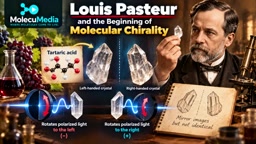
This was a historic observation, linking the visible difference in crystal shape to an underlying molecular property. Over the following decades, chemists developed a deeper understanding of three-dimensional molecular structure, recognizing that certain atomic arrangements could produce non-superimposable mirror images. Stereochemistry was born.
But understanding chirality was only the beginning. Chemists still faced a practical challenge: how to intentionally produce one enantiomer rather than the other? This became one of the great goals of modern organic synthesis — if chemists could control molecular chirality, they would gain extraordinary control over the molecules they created.
Asymmetric catalysis is one of the most effective strategies in modern organic synthesis for obtaining a single enantiomer. Its core idea is to use a small amount of a chiral catalyst to lower the activation energy for the reaction pathway leading to one enantiomeric product, so that the reaction proceeds preferentially along a specific pathway, thereby creating an enantiomeric excess in the product. Asymmetric catalysis can be divided into three major categories: enzymatic catalysis, metal catalysis, and organocatalysis. Compared with traditional chemical resolution methods (first synthesizing a racemate and then separating it), asymmetric catalysis has significant advantages such as high atom economy, fewer steps, and less waste. The 2001 Nobel Prize in Chemistry was awarded to Knowles, Noyori, and Sharpless for their pioneering contributions to asymmetric catalytic hydrogenation and oxidation reactions. Kagan's research further revealed a complexity in asymmetric catalysis that is often overlooked: catalyst molecules do not operate in isolation — their interactions with one another can significantly alter catalytic efficiency and stereoselectivity, which is precisely the root of nonlinear effects.
Kagan and Nonlinear Effects: Small Imbalance, Big Results
Henri B. Kagan was born in France in 1930 and became one of the most influential pioneers in asymmetric synthesis and catalysis. One of his most striking discoveries came in the 1980s.
Imagine a reaction that produces two enantiomers, which we will call the left-handed product and the right-handed product. Introduce a chiral catalyst — a catalyst accelerates a chemical reaction but is not consumed in the process. A chiral catalyst can make the reaction pathway leading to one enantiomer more favorable than the pathway leading to the opposite enantiomer. Chemists usually describe this preference using enantiomeric excess (ee): ee is zero when the two enantiomers are equal in amount, and 100% when only one enantiomer is present.
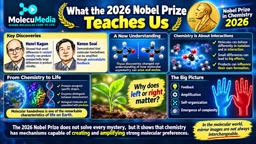
Suppose your catalyst has only a modest enantiomeric excess. You might reasonably expect the ee of the product to follow a simple proportional relationship. But Kagan found that this assumption can be wrong. In 1986, he reported a remarkable phenomenon: in certain catalytic systems, the relationship between catalyst ee and product ee is nonlinear. A small imbalance in catalyst chirality can produce a larger imbalance in the product, which is known as a positive nonlinear effect. In other cases the opposite occurs — the product ee is lower than a simple proportional relationship would predict, which is called a negative nonlinear effect.
The reason is that catalysts do not always operate as isolated, independent molecules. They can associate with one another, different catalyst combinations can have different activities and selectivities, and the actual catalytic system may contain multiple interacting chemical species. The result is that the behavior of the entire system can differ greatly from what would be predicted by looking at a single catalyst molecule alone.
This was an important conceptual breakthrough: asymmetric synthesis is not just about choosing the right chiral catalyst, but also about understanding the chemical interactions that determine catalyst behavior. Kagan revealed a mechanism by which molecular asymmetry can be amplified.
Soai and Asymmetric Autocatalysis: Molecules That Copy Their Own Chirality
Another scientist took this story even further. Kenso Soai was born in Hiroshima, Japan, in 1950 and became an organic chemist, serving as a professor at Tokyo University of Science. His research produced one of the most striking experimental demonstrations in asymmetric chemistry.
To understand his work, one needs to understand the concept of autocatalysis. Normally we think of a catalyst as a substance added to a reaction to help produce the product. But in an autocatalytic reaction, the product itself participates in catalyzing the formation of more product. Imagine a reaction that produces molecule A, and molecule A helps accelerate the formation of additional A — as A accumulates, the reaction can accelerate, creating a positive feedback process.
Soai's work added another remarkable feature: chiral autocatalysis. The product can help produce more product with the same molecular chirality. Imagine starting with a very small amount of the right-handed product, and that right-handed product promotes the formation of more right-handed product. As the reaction continues, the initial imbalance becomes stronger. Or start with a slight preference for the left-handed form, and under suitable conditions, that preference can also be amplified. This is asymmetric autocatalysis, and it provides a chemical pathway from a tiny initial imbalance to an overwhelmingly dominant enantiomer.
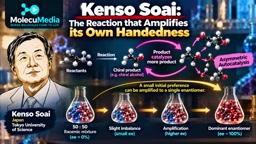
In 1995, Soai and colleagues reported a landmark asymmetric autocatalytic reaction: the addition of a dialkylzinc reagent to a pyrimidine-containing aldehyde, producing a chiral alcohol that can promote the reaction. In 2003, he reported a remarkable result — under certain conditions, the reaction produced essentially a single enantiomer. The Nobel Committee highlighted this achievement as a decisive demonstration of how strong homochirality can emerge in a chemical system.
Autocatalysis and chiral autocatalysis are key concepts for understanding Soai's work. In ordinary catalysis, the catalyst is an externally added substance; in autocatalysis, the product of the reaction itself acts as a catalyst, accelerating its own formation and creating a positive feedback loop. When the product is chiral, chiral autocatalysis emerges: the right-handed product preferentially catalyzes the formation of more right-handed product, and vice versa. This means that a tiny initial chiral bias in the system is continuously amplified as the reaction proceeds, ultimately leading to an overwhelming advantage for one enantiomer. Mathematically, this process can be described by autocatalytic kinetic equations, whose solutions show that ee increases nonlinearly with time. Notably, in an ideal autocatalytic system, even starting from an extremely low ee, with sufficient reaction time and appropriate kinetic conditions, it is theoretically possible to reach nearly 100% enantiomeric purity. The Soai reaction is by far the most famous experimental model of chiral autocatalysis and is widely used to study the origin of homochirality and mechanisms of chiral amplification.
Deep Connections to the Origin of Life
Now we arrive at one of the deepest questions in chemistry: why does life use a specific molecular chirality?
Biological proteins are built mainly from L-amino acids, and the nucleic acids that store genetic information contain sugars of a specific configuration. But how did these preferences arise? One possibility is that the early chemical environment of Earth contained a tiny imbalance between mirror-image molecules — perhaps from physical processes, mineral surfaces, light, or chance events. But a tiny imbalance alone is not enough to explain the strong molecular preferences found in living systems. Some mechanism is needed to amplify and preserve that imbalance.
This is precisely why the discoveries recognized by the 2026 Nobel Prize in Chemistry are so important. Kagan showed that chemical systems can exhibit nonlinear amplification of chirality. Soai demonstrated a particularly powerful mechanism — asymmetric autocatalysis. These discoveries suggest that chemistry has ways to amplify tiny differences in molecular chirality, providing a plausible chemical rationale for the emergence of biological homochirality.
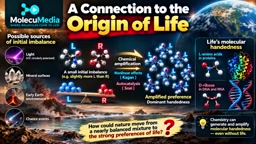
But we need to be cautious. They do not prove exactly how life on Earth began, nor do they establish that a specific Soai reaction occurred in the environment of the origin of life. The actual origin of biological homochirality remains unknown, and it is still an active scientific question. What these discoveries do demonstrate is this: the emergence of a strong preference for one molecular mirror image does not necessarily require a pre-existing living system. Under the right conditions, chemical reactions themselves can generate and amplify asymmetry.
Homochirality refers to the phenomenon in which all chiral molecules in an organism adopt the same configuration preference. For example, among the 20 common amino acids that make up proteins, all except glycine are of the L-type; and the ribose and deoxyribose in DNA and RNA are both of the D-type. This consistent choice of configuration is crucial to the higher-order structure and function of biological macromolecules — if amino acid configurations were mixed, proteins would be unable to fold into stable three-dimensional structures, and enzyme active sites would be unable to precisely match their substrates. The origin of homochirality is considered one of the deepest puzzles in origin-of-life research. Possible explanations include: physical factors such as circularly polarized light in the early Earth environment, adsorption on mineral surfaces, and parity nonconservation caused by the weak nuclear force created an initial tiny bias, which was then amplified to nearly 100% through autocatalysis or nonlinear amplification mechanisms. The discoveries honored by the 2026 Nobel Prize in Chemistry provide a solid experimental foundation for this chemical amplification pathway "from tiny bias to overwhelming preference."
Implications for Chiral Drug Development
Back to a practical question: why should scientists in pharmaceutical research care about these discoveries? Because many drug molecules are chiral, and a drug's biological activity can depend strongly on its three-dimensional configuration.
Suppose you develop a new molecule that inhibits a disease-related enzyme. You find that one enantiomer binds the enzyme efficiently, while the opposite enantiomer has a much weaker effect. If your synthesis produces a racemic mixture, you may need to separate the two enantiomers — requiring additional processing, solvents, equipment, time, and cost. A more efficient approach may be to develop a reaction that preferentially produces the desired enantiomer. This is the goal of asymmetric synthesis, and asymmetric catalysis is one of its most powerful tools.
Chiral catalysts can guide the formation of new stereocenters, making one enantiomer more likely to form than the other. But catalyst behavior can depend on far more than its individual molecular structure — it can also depend on aggregation, concentration, interactions with other species, and the reaction environment. Kagan's discovery of nonlinear effects helped chemists understand these complexities, explaining why the relationship between catalyst enantiomeric purity and product enantiomeric purity is not always simply linear.
Soai's work demonstrated another equally fascinating principle: reaction products can participate in amplifying their own chirality. You may not have noticed that the specific Soai reaction is not the standard industrial method used to make most chiral drugs; its importance lies mainly in the fundamental chemical principles it reveals.
Two Scientists, Two Discoveries, One Question
On October 7, 2026, the Royal Swedish Academy of Sciences announced that Kagan and Soai would share the Nobel Prize in Chemistry for their discoveries concerning nonlinear effects and autocatalysis in asymmetric organic synthesis. The announcement was especially significant for Kagan — his contributions to asymmetric catalysis have been recognized for decades. For Soai, it was also an extraordinary moment; at the announcement, he described receiving the Nobel Prize as one of the most exciting experiences of his life.
Their work answered different sides of the same fundamental question: how does chemistry produce a strong preference for one molecular mirror image? Kagan revealed that molecular chirality can be amplified through nonlinear behavior in asymmetric catalysis. Soai showed that chiral products can help catalyze the formation of more products with the same chirality.
These discoveries changed our understanding of how molecular asymmetry arises and evolves. They also remind us that chemistry is not merely a collection of molecules, but a science of interactions. A molecule may behave one way in isolation and another way when interacting with other molecules. Small differences in chemical systems can sometimes produce much larger effects, and reaction products can sometimes influence the direction of their own formation.
These principles connect chemistry to broader scientific ideas about feedback, amplification, self-organization, and the emergence of complexity. Perhaps the most fascinating connection is to life itself — living organisms depend on highly ordered molecular systems, proteins recognize specific molecular shapes, enzymes distinguish different stereoisomers, and biomolecules assemble with extraordinary stereochemical precision.
The work of Kagan and Soai did not solve all the mysteries surrounding the origin of chirality, but it demonstrated that chemistry has mechanisms for creating and amplifying strong molecular preferences. This brings us back to the original question: why does left or right matter? Because in the molecular world, mirror images are not always interchangeable. They can behave differently, interact in different ways, and under the right conditions, one can become overwhelmingly dominant.
One-line Summary
2026 Nobel Prize in Chemistry awarded to Kagan and Soai for revealing how tiny biases in chiral molecules can be amplified by nonlinear effects and autocatalysis.
Paragraph Summary
The 2026 Nobel Prize in Chemistry was awarded to French chemist Henri B. Kagan and Japanese chemist Kenso Soai for their discoveries concerning nonlinear effects and autocatalysis in asymmetric organic synthesis. Chiral molecules and their mirror images have different biological effects, and the origin of life's preference for specific configurations (homochirality) has long been a mystery. Kagan discovered that a small imbalance in catalyst chirality can produce a larger imbalance in the product (positive nonlinear effect), breaking the assumption of a simple proportional relationship between catalyst and product ee. Soai demonstrated asymmetric autocatalysis — chiral products can catalyze the formation of more products with the same chirality, achieving near single-enantiomer reaction results in 2003. These discoveries provide a chemical rationale for the origin of biological homochirality and are of great significance for designing efficient asymmetric catalytic systems in the pharmaceutical field.
Related articles

Workbuddy for Absolute Beginners: How a Desktop AI Agent Fits Into Real Workflows
A beginner's guide to the Workbuddy desktop AI agent: installation, claiming credits, file management, and building automated workflows—compared with CodeX for fit and cost, helping professionals shift from AI question-askers to AI managers.

OpenAI's New Agent Stack: Computer Use, Decisions API, and Ultra-Fast Workflows
OpenAI Dev Day unveiled a new agent stack: Computer Use outperforms humans, Decisions API delivers ultra-low-latency classification via Luna, Agents API opens the same Computer Use capabilities, and GPT-6.1 Sol costs only one-seventh of Astra. Core updates, benchmark data, and developer insights.

Liang Wenfeng Open-Sources DeepInfo Inference Framework, Takes On U.S. Ban
DeepSeek open-sources its DeepInfo inference framework after its models, featuring GPU/CPU cross-pipelining, small-model prediction with large-model verification, and full Huawei Ascend and NVIDIA chip support—facing the U.S. federal ban head-on. This article analyzes its significance for AI deployment and open-source strategy.