2026 PyTorch Foundation Contributor Awards Announced

The PyTorch Foundation announced its fourth annual Contributor Awards, recognizing diverse contributors across the open source ecosystem.
The PyTorch Foundation announced the winners and nominees of its fourth annual Contributor Awards during the keynote session of PyTorch Conference 2026. Now in its fourth consecutive year, the awards cover multiple dimensions including code contributions, community building, documentation improvements, and educational outreach, aiming to bring "invisible work" such as issue triage, PR reviews, tutorial writing, and localization into the spotlight. The article notes that the nomination phase often reflects the breadth of the community better than the winners list and serves as a ready-made reference for newcomers. Since the official announcement has not yet disclosed complete winner introductions or contribution lists, the article does not offer speculative interpretations of specific individuals, emphasizing only that the foundation scheduled recognition during the conference keynote rather than in breakout sessions, reflecting its emphasis on community governance, and recommends that readers consult the original official blog post for first-hand information.
An Annual Milestone for the Open Source Ecosystem
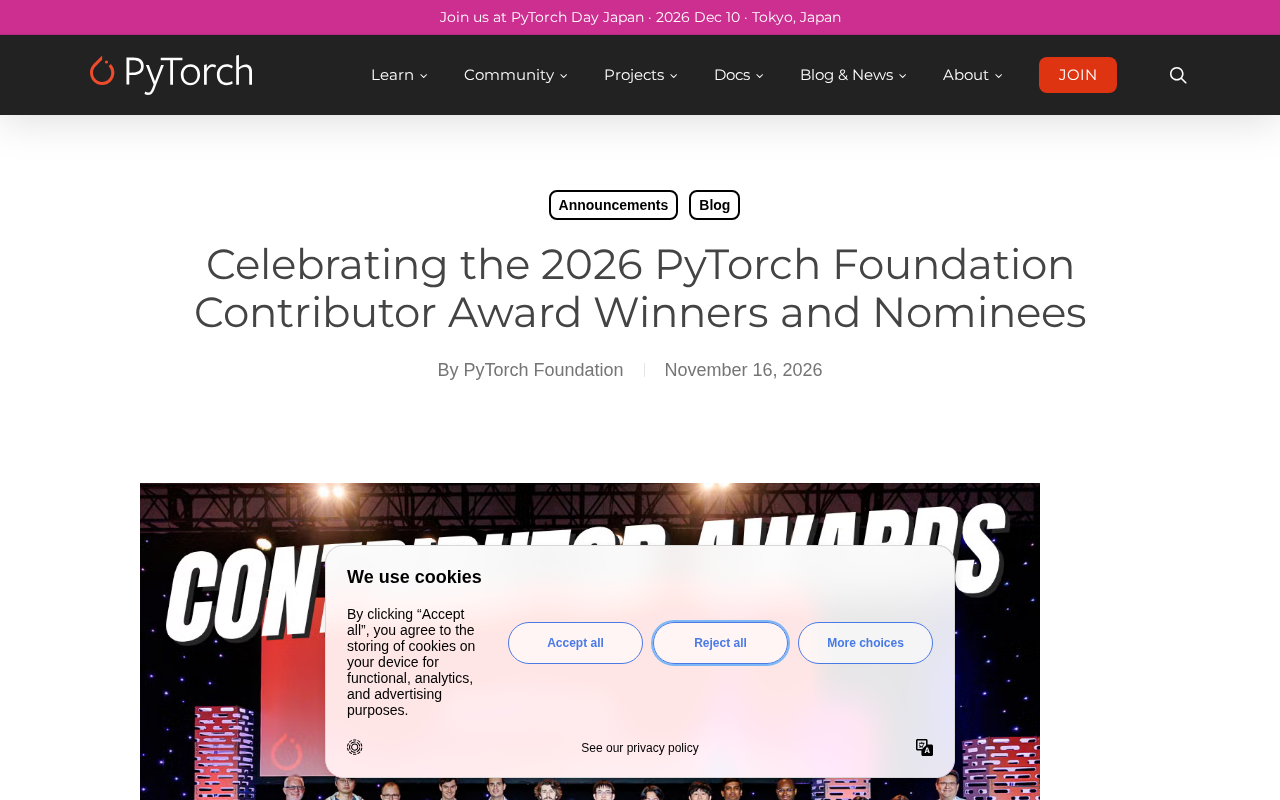
The PyTorch Foundation recently announced the winners and nominees of its fourth annual Contributor Awards. The awards were presented on the keynote stage at PyTorch Conference 2026 to recognize individuals who have made outstanding contributions to the PyTorch open source ecosystem.
According to the official PyTorch blog, the awards have now been held for four consecutive years and have gradually become an important annual ritual for the PyTorch community. Although the official announcement is brief and does not list the winners' names or specific contributions individually, judging from the positioning of the award, it covers multiple dimensions—code contributions, community building, documentation improvements, and educational outreach—which are precisely the key elements that keep a large open source framework running sustainably.
Why the Contributor Awards Are Worth Paying Attention To
The Invisible Pillars of Open Source Projects
The value of a deep learning framework like PyTorch is reflected not only in the pace of iteration of its core codebase but also in its reliance on a large volume of non-code contributions: issue triage, PR reviews, tutorial writing, localization and translation, conference organization, and more. The significance of the Contributor Awards lies in bringing these "invisible efforts" into the spotlight.
From an industry perspective, such awards are also a reflection of the maturity of foundation governance. Since PyTorch transitioned to a foundation governance model, community operations have gradually become institutionalized, and the annual awards are a relatively lightweight yet symbolically clear part of this—sending a signal to potential contributors that participation is seen and recorded.
The "non-code contributions" often mentioned in open source projects have relatively clear categories in the context of community governance. Drawing on the divisions used in community health frameworks such as CHAOSS (Community Health Analytics for Open Source Software), common dimensions include: code review and merge maintenance, issue and PR triage and reproduction, documentation and tutorial writing, localization and translation, user support and Q&A, event organization and evangelism, and participation in governance committees and working groups. These efforts typically do not directly produce commit records, making them difficult to measure through traditional metrics such as commit counts or lines of code, yet they directly determine the onboarding cost for new users and the burden on core maintainers. For this reason, in recent years more and more foundations have begun introducing contributor recognition mechanisms, contributor tier systems, and diverse contribution measurement methods in an attempt to give non-code work visibility and incentives.
The Value of the Nomination Process Itself
The announcement also emphasizes both groups: "winners and nominees." The nomination phase often reflects the breadth of the community better than the final winners: nominations come from mutual recognition among community members, and their coverage is usually far broader than the final winners list. For newcomers hoping to enter the field of open source contributions, such lists serve as a ready-made reference for understanding "what kinds of work the community values."
The foundation governance model is the premise for understanding such awards. PyTorch transitioned in 2022 to the PyTorch Foundation under the Linux Foundation, adopting a foundation structure similar to other large open source projects: a Technical Steering Committee (TSC) is responsible for technical direction, a governing board handles governance and funding matters, and multiple working groups are responsible for specific topics such as documentation, community, and ecosystem. Under this structure, community operations shifted from being initially dominated by a single entity, Meta, to a governance structure with joint participation from multiple companies and institutions. The annual Contributor Awards are a lightweight incentive mechanism promoted by the foundation's community working group, with decisions and nominations typically completed jointly by community members, complementing purely technical contribution leaderboards.
What the Awards Reveal About the Direction of the PyTorch Ecosystem
It should be noted that the official announcement currently provides only the occasion of the awards and basic qualitative descriptions, and has not yet disclosed complete winner introductions or contribution lists. Therefore, this article does not offer speculative interpretations of specific winners.
What is certain is that the PyTorch Foundation scheduled contributor recognition during the conference keynote rather than in a peripheral breakout session, which in itself demonstrates the foundation's emphasis on community governance. Against the backdrop of increasingly fierce competition among AI frameworks, ecosystem stickiness increasingly depends on community health, and community health in turn depends on sustained contributor incentives. The Contributor Awards are a low-cost but clearly beneficial long-term component of this logic.
How to Follow Up for Complete Information
Readers interested in the winners list and their contributions are advised to consult the original announcement on the official PyTorch blog for first-hand complete information. If you are a PyTorch user yourself, you may want to keep an eye on the nomination channel for the next awards—the barrier to participation in open source community recognition mechanisms is often lower than you might imagine.
One-line Summary
The PyTorch Foundation announced the fourth annual Contributor Awards, recognizing diverse contributors across the open source ecosystem.
Paragraph Summary
The PyTorch Foundation announced the winners and nominees of its fourth annual Contributor Awards during the keynote session of PyTorch Conference 2026. Now in its fourth consecutive year, the awards cover multiple dimensions including code contributions, community building, documentation improvements, and educational outreach, aiming to bring "invisible work" such as issue triage, PR reviews, tutorial writing, and localization and translation into the spotlight. The article notes that the nomination phase often reflects the breadth of the community better than the winners list and serves as a ready-made reference for newcomers to understand what kinds of contributions the community values. Since the official announcement has not yet disclosed complete winner introductions or contribution lists, the article does not offer speculative interpretations of specific individuals, emphasizing only that the foundation scheduled recognition during the conference keynote rather than in breakout sessions, reflecting its emphasis on community governance, and recommends that readers consult the original official blog post for first-hand information.
Related articles

Prompt Engineering for Beginners: From Writing Prompts to Engineering Thinking
Starting from the essence and four functions of prompts, this article systematically explains the six-step process, four success criteria, learning value, and practical limitations of prompt engineering to help you build a complete understanding.

Anthropic Launches Nasdaq IPO: AI Giant's Listing and Risk Disclosures
Anthropic officially launches its Nasdaq IPO under ticker ANT, with market valuation expected to potentially exceed SpaceX's record. The prospectus devotes nearly 100 pages to AI risks, while first-half revenue grew over 14x but net losses widened sharply, reigniting the AI bubble debate.

Rust cURL Clone Uses 4,832 unsafe Blocks—Is the Memory Safety Myth Broken?
A Rust cURL clone uses 4,832 unsafe keywords, challenging Rust's memory safety narrative. We analyze what unsafe really means, compare Fil-C, and examine rewrite motives.