23 AI Agents Run a Trading MCP Server: 239 Backtests, Only 2 Orders Placed
A Reddit developer audited 421 MCP calls from 23 accounts and found agents favor backtesting over execution—but zero-rejection logs hide a blind spot.
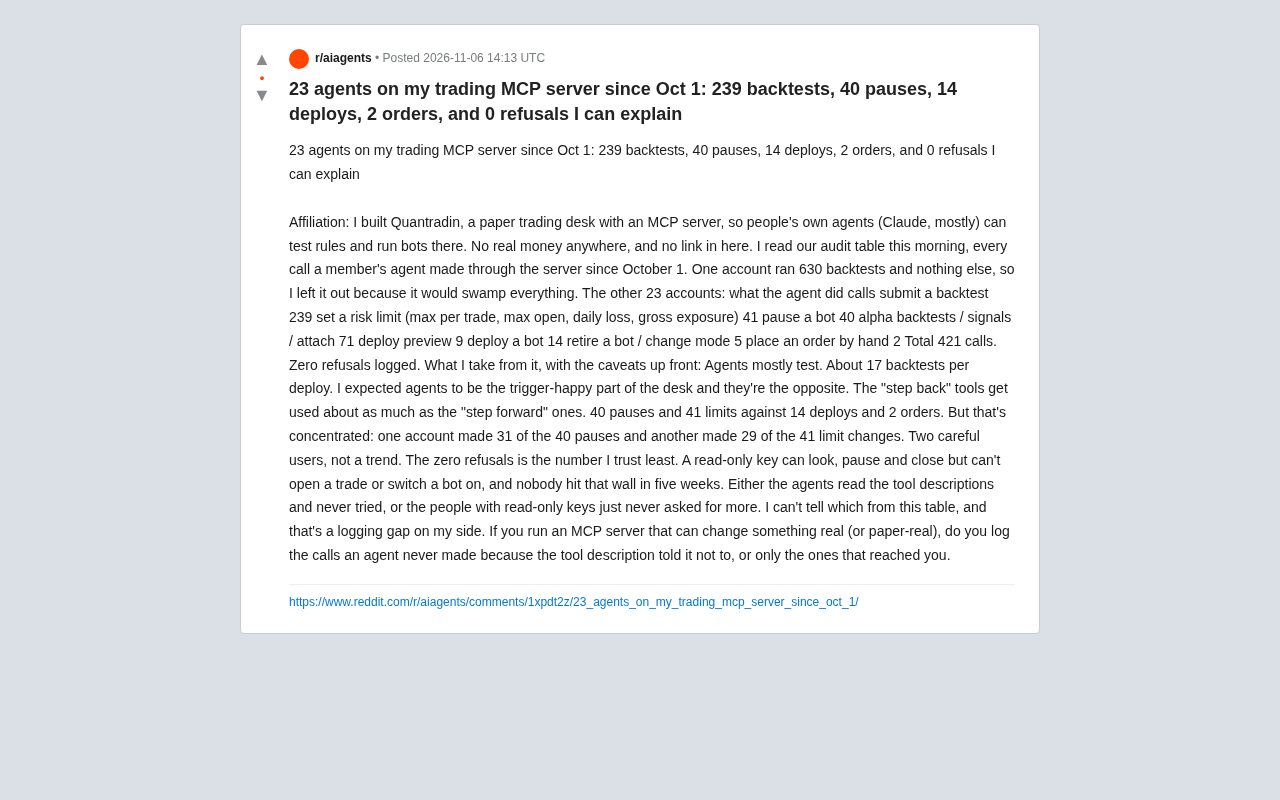
A developer published an audit of the MCP server on his simulated trading platform Quantradin: 23 accounts made 421 calls over five weeks—239 backtests, only 14 deployments, 2 manual orders, averaging about 17 backtests per deployment. Risk tools (40 pauses, 41 limit settings) were used nearly as often as execution tools but were highly concentrated in two accounts, indicating individual caution rather than a general trend. The developer distrusts the "zero rejections" record because read-only key boundaries were never tested and the system cannot log calls agents abandoned due to tool descriptions. The article argues tool descriptions act as implicit pre-call policy constraints, and MCP logs must cover both blocked and never-initiated calls to validate permission systems.
When AI Agents Take Over the Trading Desk: A Real Audit from an MCP Server
A developer on Reddit has published operational data from Quantradin, a simulated trading platform he built. The platform includes an MCP server that lets users connect their own AI agents (mostly Claude) to test trading rules and run bots. The entire environment involves no real money.
He tallied all 421 calls from 23 accounts (excluding one anomalous account) starting October 1 of a given year. The most interesting thing about this audit table isn't how aggressive the AI was—it's precisely how restrained it was.
MCP (Model Context Protocol) is an open protocol proposed by Anthropic to standardize how AI models connect to external tools and data sources. You can think of it as the "tool interface layer" for AI applications: the server exposes a set of tools with descriptions (such as "submit backtest" or "set risk limits"), and the agent decides whether and when to call them based on those descriptions. Unlike traditional function calling, MCP emphasizes that the tool descriptions themselves provide context to the model, which infers each tool's purpose, parameters, and permission boundaries from them. This explains a point that recurs throughout the article—tool descriptions aren't just documentation; they are implicit constraints that actively participate in behavioral decisions. MCP servers thus become a natural audit point for observing agent behavior: every call corresponds to a choice the model made based on tool descriptions.
The Full Picture: A Stark Ratio Between Testing and Deployment
First, here's how the 23 accounts behaved over five weeks:
- Backtests submitted: 239
- Risk limits set (per-trade cap, max position, daily loss, total exposure): 41
- Bots paused: 40
- Alpha backtests/signals/mounting: 71
- Deployment previews: 9
- Bots deployed: 14
- Bots retired or mode switched: 5
- Manual orders placed: 2
That's 421 calls in total, with zero rejections. The developer deliberately excluded one account that ran 630 backtests and did nothing else, because it would have skewed the overall distribution.
What the Backtest-to-Deployment Ratio Tells Us
On average, the agent ran about 17 backtests before deploying each bot. This ratio is the most thought-provoking part of the entire table. The developer's own expectation was that the agent would be the most impulsive element on the trading desk. The result was the exact opposite.
This may suggest that when an agent is explicitly told "there are backtesting tools, risk parameters, and deployment previews here," it prioritizes these "verify before acting" capabilities. Tool descriptions shape the agent's behavioral path.
Backtesting refers to replaying a trading strategy against historical market data to evaluate its returns, drawdowns, and risk characteristics. In the quantitative trading workflow, backtesting is a standard verification step before deployment, but it produces no real or simulated position side effects. The significance of "about 17 backtests before each deployment" lies precisely in the fact that backtesting is a low-side-effect, high-information tool—the agent calling it repeatedly means it tends to accumulate evidence through low-cost means before taking actions with side effects (deploying bots, placing manual orders). By contrast, a deployment preview is a "dry run" mechanism that shows how a bot will run without actually starting it, likewise an intermediate step that reduces execution risk. Only by understanding these cost-side-effect differences between tools can you grasp the behavioral logic behind the call distribution.
Tools That Step Back Are as Common as Tools That Step Forward
More counterintuitive still is the frequency of risk-control tools. There were 40 bot pauses and 41 risk limit settings, compared with only 14 deployments and 2 manual orders.
In aggregate, "hitting the brakes" and "hitting the gas" were almost equally frequent. But the developer cautions that these numbers are highly concentrated: one account contributed 31 of the 40 pauses, and another contributed 29 of the 41 risk adjustments.
In other words, this isn't a universal trend but the behavioral signature of two cautious users. Remove those two accounts, and the conclusion that "agents are restrained" weakens considerably. This is a boundary that must be preserved when interpreting the data.
The Logging Blind Spot Behind Zero Rejections
The number the developer trusts least is precisely "zero rejections."
The platform has read-only keys: holders can view, pause, and close positions, but cannot open new positions or start bots. Over five weeks, no account ever hit that wall. There are two possible explanations:
First, agents read the tool descriptions, understood the permission boundaries, and never attempted to overstep them; second, users holding read-only keys simply never requested higher permissions in the first place.
From the audit table alone, these two cases cannot be distinguished. The developer acknowledges this as a logging gap on his end—the system only records calls that reach the server, not the behavior of an agent that "read the tool description and decided not to try."
The Real Question for MCP Server Operators
He ends the post with a question: if the MCP server you operate can change something real (or simulated-real), would you log the calls that agents actively abandoned because of tool descriptions, or only the calls that actually reached the server?
This question strikes at the heart of agent observability. Tool descriptions are themselves an implicit policy constraint that filters behavior before a call ever happens. If logs only record explicit calls, you'll always see "what the agent did" but never "what rules dissuaded the agent." For high-risk scenarios that require auditing, this blind spot may be more worthy of attention than any actual overreach attempt.
A read-only key is a credential type in a permission system whose holder can query status, pause bots, and close positions, but cannot open new positions or start new bots. This design follows the principle of least privilege, aiming to grant observation capability while limiting side effects. The reason "zero rejections" is untrustworthy is that the audit table only records calls that reached the server: if an agent reads a tool description, concludes it lacks permission to open a position, and never sends a request, that decision process leaves no log at all. In other words, there are two paths to validating a permission system—passive validation (recording rejected overreach attempts) and active validation (agents self-constraining due to descriptions)—and the latter is unobservable under current logging systems. For high-risk scenarios, this absence of "calls that never happened" means "zero rejections" could mean either the system is secure or the system was never truly tested.
Takeaways for Agent Deployment
This dataset is small—only 23 accounts over five weeks—but it offers a rare observation window into how real users connect agents to a tool system with side effects, and what behavioral patterns agents exhibit within it.
A few takeaways: first, rich tool interfaces guide agents toward a "verify more, execute less" path, provided those tools are clearly described; second, individual variation far outweighs aggregate trends, and a handful of cautious users can dominate the statistics; third, log design needs to cover both "blocked calls" and "calls never initiated," otherwise the effectiveness of the permission system cannot be validated.
For teams building MCP servers or similar agent tool platforms, the value of this audit table isn't in those impressive ratios—it's in its honest labeling of its own blind spots.
Related articles
 Tech Frontiers
Gemini Omni 1.2 Flash: AI Video Moves Toward Draft-Style Editing
Google's Gemini Omni 1.2 Flash update enables conversational, draft-style editing of the same video—swap scenes while keeping products, adjust lighting while keeping characters. Clips up to 15s, 720p costs 30% less than the previous Flash—ideal for e-commerce ads, previs, and short-asset production.

Codex Tutorial: One-Command Install and Run Your First Task
Codex tutorial: one-command install and run your first task. Covers the four Codex forms, sandbox and approval guardrails, AGENTS.md and MCP configs, cloud network policy, and the iron rule of human review—everything you need to get started with this autonomous coding agent.
 Tech Frontiers
Localix: An Open-Source Agentic Development Environment with Multi-Model and Local AI Integration
Localix is an MIT open-source Agentic Development Environment (ADE) supporting seamless Claude Code plugin loading, multi-model cloud and local execution, Mini Apps extensions, and agent context management—an open AI collaboration workbench for developers.