23 AI Technologies Slated for Export Control: How Are API and Open Source Defined?

Draft rules would control export of 23 core AI technologies, with API and open source exempted, amid a wave of model updates.
MOFCOM and MOST released a draft catalogue proposing export management for 23 AI technologies, targeting large model weights, source code and architecture, with thresholds of 10^26 FLOPs or 2 trillion parameters; agent capabilities are judged by task decomposition and concurrent collaboration. The draft excludes API, APP, web, SaaS and on-device deployment from export, and places already open-sourced or published technologies under automatic licensing with report-and-release. Comments close November 15. The article also rounds up recent AI news: DeepSeek V4.1 Flash 1017 at unchanged pricing (~1.3 yuan per task) with free Search and Fetch APIs; Anthropic using Claude to design quantum circuits; Kimi K3.1 and Claude Fable 5.5 launch rumors; Gemini for Argon converting PDFs to interactive webpages; and Vercel data showing open-weight models account for 71.5% of tokens but only 23% of spending.
23 AI Technologies Slated for Export Control: How Are API and Open Source Defined?
The Ministry of Commerce and the Ministry of Science and Technology recently released a draft for public comment of the Catalogue of Technologies Prohibited or Restricted from Export from China, proposing to bring 23 artificial intelligence technologies under export management. The news sparked widespread discussion in developer communities, with core questions centering on two points: Does providing services via API count as export? And how should open-source models be defined?
What Is Being Regulated: Weights, Source Code, and Architecture
According to the draft, what is restricted is the underlying technology of large models, including model weights, source code, and architecture. There are two types of trigger thresholds: computing power reaching 10^26 floating-point operations, or parameter count reaching 2 trillion; for the agent direction, the criteria are task decomposition and concurrent collaboration capabilities—for example, being able to decompose tasks of 20+ steps and support 60+ concurrent collaborations.
This means regulation targets the technology transfer stage, not the product application layer. Ordinary developers calling models in their daily work and building applications are not within the scope of restriction.
Model weights are a set of parameters obtained after neural network training is complete (typically billions to trillions of floating-point numbers), which determine how the model responds to inputs and can be viewed as the model's "knowledge body." Source code refers to program code such as training frameworks, inference engines, and fine-tuning scripts; architecture refers to structural designs such as network layer counts, attention mechanisms, and expert routing methods. Together, these three constitute the necessary conditions for reproducing or modifying a large model, which is why they are the core targets of export control. Notably, weight files themselves can be directly copied, quantized and compressed for cross-border transmission—which is why regulators chose "computing power" and "parameter count" as trigger thresholds: these two metrics can be objectively verified without fully grasping the technical details.
10^26 floating-point operations is a magnitude commonly used internationally when discussing frontier model training thresholds. It roughly corresponds to the compute investment of thousands of high-end GPUs training for weeks to months—a training scale only a few organizations can achieve. Using computing power rather than parameter count alone as the threshold can cover different forms such as dense models and mixture-of-experts (MoE) models, avoiding missed detection of sparse models that might occur when judging by parameter count alone.
The threshold for the agent direction falls on the capability dimension: task decomposition steps and concurrent collaboration count. Such metrics attempt to characterize a model's level of autonomous planning, tool invocation, and multi-agent coordination, rather than model size. Since agent capabilities are often jointly determined by prompt engineering, tool interfaces, and orchestration frameworks, their "technology" boundary is blurrier than weights, and implementation may require accompanying recognition rules.
API, APP, and On-Device Deployment Do Not Count as Export
The draft explicitly states that providing APIs, APPs, web pages, SaaS, and on-device deployment to external parties are not considered export. Normal product going global—whether launching overseas versions of applications or providing services to overseas users via API—does not require registration.
Only acts of transferring or licensing underlying technology require registration. This definition effectively reassures the vast majority of AI application teams: as long as cross-border transfer of model weights and source code is not involved, business can proceed as usual.
How Open Source Is Managed: Automatic Licensing, Report-and-Release
For technologies already open-sourced or published in papers, the draft provides a relatively lenient path: automatic licensing, essentially report-and-release. This contrasts with the industry's earlier fears of a "one-size-fits-all approach to open source."
However, specific implementation details remain to be clarified, particularly the determination of the "already open-sourced" timing and whether subsequent version updates re-trigger licensing. The comment period ends on November 15, and developers still have the opportunity to express their concerns through official channels.
Automatic licensing is a type of procedural arrangement in technology export management: for technologies listed as automatic licensing in the catalogue, exporters can obtain a license upon submitting an application as required, without case-by-case substantive review, making it close to "filing equals release" in practice. Together with "prohibited from export" and "restricted from export," it forms a three-tier progressive management approach, with the latter two corresponding respectively to no export allowed and export only after approval. Classifying already open-sourced or published technologies as automatic licensing means regulators acknowledge that publicly available technology no longer has substantive confidentiality, and the management focus shifts to record-keeping and statistics rather than blocking.
The related judgment difficulty lies in the criteria for determining "already public": whether it is based on the first release of weight files, formal publication of papers, or public availability of code repositories; whether derivative models, fine-tuned versions, and quantized versions are considered the same technology; and whether new versions re-trigger the licensing process as models continue to iterate. These details will typically be clarified in supporting measures or Q&As accompanying the formal catalogue, and remain a key focus of developer feedback during the comment period.
Notable AI Developments During the Same Period
DeepSeek V4.1 Flash 1017: Same Price, Higher Benchmark Scores
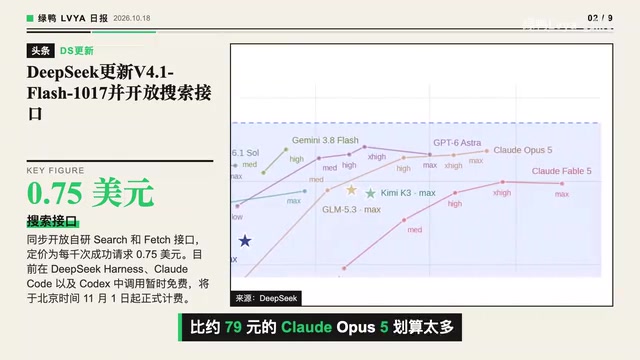
DeepSeekAd updated V4.1 Flash to version 1017, launched simultaneously on web, APP, and API, with prices unchanged. The 763 billion total parameters continue to use the MIT open-source license, DeepSRV benchmark scores rose to 77.0%, and cost per task is about 1.3 yuan—a striking difference compared to Claude Opus 5's approximately 79 yuan per task.
Officials also opened Search and Fetch interfaces, callable in Claude Code and Codex, free until November 1. For developers who write code, this is a window worth seizing.
Anthropic Uses Claude to Automatically Design Quantum Circuits
Anthropic researchers used Claude Mythos 5 to automatically design quantum circuits, covering 8 categories of computational primitives including chemistry and number theory. The system ran continuously for 53 hours to optimize elliptic curve point addition, reducing gate count by 17x; another decoder design compressed storage budget from 665 qubits to 19. This remains circuit design and resource estimation research, but the iterative workflow of "natural language plus program scoring" can already be borrowed by algorithm and research personnel.
Kimi K3.1 Clues: Gray Release or Imminent
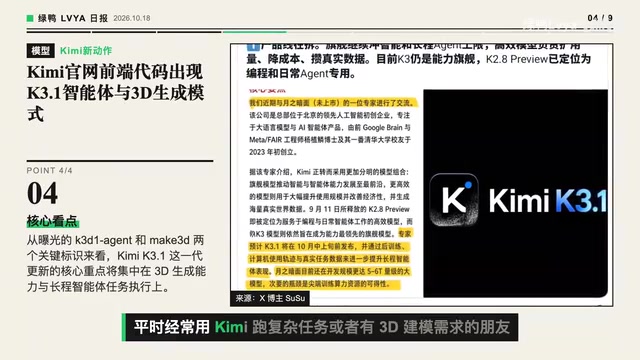
According to a leak from Bilibili creator Susu, the Kimi official website's frontend model selection code contains K3D1 Agent (i.e., the Kimi K3.1 agent version), and OK Computer includes a Make 3D mode, pointing to 3D generation capabilities. The leak suggests K3.1 has entered gray release or is about to launch. Users who frequently use Kimi or have 3D modeling needs should watch for official website updates.
Claude Fable 5.5 Possibly Launching Next Week
According to a leak from Testing Catalog, Anthropic partners have already obtained access to Claude Fable 5.5, expected to launch next week. Traces of Fable 5.5 have also appeared in Microsoft Azure catalogues and LightLM, along with early codenames such as Claude Onigiri and E-App, indicating a string of new models in the queue. Developers planning to upgrade workflows or integrate new APIs should reserve budget in advance.
Gemini for Argon: One-Click PDF-to-Interactive Webpage
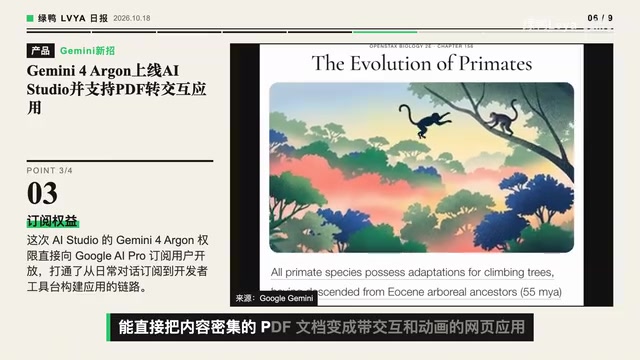
Google has introduced a new feature for Gemini for Argon: Google AI Pro subscribers can directly use Gemini for Argon in AI Studio's Build and Playground to create applications; in the Gemini App combined with Canvas, content-dense PDF documents can be converted into interactive and animated web applications. Users with dull reports or papers to present can now directly hand them to the model to generate interactive webpages.
OpenCode Security Incident: External Model Provider Accounts Exploited
OpenCode officially posted in the early morning stating that a security incident occurred the previous night related to a large-scale distillation attack, affecting 1.4% of OpenCode Console users, mainly involving some accounts connected to external model providers. Officials are working with Anthropic, OpenAI, and Google on remediation and have sent notification emails to affected users. If you have not received an email, your account is secure.
Grokbot Speed-Up: Computer Operation Tasks Three Times Faster
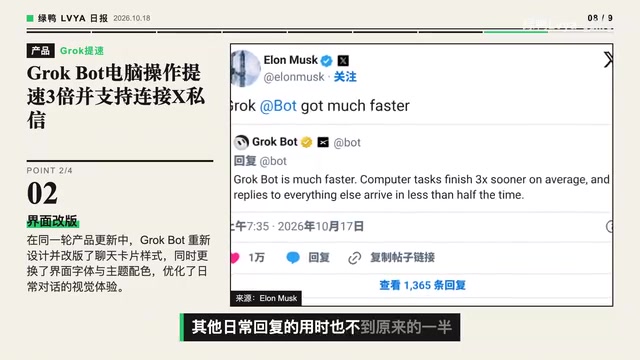
Musk posted that Grokbot has become much faster. Official data shows that computer operation tasks are completed three times faster on average, and daily replies take less than half the previous time. This update also adjusted chat cards, fonts, and themes; voice calls are faster and more stable, can remember conversation history, and can directly connect to X direct messages.
AI Gateway Production Index: Open-Source Models Consume 70% of Traffic
Vercel released its October AI Gateway Production Index. As of September, open-weight models on the platform ran 71.5% of tokens but accounted for only 23% of spending. DeepSeek alone accounted for 58% of tokens at only 6.6% of spending; V4.1 Flash single-handedly handled nearly half the workload at just 2% of spending. The average price per token in September dropped 47% compared to last December. For AI application teams, switching main traffic to domestic open-source models can save considerable costs.
Boundaries and Industry Impact of Export Control
From the wording of the draft, the regulatory approach is "regulate technology transfer, not product services." API calls, SaaS subscriptions, and on-device deployment are all excluded from the definition of export, and open-source projects go through the automatic licensing channel. This design leaves room between security and industry vitality.
The truly ambiguous areas are: indirect exposure of model weights through cloud services, branching and derivation in open-source communities, and the recognition of "technology licensing" for agent capabilities. These details will determine the actual friction costs after the policy is implemented. Before the comment period closes on November 15, developers' feedback deserves to be heard.
Related articles

Chain of Thought Isn't Just for AI: How Humans Can Use CoT to Improve Thinking Quality
Chain of Thought isn't just a prompt trick for large models. Starting from a Hacker News discussion, this article analyzes why CoT works for human thinking too, breaks down actionable ways to transfer it, and highlights the key differences between human CoT and machine CoT.
Cloudflare Teams Up with OpenAI: Closi…
Cloudflare Teams Up with OpenAI: Closing the Loop from Vulnerability Discovery to Defense with AI
Cloudflare uses OpenAI Daybreak to investigate security vulnerabilities and generate reviewable remediation plans, while developers use Codex to boost coding efficiency and quality.

Orca Multi-Agent Orchestration in Practice: A Guide to Parallel Collaboration with Claude and Codex
Orca is Stable AI's free open-source agent workbench supporting 34 agents like Claude Code and Codex in parallel. Learn its Git worktree isolation, multi-model orchestration, and mobile management.