25 Years Later, Xbox Once Again Tries to Reinvent Itself
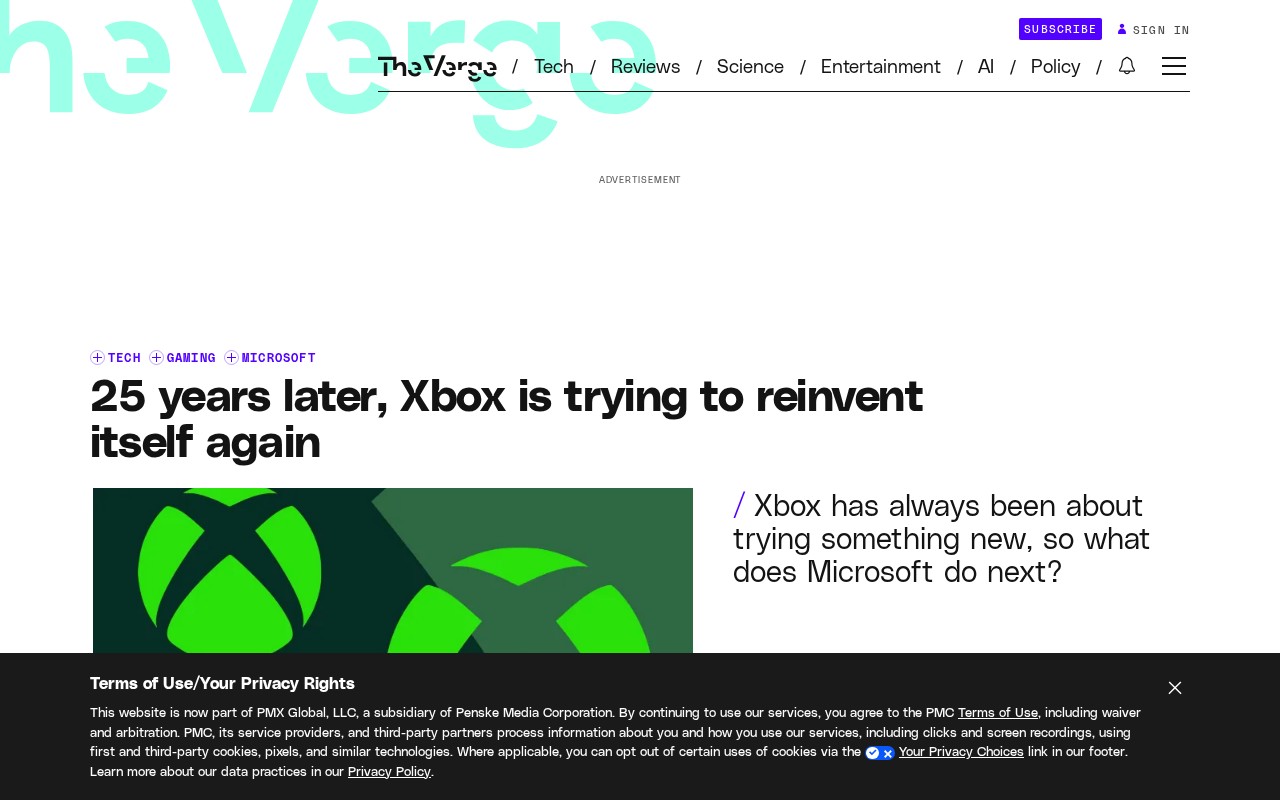
After twenty-five years, Xbox has gone from challenger to incumbent and once again faces a point where it must reinvent itself.
The article begins with the launch of the original Xbox on November 15, 2001, and reviews Microsoft's twenty-five-year history of constantly seeking change in a console market dominated by Sony and Nintendo. The Xbox 360 once led, but subsequent generations were again suppressed by rivals, leaving Xbox always in the role of seeking change in the cracks. Unlike 2001, today's Xbox is not starting from scratch; it has existing users, a cross-generational service system, and established developer relationships. Therefore, this round of "reinvention" is more likely to occur at the level of business models and platform boundaries, rather than reinventing a console. The article points out that the core highlight is not whether new hardware will be launched, but whether Xbox can redefine its relationships with players, developers, and competitors, and what it can still rely on to make people look forward to it after the challenger becomes an established beneficiary.
From Challenger to Incumbent: Xbox's Cycle
On November 15, 2001, the original Xbox officially launched. At the time, Microsoft faced a console market firmly controlled by Sony and Nintendo. Twenty-five years later, Xbox finds itself back at a similar starting point—it is no longer the newcomer with nothing to lose, but it still needs to find a breakthrough in a landscape dominated by its rivals.
According to an RSS source report, Microsoft has spent the past 25 years trying to shake up the console market, and now Xbox has once again reached a point where it needs to "reinvent itself." The original article does not elaborate on specific strategic details, but it clearly points out one key difference: this time, Xbox is not starting from scratch.
Twenty-Five Years of Shifting Between Offense and Defense
The original Xbox's debut was a typical move by Microsoft to force its way into the hardware market using its advantages in capital and software ecosystem. After that, the Xbox 360 briefly took the lead in sales and reputation, but in subsequent generations, Sony and Nintendo regained the upper hand through their respective content strategies and product positioning.
The original article uses "take on an industry dominated by Sony and Nintendo" to describe the situation in 2001, while "Twenty-five years later, Xbox finds itself in a similar position" juxtaposes the present with that time. This juxtaposition does not mean the competitive situation is exactly the same, but rather reminds us that Xbox has never escaped its role of seeking change in the cracks between strong competitors.
The Industry Logic of Console Generation Turnover
The console industry operates on "generations" as its basic cycle, typically updating hardware platforms every 6 to 8 years, with Sony's PlayStation, Nintendo, and Microsoft's Xbox each launching new-generation products at their own pace. Generation turnover is not simply a hardware upgrade, but an opportunity for user migration, developers re-betting, and brand positioning reshuffling. For this reason, "offense-defense shifts" often occur at the nodes of generational transition: leaders try to retain users through backward compatibility and ecosystem lock-in, while laggards pin their hopes on a fresh start in the new generation.
The Xbox 360's relative lead and the relative passivity of subsequent generations are precisely a manifestation of this cyclical logic. Understanding the generational structure helps explain why "being in a similar position twenty-five years later" is not simply a historical repeat, but rather a situation in which the competitive landscape can be rearranged in each cycle.
What's Different This Time: Not Starting from Scratch
The original article particularly emphasizes one point—"It's not starting from scratch this time around." This is the key to understanding Xbox's current strategy.
Starting from scratch means building a brand, laying out channels, and accumulating users; today's Xbox, by contrast, has a massive existing user base, a cross-generational service system, and established developer relationships. Its "reinvention" is more likely to occur at the level of business models and platform boundaries, rather than reinventing a console. Although the original article does not provide a specific path, the wording "reinvent itself" suggests that the scale of change will not be small.
The Challenge of Restructuring in the Stock Era
For any hardware platform that has lasted twenty-five years, the biggest challenge often comes from within: how to open up a new growth narrative while maintaining existing users. Xbox's situation is a typical sample of this proposition—it cannot completely abandon the past, yet it must show the outside world a self that is different from the past.
Platform Ecosystem and the Lock-in Effect of Existing Users
What "not starting from scratch" specifically refers to in the gaming industry is several types of inheritable assets: account systems and digital game libraries, paying users accumulated through subscription services (such as Xbox Game Pass), historical content brought by cross-generational compatibility, and long-established cooperation channels with third-party developers. These assets constitute a kind of "lock-in effect"—the higher the user migration cost, the harder it is for the platform to be taken away all at once, but also the harder it is to quickly turn things around through a single point of innovation.
Therefore, "reinvention" in the stock era is often not about redoing hardware, but about redrawing platform boundaries, such as extending game services to more devices and adjusting content exclusivity strategies. The original article uses "reinvent itself" without elaborating on the path, which precisely indicates that the focus of change may lie in the redefinition of business models.
Editorial View: Where the Highlights of Reinvention Lie
Based on the wording of the original article, the core highlight of Xbox's current round of "reinvention" is not whether it will launch new hardware, but whether it can redefine its relationships with players, developers, and competitors. Twenty-five years ago, Xbox gained attention by assuming the identity of a "challenger"; twenty-five years later, it needs to answer a harder question: when a challenger becomes an established beneficiary within the ecosystem, what can it still rely on to make people look forward to it?
This is precisely where the suspense left by the original article lies—the direction is clear, but the path is not detailed. For readers concerned with the landscape of the gaming industry, Xbox's next moves in platform strategy and content ecosystem will be key signals for judging the success or failure of this round of reinvention.
Background Supplement
On the Identity Transition Between "Challenger" and "Incumbent"
In platform economy research, the difference between "challenger" and "incumbent" lies not only in market share, but also in the direction of innovation incentives. Challengers often rely on aggressive pricing, differentiated features, or subsidies to exchange for growth; incumbents tend to maintain the stability and monetization efficiency of the existing ecosystem. When a company shifts from the former to the latter, the most typical risk is the "innovator's dilemma": existing profit structures and user expectations will suppress risk-taking behavior.
Xbox's situation is precisely on this transition belt—it has the assets of an incumbent, yet still needs the narrative of a challenger. This tension is the background framework for understanding the difficulties of its "reinventing itself."
One-line Summary
After twenty-five years, Xbox has gone from challenger to incumbent and once again faces a point where it must reinvent itself.
Paragraph Summary
The article begins with the launch of the original Xbox on November 15, 2001, and reviews Microsoft's twenty-five-year history of constantly seeking change in a console market dominated by Sony and Nintendo. The Xbox 360 once led, but subsequent generations were again suppressed by its rivals, leaving Xbox always in the role of seeking change in the cracks. Unlike 2001, today's Xbox is not starting from scratch; it has existing users, a cross-generational service system, and established developer relationships. Therefore, this round of "reinvention" is more likely to occur at the level of business models and platform boundaries, rather than reinventing a console. The article points out that the core highlight is not whether new hardware will be launched, but whether Xbox can redefine its relationships with players, developers, and competitors, and what it can still rely on to make people look forward to it after the challenger becomes an established beneficiary.
Related articles

From 0 to 1: Vibe Coding an AI Knowledge Base — A Practical Retrospective and Tech Stack Breakdown
A retrospective on building the AI knowledge base OilBook from scratch with Vibe Coding: Next.js+Neon stack, Oil Dev Skill workflow, Stripe paywall security, interview-style writing, AI-flavor control, and Vercel deployment.

GLM-5.4 Hands-On: Native Vision Meets a New Vibe Coding Workflow
Hands-on with Zhipu GLM-5.4: native vision tested across a 3D product demo, pure-code video generation, and remote-control Vibe Coding, compared with GPT-6.2 and Gemini Neon.

AI and Humans Claim to Prove the Riemann Hypothesis: Machine-Verified, Yet Nobody Can Understand It
Anthropic mathematician and AI Claude claim to prove the Riemann Hypothesis with 17 million lines of Lean code, machine-verified but unreadable by humans. This article analyzes the event, the zero proportion record from 41.6% to 67.2%, and the gap between machine verification and human understanding.