GLM-5.4 Hands-On: Native Vision Meets a New Vibe Coding Workflow

GLM-5.4 leaps ahead with native vision and Loop architecture, but over-checking hurts efficiency.
Based on three hands-on tests by a Bilibili creator, this article evaluates Zhipu GLM-5.4. Native vision lets it directly understand images and videos, giving a qualitative leap over GLM-5.3 in a 3D humidifier demo and beating GPT-6.2 on interactivity. In pure-code 15-second video generation it has sound sync and narrative rhythm but less visual richness than Gemini Neon. A remote-control Vibe Coding case completes the full loop from requirements to mockup iteration, auto doc writing, and auto development. The main weakness is efficiency: generation is fast, but over-checking makes total time much longer, and Zhipu admits a "thunderous deep thinking" tendency. It ranks 7th in KingBench4's coding evaluation, the highest among domestic models.
Zhipu's newly released GLM-5.4 has stirred up considerable discussion in the AI community. The company claims it uses an entirely new Loop architecture that significantly boosts the model's intelligence without increasing parameter count, even rivaling giant models with 2–3 trillion parameters. More importantly, it fills in native vision capabilities, so images and videos can be fed in directly. Bilibili creator "Zhipu" (质普), who got hold of the model after a 100-day gap, put it through three hardcore tasks: a 3D product manual, generating a 15-second video purely from code, and Vibe Coding with a remote control. How did it go? Let's break it down using the hands-on data and an industry perspective.
Native Vision: From "Second-Hand Description" to "Seeing Directly"
In the GLM-5.3 era, the model itself wasn't multimodal — it relied on an external vision-understanding plugin to "see" images and videos. That back-and-forth translation inevitably lost detail. GLM-5.4 adds native vision, so images and videos can be handed to it directly. This was on full display in the first task.
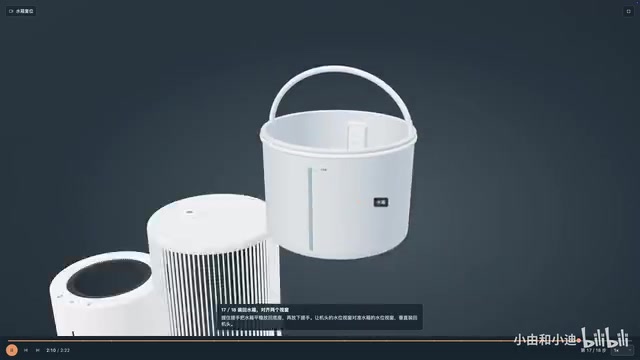
The creator gave GLM-5.4, GLM-5.3, and GPT-6.2 the same task: based on a humidifier manual and two demonstration videos, produce a 3D animated operation demo. GLM-5.3's output had obvious problems: a crude appearance, a missing top display screen, a progress overlay blocking the operation view during playback, and some steps blown out to a white blur. The root cause was that 5.3 couldn't understand the raw material and depended on plugin descriptions, losing critical detail.
GLM-5.4's improvement is visible to the naked eye. The product's proportions closely match the real object, the top display is refined, and component structures are clear when zoomed in. The demo steps are broken down in detail, the progress overlay doesn't block the view, and you can pause at any time and freely rotate the view to inspect details. There were flaws too: the power cord and plug weren't connected, a section was missing in the middle of the faucet on the water tank, and there was occasional clipping during the animation. But compared with 5.3, this is a qualitative leap.
GPT-6.2's appearance fidelity is also high, with no obvious part defects, but the surface is too smooth and rounded — like a plastic toy — lacking realism, with occasional clipping. Its biggest problem is that it turns the demo into a fixed-camera video that can't be rotated or zoomed in for detail. Visually GPT-6.2 is smoother because the camera angles are preset, but that sacrifices interactivity. The creator asked directly in the video: "Which do you all think is better, GLM-5.4 or GPT-6.2?"
From an industry perspective, native vision means more than "understanding images." It lets the model self-check during generation — looking at its own output and revising against requirements. That's a foundational capability for multimodal Agents. GLM-5.4 takes a key step here.
The core difference between native multimodality and external plugins lies in the information pathway. The plugin approach typically uses a separate vision model to encode an image or video into a text description, then hands that to the language model for reasoning — essentially having a "translator" describe the scene. Details like object counts, spatial relationships, and small text are easily lost in that description, and latency and error accumulate across the two calls. Native multimodality aligns the vision encoder with the language backbone during training, so image patches and video frames enter the same attention mechanism directly. The model can repeatedly revisit the original pixels during inference, giving it the ability to "self-check while generating." This is also the prerequisite for multimodal Agents: an Agent needs to judge whether its own output meets requirements rather than blindly guessing from external descriptions. The cost is higher training data and compute thresholds, and visual tokens also eat into the context budget.
Pure-Code Animated Video: It Can Convey an Idea, but the Visuals Lack Richness
The second task was more challenging: with no constraints given, the model had to act as its own motion designer and generate a 15-second 4K landscape short film purely by writing code. The contestants included GLM-5.3, DeepSeekAd, Kimi, GLM-5.4, GPT-6.2, and Gemini Neon.
The results fell into clear tiers. GLM-5.3, DeepSeek, and Kimi all produced silent videos with varied styles but sparse motion and flat pacing. GLM-5.4 had sound effects that matched the visuals naturally; its strength was using motion to tell an idea, with nimble small movements and a sense of rhythm throughout — but the visual elements were sparse. GPT-6.2 had good visual texture and accurate sound-effect sync, though its tone may not appeal to everyone. Gemini Neon performed best overall: the richest visual information, the biggest rhythmic swings, and sound effects perfectly matched to visual changes.
This task revealed GLM-5.4's positioning: it's more a designer who clearly expresses an idea than an artist chasing visual bombardment. For a Vibe Coding scenario like "making videos with code," it can already produce usable narrative shorts, but there's still a gap to the visual expressiveness of top closed-source models.
Vibe Coding was coined by Andrej Karpathy in early 2025. It refers to developers describing intent in natural language while the model generates and iterates on code, with humans mainly judging "whether it feels right" rather than reviewing line by line. Its difference from traditional code completion lies in the level of abstraction: completion continues an existing file, while Vibe Coding often generates a complete project from scratch, including UI, interaction logic, and even build scripts. When evaluating this capability, the industry typically looks at three dimensions — whether requirements are understood accurately, whether the output runs directly, and whether it converges after multiple rounds of feedback. The remote-control case in this article is a typical closed loop: design mockups, task brief, code, and debugging are all chained together by the model, with humans only annotating and correcting at key points. This also explains why "over-checking" becomes a problem: the bottleneck in Vibe Coding is often not writing code but the number of rounds the model spends self-verifying.
Remote-Control Vibe Coding: Fully Automated Development from Mockup to Runnable Tool
The third task was closest to a real development scenario. The creator bought a voice remote and wanted to turn it into a voice input device, so that with the Doubao input method he could "Vibe Code while holding the remote." He asked GLM-5.4 to recreate the main interface of an existing desktop toolbox as an interactive prototype, then design the remote-control interaction on top of it.
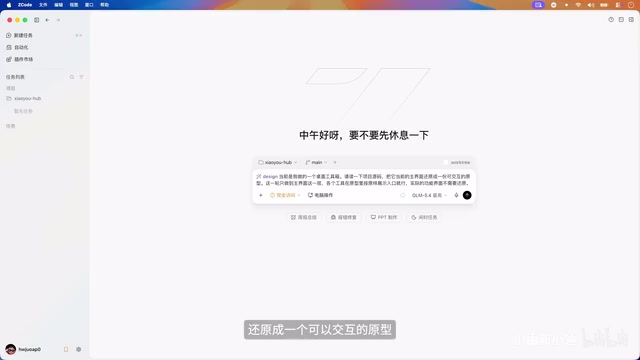
In step one, recreating the prototype, GLM-5.4's mockup was "almost indistinguishable" from the real software interface — highly accurate. In step two, he uploaded a photo of the actual remote and asked GLM-5.4 to design the functional prototype and write a development task brief. After the mockup came out, the creator found two problems: the voice shortcut defaulted to the Option key (actually the Fn key), and the remote's shape didn't match the real device. After pointing these out with annotations, GLM-5.4 fixed them automatically. The creator then flagged a truncated shortcut dropdown and sent a reference image to adjust the button display style. After a few rounds of iteration, the mockup met requirements.
Next came the real challenge: having GLM-5.4 write the development docs and build the tool based on the mockup. The creator only helped by pressing a few remote buttons; everything else was done automatically by the model. The first version only did button mapping, and audio still used the computer's microphone. The creator then asked it to use the remote's microphone — but the remote sends an incomprehensible stream of data over Bluetooth, and GLM-5.4 had to reconstruct that data into sound itself before handing it to the Doubao input method for transcription. There were issues with poor transcription and echo along the way; once resolved, the tool was complete. In testing, "Hello hello, I'm Xiaoyou" worked well.
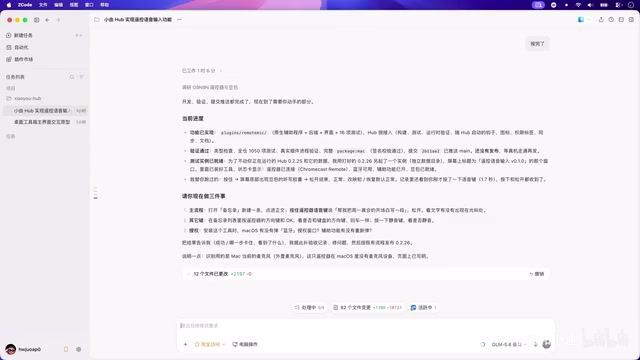
The value of this case is that it demonstrates Vibe Coding's complete loop: natural-language requirements → model-generated mockup → annotation feedback and iteration → automatic doc writing → automatic development → hands-on debugging. The creator summed up: "Throughout the entire development process, apart from pressing a few buttons on the remote to cooperate with it, I didn't do anything else."
Efficiency vs. Depth: Two Sides of the Same Coin
With all three tasks done, GLM-5.4's capability gains are undeniable — but a glaring problem surfaced: it's slow. In the first 3D task, GLM-5.4 took 2 hours 38 minutes in total, GLM-5.3 took 1 hour 14 minutes, and GPT-6.2 took under 30 minutes. The creator initially assumed generation speed was slow, but after measuring found that 5.4's per-second generation speed was actually faster than GPT-6.2's. The problem was "over-checking" — it finished the file early, then kept repeatedly checking and polishing details, stretching out the overall cycle.
Zhipu itself admits that GLM-5.4 tends to fall into "thunderous deep thinking" and can't stop once it starts. The creator did run into this during testing. This is actually a common ailment of deep-reasoning models: the deeper the thinking, the longer it takes. The creator called on Zhipu to release a "fast mode" later to improve development efficiency.
Test-time compute scaling is the background for understanding this "thunderous deep thinking." Traditional scaling laws improve capability by increasing parameters and training data, while the new generation of reasoning models shifts toward spending more compute at inference time: generating longer chains of thought, sampling multiple candidate paths, self-reflecting and backtracking. Designs like the Loop architecture have the model repeatedly polish the same output in an internal loop, raising effective intelligence without increasing parameters. The payoff curve isn't linear — the first few rounds of checking often significantly reduce errors, but marginal returns drop quickly in later rounds, and over-optimization can even make things worse. So in engineering practice you typically need stopping criteria, confidence thresholds, or fast/deep dual modes to spend compute on the parts that are genuinely uncertain. The timing data in this article is a direct reflection of that trade-off.
Overall Assessment: Domestic SOTA, but the Gap Remains
In overseas blogger KingBench4's coding evaluation, GLM-5.4 ranked 7th among 19 models — the highest-ranked domestic model. Comparing with the previous generation GLM-5.3, the creator believes 5.4 is a very clear improvement, especially the native vision capability that lets the model look at its own output to check results and revise against requirements, with notable gains in video making and mockup recreation. Objectively, there's still a gap to international top closed-source models like GPT and Gemini, but in terms of overall strength it can be called domestic SOTA.
The creator also mentioned Zcode (Zhipu's coding tool). He's watched it update along the way, and the current version feels good to use: it can operate a browser, operate desktop software, and click web elements, and its task list and sub-agent status views are convenient to manage. The best part is remote control — no software download needed; you can connect right from the browser.
GLM-5.4's release sends a clear signal: domestic models are shifting from "catching up on parameters" to "polishing capabilities." Native vision fills the multimodality gap, the Loop architecture squeezes out more intelligence without adding parameters, and Vibe Coding's boundaries are expanding from writing code to making videos, 3D, and tools. The remaining issue is efficiency — once the model learns a "fast mode," its practical value will rise another level.
One-line Summary
GLM-5.4 achieves a capability leap with native vision and the Loop architecture, but over-checking slows efficiency.
Paragraph Summary
Based on three hands-on tests by Bilibili creator "Zhipu," this article evaluates Zhipu GLM-5.4's real capabilities. The model adds native vision and can directly understand images and videos, delivering a qualitative improvement over GLM-5.3 (which relied on plugin descriptions) in a humidifier 3D operation demo, with better appearance fidelity and interactivity than GPT-6.2's fixed-camera approach. In the pure-code 15-second video task, GLM-5.4 offers sound-effect sync and narrative rhythm but falls short of Gemini Neon in visual richness. The remote-control Vibe Coding case runs the full loop from requirement description and mockup iteration to automatic doc writing and automatic development/debugging. The main weakness is efficiency: generation speed isn't slow, but over-checking and polishing make total time far longer than competitors, and Zhipu admits a tendency toward "thunderous deep thinking." It ranks 7th in KingBench4's coding evaluation, the highest among domestic models.
Related articles

From 0 to 1: Vibe Coding an AI Knowledge Base — A Practical Retrospective and Tech Stack Breakdown
A retrospective on building the AI knowledge base OilBook from scratch with Vibe Coding: Next.js+Neon stack, Oil Dev Skill workflow, Stripe paywall security, interview-style writing, AI-flavor control, and Vercel deployment.

AI and Humans Claim to Prove the Riemann Hypothesis: Machine-Verified, Yet Nobody Can Understand It
Anthropic mathematician and AI Claude claim to prove the Riemann Hypothesis with 17 million lines of Lean code, machine-verified but unreadable by humans. This article analyzes the event, the zero proportion record from 41.6% to 67.2%, and the gap between machine verification and human understanding.

The Prime Corridor: AI Cracks a 167-Year-Old Mathematical Conjecture and Locks Onto the Universe's Hidden Orbit
AI allegedly formalizes the Riemann Hypothesis in Lean-4. We unpack the viral "prime corridor" narrative: from an 1859 manuscript to 2026 machine verification, and what it means for superintelligence.