27B Parameter LLM on an iPhone? A Deep Dive into On-Device Full-Parameter AI

Prismo claims to run a full 27B-parameter LLM locally on iPhone 17 Pro using 13× compression.
AI startup Prismo claims to have compressed the 27B-parameter Qwen model from 54GB to under 4GB — a 13× ratio — enabling full-parameter local inference on an iPhone 17 Pro. This article examines the compression techniques involved, contrasts Prismo's full-activation approach with Apple's sparse MoE strategy, and critically evaluates whether the "zero performance loss" claim holds up under scrutiny.
Squeezing a 27B Model onto a Phone: An Industry-Shaking Claim
AI startup Prismo recently made a claim that could upend industry assumptions: they've fully compressed the 27-billion-parameter open-source model QW3.6 (from the Qwen family) and successfully achieved local, full-parameter inference on an iPhone 17 Pro. This means complex conversations, logical reasoning, autonomous coding agents, and code generation — all in theory runnable offline on a single phone.
About the Qwen Series: Qwen (通义千问) is a large language model series developed by Alibaba DAMO Academy. Continuously open-sourced and iterated since 2023, it has gone through a full evolution cycle from Qwen1 to Qwen2 and now its third-generation architecture. QW3.6 not only outperforms most competitors at the same parameter count on standard reasoning benchmarks (e.g., MMLU, HumanEval), but also introduces a 128K context window for long-text processing. The Qwen series is released under the Apache 2.0 license, which permits commercial use and modification — one of the most permissive licenses in the open-source LLM ecosystem. This has made it a go-to base model for academia, independent developers, and on-device compression experiments. Compared to Meta's Llama series, Qwen's native Chinese language support makes it especially popular in the Asia-Pacific region, and its open weights make it highly accessible for quantization and compression research.
For an AI application ecosystem long dependent on cloud compute, this breakthrough — if real — would redefine the capability ceiling of "on-device AI." A 27B-parameter model was previously nearly exclusive to high-end GPU clusters in data centers. Getting it to run on a phone is roughly equivalent to stuffing a server into your pocket.
How Prismo's Approach Differs from Apple's On-Device AI
You might not have noticed: Prismo's technical approach is fundamentally different from the familiar "sparse activation" strategy.
Apple's own on-device model is nominally 20 billion parameters, but uses a MoE (Mixture of Experts) partial-activation mechanism — only 1 to 4 billion parameters are activated per inference. The vast majority remain "dormant" during any single inference pass, trading lower compute and memory overhead for a larger headline parameter count.
Deep Dive: The MoE Mechanism: The Mixture of Experts (MoE) architecture draws inspiration from the cognitive science concept of "specialized division of labor," first sketched by Geoffrey Hinton and colleagues in 1991, and has seen renewed interest as large models have scaled. Its core design replaces the feed-forward network (FFN) layers in a standard transformer with multiple parallel "expert sub-networks," governed by a lightweight gating network that dynamically routes each token at inference time — typically activating only the Top-2 or Top-4 expert modules. GPT-4, Mixtral 8×7B, and Google Gemini 1.5 all use MoE variants, achieving expressive capacity equivalent to far larger dense models at a fraction of the inference cost. Apple's on-device application follows similar logic: by designing models with a large total parameter count but a small number of active parameters per inference, they maximize the marketing impression of scale while tightly controlling real-world compute consumption. Understanding this distinction is essential for accurately evaluating the true capability of on-device models.
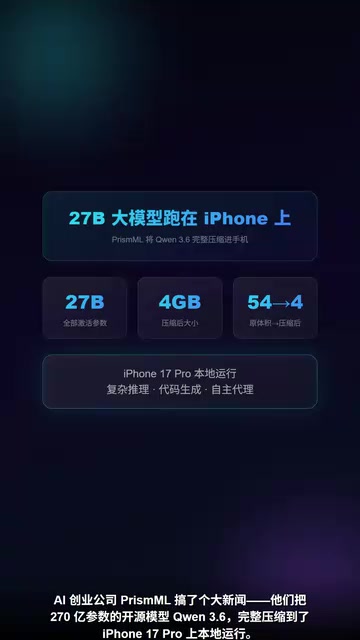
Prismo, by contrast, claims their approach activates all 27 billion parameters simultaneously. This is a critical distinction: full-parameter activation typically means stronger model expressiveness and more consistent output quality, but it also imposes far greater computational and memory pressure than sparse-activation approaches. If Prismo can genuinely achieve real-time full-parameter activation on a phone, the technical achievement is a full tier above existing solutions.
54GB Down to 4GB: The Technical Logic Behind the Compression Ratio
What truly commands attention is the compression ratio.
The original QW3.6 27B model weighs in at approximately 54GB, and Prismo claims to have compressed it to under 4GB using what they call a "mathematical compression technique" — a compression ratio exceeding 13×, with no loss in model performance, according to the company.

From a technical standpoint, model compression generally follows a few main paths:
- Quantization: Reducing FP16/FP32 weights to INT4 or lower bit widths
- Pruning: Removing redundant connections and weights
- Knowledge Distillation: Training a smaller model to mimic the behavior of a larger one
Deep Dive: Quantization Techniques: Quantization is currently the most mainstream and highest-compression-ratio path for on-device model compression. The basic principle is to map floating-point neural network weights to discrete integer representations, sacrificing some numerical precision in exchange for dramatic gains in storage and compute efficiency. Working through the storage math: 27B parameters × 2 bytes (FP16) ≈ 54GB, which exactly matches the original model size; INT8 brings this down to ~27GB; INT4 further reduces it to ~13.5GB; 2-bit quantization theoretically yields ~6.75GB; and 1.5-bit approaches ~5GB. To reach Prismo's claimed sub-4GB target, the average bit width would need to be below 1.5-bit, or additional compression techniques would need to be layered on top of quantization. In recent years, the GGUF format popularized by the llama.cpp ecosystem, MIT's AWQ (Activation-aware Weight Quantization), and research-grade schemes like QuIP# have continuously pushed the precision-loss boundary of ultra-low-bit quantization lower. However, a widely accepted principle in the field holds that quantization below 2-bit causes noticeable capability degradation on high-precision tasks such as multi-step reasoning and mathematical computation — which is precisely why Prismo's claim of "13× compression with zero performance loss" is met with deep skepticism by experts.
A 54GB-to-4GB ratio roughly corresponds to quantizing from FP16 to an extremely low bit width. Maintaining "no performance loss" under such aggressive compression requires exceptionally sophisticated algorithm design.
A note of caution is warranted here: "no performance impact" is a vendor's self-reported claim. Without third-party benchmark testing and real-world user feedback, actual performance remains to be seen. Precision loss from compression tends to surface most clearly on long-context reasoning and multi-turn complex dialogue tasks.
What Can On-Device AI Actually Do?
According to Prismo, the compressed model running on an iPhone 17 Pro can handle the following demanding tasks:
- Complex Conversations: Multi-turn context understanding and content generation
- Logical Reasoning: Mathematical computation, commonsense reasoning, and more
- Autonomous Coding Agent: Operating as an AI agent to autonomously complete task chains
- Code Generation: Writing code directly on the local device

iPhone 17 Pro Hardware Background: The core architectural advantage of Apple chips for on-device large models lies in their Unified Memory design — the CPU, GPU, and Neural Engine all share the same physical memory pool, eliminating the data transfer latency across buses that plagues traditional heterogeneous compute architectures. Memory bandwidth exceeds 300 GB/s, far outpacing discrete GPU GDDR architectures. The A19 Pro chip is expected to continue and enhance this design, with the Neural Engine's TOPS (Tera Operations Per Second) throughput potentially exceeding 40 TOPS. However, beyond raw hardware capability, memory capacity remains the critical constraint: once 4GB of model weights are loaded, the inference process still requires headroom for the KV cache (the key-value matrix storing conversational history), intermediate activations, and system overhead. The actual supported context length may be far shorter than the cloud version's 128K window. This "memory ceiling" ultimately defines the on-device model's real limits when handling tasks like long-document summarization or very large codebases.
If these capabilities can run stably on-device, the significance goes far beyond benchmark showmanship. Users would be able to access near-cloud-quality AI experiences in a fully offline, fully local environment — enormously valuable for privacy-sensitive use cases, low-connectivity environments, and reducing cloud inference costs.
Company Background and a Bold Prediction: 95% of Inference Will Run Locally
Prismo is a spinout from Caltech (California Institute of Technology), holding an exclusive patent license for the underlying technology. This academic pedigree lends some credibility to the claims, but a patent license is not the same as a product that has been validated at scale in production.
What Academic Backing Means — and Its Limits: Caltech consistently ranks among the top ten universities globally and has a strong tradition of original research in computer science, applied mathematics, and engineering physics. Notable tech companies including DeepMind and SpaceX have deep ties to its alumni. Caltech spinout companies typically follow a well-defined path from lab to market: academic publication → patent filing → exclusive license → company formation. This path gives Prismo a degree of credibility, suggesting its core compression algorithm has likely undergone peer-reviewed academic validation. However, there is a fundamental gap between academic validation (specific datasets, controlled hardware, fixed evaluation metrics) and real-world product conditions. Industrial-grade products must contend with input diversity, long-term stability, and cross-device compatibility — dimensions that academic papers typically ignore. A patent establishes that a technical approach is novel and inventive, but the distance between that and "ready for large-scale deployment" remains considerable. That is precisely why opening model weights to independent community replication is the most direct and compelling way to validate Prismo's claims.
The company's CEO, Baba Kasebi, has offered a bold prediction: within three years, 95% of AI inference will run on local devices, with only the most demanding 5% requiring the cloud.

If this plays out, it would fundamentally reshape the current AI infrastructure landscape — one dominated by centralized cloud inference. Cloud providers' inference businesses, AI application business models, and chip vendors' product roadmaps could all be affected. Of course, "95%" reads more as a visionary statement than a precise forecast; real-world adoption is still constrained by model quality, device compute, power consumption, and thermal management.
How to Think Rationally About This On-Device AI Moment
Prismo says this open-source model will soon be available for download. That detail matters enormously — once the model is public, the community can immediately verify its compression quality, inference speed, and real-world performance.
For claims this disruptive, an "optimistic but cautious" stance makes sense:
- The technical direction deserves recognition: On-device full-parameter inference for large models is a recognized and important industry trend. Any substantive breakthrough merits serious attention.
- Performance claims require empirical validation: Statements like "compression with no performance loss" and "27B parameters fully activated on a phone" ultimately need to be verified by community testing and independent third-party benchmarks after the public release.
- Heat and battery life are the hidden gatekeepers: Even if the model runs successfully, the phone's thermal behavior, battery drain rate, and sustained inference throughput under prolonged high-load operation are the real determinants of day-to-day usability.
The Thermal and Power Challenges of On-Device AI Inference: Mobile chip thermal design power (TDP) is tightly constrained to roughly 3–8 watts — a limit set by battery capacity, form factor, and user comfort. By comparison, laptop chips typically run at 15–45W TDP, and a data center H100 GPU has a TDP of 700W. This order-of-magnitude gap directly defines the ceiling for sustained mobile inference. When chip temperature exceeds a threshold (Apple chips typically throttle at around 45–50°C), the system automatically triggers thermal throttling, cutting processor frequency by 30–60% and causing inference speed to drop sharply from the peak shown in demos. This means the "first inference speed" a vendor demonstrates and the "sustained inference speed" a user experiences during extended use can differ by several times. On the energy side, high-intensity inference tasks can draw 3–5× the power of normal usage; sustained operation could cut battery life from a normal 12–15 hours down to 3–4 hours. Thermal management and power consumption are the physical constraints that no algorithm can fully solve — the hardest gap between "feasible in the lab" and "usable as a product," and the hidden deciding factor in whether this on-device AI revolution actually lands.
Regardless of how the eventual validation turns out, Prismo's attempt sends a clear industry signal: putting powerful large models in your pocket is moving from science fiction to engineering reality. The upcoming public download may well be the first genuine litmus test of this on-device AI revolution.
Key Takeaways
Related articles
CriticGen: A New Framework That Transforms AI Evaluation into Actionable Improvement Feedback
CriticGen proposes a generation-aware evaluation framework that transforms AI assessment from passive scoring to an active optimization loop, achieving 73.17% answer improvement and 93.28% non-degradation rate.
Vercel AI SDK workflow-harness Update Analysis
Deep analysis of Vercel AI SDK workflow-harness 1.0.107 update: architecture design, engineering practices, and developer value for building reliable AI apps.
Rootless Containers Explained: Principles, Benefits, and Leading Implementation Approaches
A deep dive into rootless container principles and security benefits, comparing Podman, Docker Rootless mode, and Kubernetes integration with practical migration advice.