3 Free AI Perks Roundup: LongCat LLM, AtomCode, and GMI Image API

LongCat LLM, AtomCode, and GMI Cloud launch limited-time free trials across LLM, coding, and image generation.
Several AI platforms have simultaneously rolled out limited free resources: Meituan's LongCat 2.5 preview offers two weeks of free access on OpenRouter with a 1M-token context window, multimodal image understanding, and zero data retention; open-source coding assistant AtomCode integrates GLM, Qwen, and DeepSeek with one-command setup for domestic developers; and GMI Cloud is offering free API access to its HiDream 3.5 image generation model from September 25 to October 1. The article advises developers to choose based on their specific needs and treat these short windows as opportunities for technical validation rather than long-term reliance.
Multiple AI platforms have recently rolled out free trial offers in quick succession, spanning three major categories: large language model chat, coding assistants, and image generation. Based on a roundup from Bilibili creator Xiaorou's news briefings, these limited-time free resources are quite attractive to developers and AI enthusiasts — though they typically come with short time windows and limited availability. Here's a breakdown of each offer's key details and use cases.
LongCat LLM: 1M-Token Context Window, Free for Two Weeks
Meituan's LongCat (龙猫) large language model has launched a 2.5 preview version on the OpenRouter platform, available for free for two weeks.
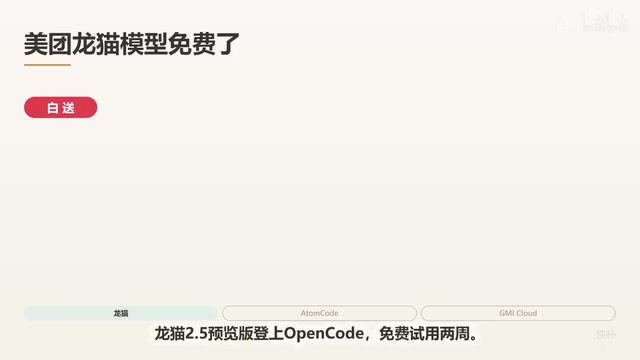
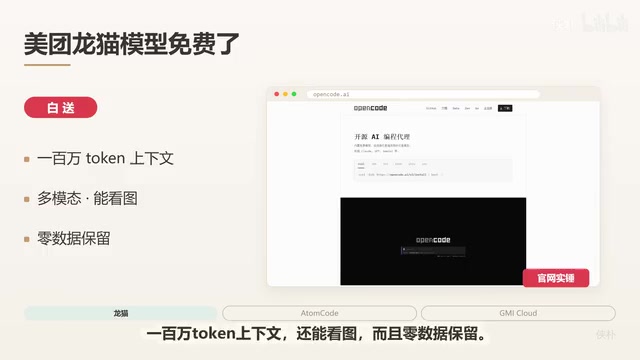
Three technical specs make this version worth noting. First, it offers an exceptionally long context window of up to 1 million tokens, capable of handling complex tasks involving long documents or large codebases. Second, it supports multimodal capabilities, including image understanding. Third, it promises zero data retention — meaning user inputs won't be stored by the platform for training or any other purpose, which is a significant consideration for privacy-conscious enterprises and individual developers.
For use cases that require processing large volumes of text — such as full-book analysis, extended conversation memory, or large-scale code reviews — a free quota at the million-token level is a rare opportunity to test in real conditions. That said, the two-week window means anyone interested should act quickly.
A context window is a core metric for measuring a large language model's single-session processing capacity — the maximum amount of text a model can "see" at once within a single conversation or request. 1 million tokens is roughly equivalent to 750,000 English words or about 500,000 Chinese characters, enough to fit an entire novel or a medium-sized codebase. By comparison, mainstream commercial models like GPT-4o have a standard context of 128K tokens — LongCat's 1M offering is roughly 8× that. This has real practical significance for tasks requiring cross-document reasoning, extended memory, or full-repo code review: the model can process an entire document in a single request without chunking, substantially reducing reasoning errors caused by information truncation. OpenRouter, as an aggregation layer that unifies access to multiple AI model APIs, also makes it easy for developers to switch between models through a single interface — a convenient entry point for testing new model capabilities.
AtomCode: An Open-Source Coding Assistant, Up and Running in One Command
The second offering is AtomCode, an open-source coding assistant focused on domestic accessibility and free access to mainstream large language models.
According to its description, AtomCode comes with free integration of three leading domestic models: GLM (Zhipu AI), Qwen (Tongyi Qianwen), and DeepSeekAd. This combination covers the current top tier of both open-source and commercial models in China. For domestic developers, it removes the network barriers and extra costs associated with accessing overseas services.
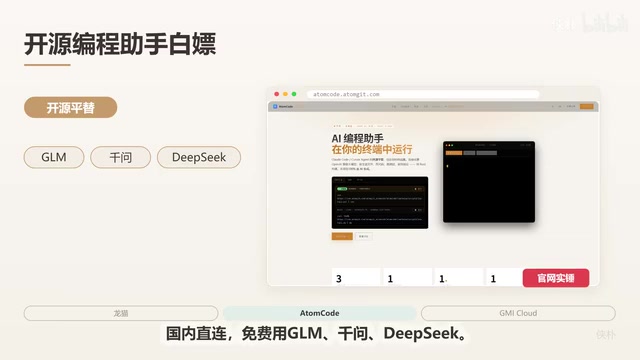
From the demo, AtomCode's installation experience is impressively lightweight — a single command handles the setup, with a claimed 30-second onboarding time, running directly in the terminal. This command-line-native interaction style suits developers who are comfortable with terminal-based workflows and reduces configuration complexity. As an open-source tool, its customizability and transparency are also noteworthy.
GMI Cloud: Image Generation API Open for Free — Limited Time
The third offering comes from GMI Cloud, and it's the most time-sensitive of the three.
GMI Cloud has opened free API access to its image generation model (referenced as HiDream 3.5-class). The free window runs from September 25 to October 1 — just one week. For developers looking to integrate text-to-image capabilities into prototypes, run batch image generation, or test product integrations, this is a zero-cost opportunity to validate output quality.
Free access via API is more practically valuable than a web-based trial, since it can be directly embedded into your own applications or workflows for programmatic use. That said, it's worth keeping an eye on the pricing model after the free period ends to avoid unexpected charges in a production environment.
The key difference between a text-to-image API and a web-based image generation tool is programmability. Web tools require manually entering prompts and downloading results each time, while an API lets developers embed image generation logic directly in code — enabling batch generation, parameterized control, and automated pipelines. For example, an e-commerce platform could automatically generate product imagery from descriptions at scale, or a game studio could programmatically generate large volumes of asset variations. HiDream is a domestic image generation model series targeting high-quality realistic and creative outputs; version 3.5 brings improvements in detail fidelity and prompt adherence. For developers looking to integrate image capabilities into their own apps, one week is short — but sufficient to complete API integration, quality evaluation, and cost estimation.
How to Think Rationally About Limited-Time Freebies
Looking at all three offers together, a clear trend emerges: AI platforms are increasingly using short-term free trials to attract users, gather experience, and collect feedback. The value for users lies in being able to test cutting-edge model capabilities at near-zero cost, helping you decide whether a long-term investment is worthwhile.
A few things to keep in mind, though: free quotas and time windows are typically short, making them suitable for technical validation rather than sustained use; for privacy-sensitive workloads, prioritize services that explicitly commit to zero data retention, as LongCat does here; and for API-based freebies, make sure to adjust your integration strategy before the free period expires.
For developers, rather than chasing every free offer indiscriminately, the smarter move is to test selectively based on your actual needs — if you work with long documents, focus on LongCat's 1M-token context; if you're building domestic coding integrations, try AtomCode; and if you need image generation capabilities, act quickly on GMI's one-week window.
The above information is sourced from Bilibili news briefings. For registration details, quota limits, and terms of use, please refer to each platform's official announcements.
Related articles

Chain of Thought Isn't Just for AI: How Humans Can Use CoT to Improve Thinking Quality
Chain of Thought isn't just a prompt trick for large models. Starting from a Hacker News discussion, this article analyzes why CoT works for human thinking too, breaks down actionable ways to transfer it, and highlights the key differences between human CoT and machine CoT.
Cloudflare Teams Up with OpenAI: Closi…
Cloudflare Teams Up with OpenAI: Closing the Loop from Vulnerability Discovery to Defense with AI
Cloudflare uses OpenAI Daybreak to investigate security vulnerabilities and generate reviewable remediation plans, while developers use Codex to boost coding efficiency and quality.

Orca Multi-Agent Orchestration in Practice: A Guide to Parallel Collaboration with Claude and Codex
Orca is Stable AI's free open-source agent workbench supporting 34 agents like Claude Code and Codex in parallel. Learn its Git worktree isolation, multi-model orchestration, and mobile management.