3 Months of an Open-Source AI Agent Memory Layer: 13K Downloads and Strangers Contributing

One indie developer's open-source AI Agent memory layer hit 13K downloads in 3 months and attracted community contributors.
An indie developer shared on Reddit how their open-source AI Agent memory layer reached ~13,000 downloads in three months, had a PR submitted to the mem0 framework under review, and attracted external contributors. The article explains why AI Agents need a dedicated memory layer — LLMs are stateless, so cross-session continuity requires an external persistence system — and analyzes how the combination of downloads and contributors signals open-source sustainability. The case is framed as a reference model for indie developers seeking opportunities in AI infrastructure.
One Developer's Open-Source Journey
As AI Agents evolve rapidly, one persistent technical pain point remains: how to give agents durable, reliable "memory." Recently, an indie developer shared a three-month progress report on Reddit about their open-source project — a memory layer for AI Agents. In just three months, it accumulated roughly 13,000 downloads, had a Pull Request submitted to the well-known memory framework mem0 currently under review, and attracted multiple contributors who had never met the author.
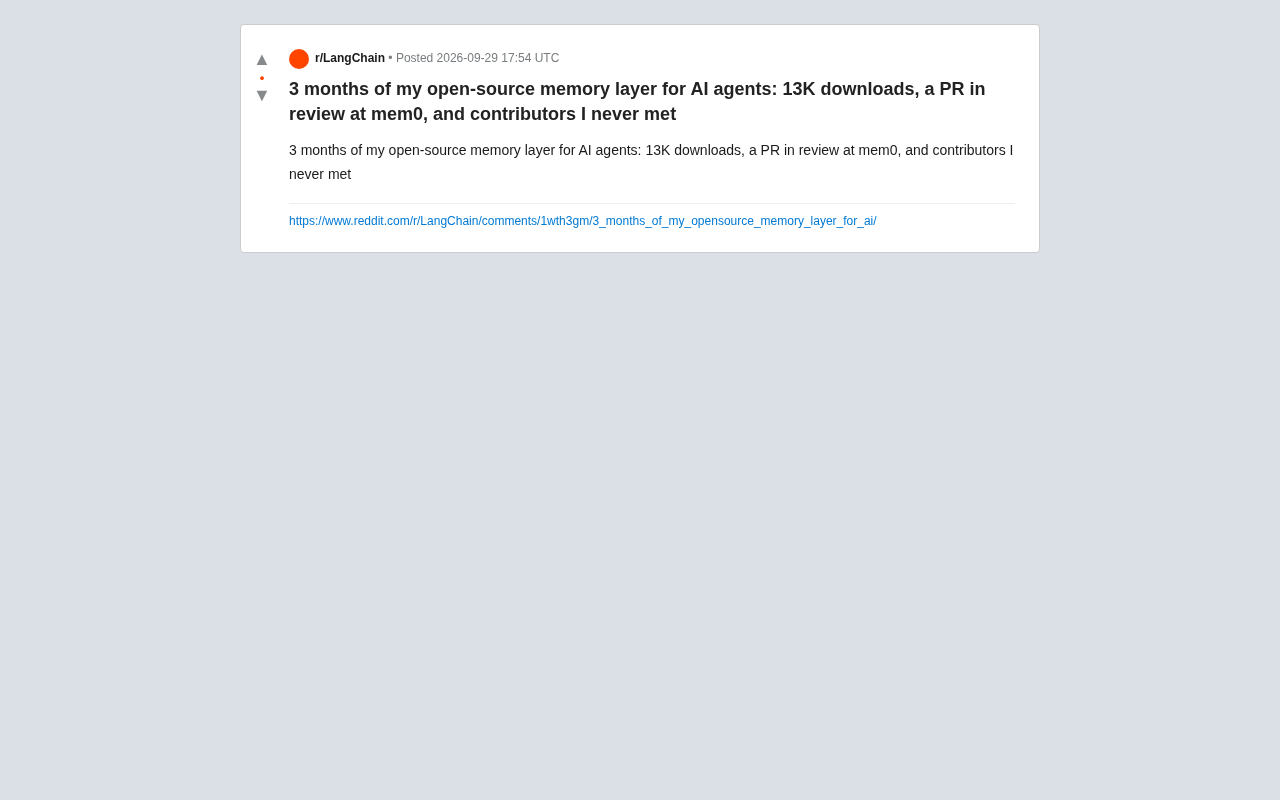
The post itself is brief, but it reflects a telling pattern in the open-source AI infrastructure space today: a solo developer who solves a real pain point can, within months, build a meaningful user base and a collaborative network.
Why AI Agents Need a Memory Layer
Large language models are inherently stateless — once a conversation ends, the context is wiped clean. For AI Agents that need to operate continuously across sessions and tasks, this is a fundamental limitation. The memory layer exists to fill that gap: it stores, retrieves, and manages information an agent accumulates through interactions, allowing the agent to "remember" user preferences, past decisions, and long-term goals.
The Core Problems a Memory Layer Solves
An agent without a memory layer treats every interaction like a first meeting, making continuous experiences impossible. A well-designed memory layer must handle several key challenges: deciding what information is worth remembering, storing and indexing it efficiently, and retrieving the right memories accurately when needed. This is exactly the value that dedicated frameworks like mem0 provide — they abstract this complex memory management capability into reusable components.
This developer's project enters precisely that space. Choosing to build in an area with clear demand and established reference points like mem0 is itself a pragmatic positioning decision.
The mainstream approaches to implementing a memory layer generally fall into a few technical patterns: vector database retrieval (embedding historical information as vectors and recalling relevant memories via semantic similarity), structured knowledge graphs (explicitly storing entity relationships for precise querying), and summarization compression (periodically condensing long-term history to control storage size). Frameworks like mem0 typically combine multiple approaches and layer in a "memory importance scoring" mechanism that automatically decides what to retain long-term and what to forget. This is technically complex — and is precisely where indie developers need to make differentiated design decisions.
It's also worth distinguishing a memory layer from a "context window." A context window is the maximum text length a model can process in a single inference pass — currently ranging from tens of thousands to hundreds of thousands of tokens across mainstream models. While context windows keep growing, they remain constrained by cost and speed and can't simply stack unlimited history. A memory layer, by contrast, is a persistent storage system that lives outside the model: it retains data after a session ends and injects relevant information on demand in future interactions, enabling cross-session continuity without relying on ultra-long contexts. The two are complementary — the context window handles recent information, while the memory layer manages long-term accumulation — making the memory layer an indispensable standalone component for production-grade Agent systems.
What 13K Downloads in Three Months Actually Means
For a solo-initiated open-source project, 13,000 downloads in three months is a genuinely healthy early signal. It shows the tool addresses a real need rather than remaining a toy-level demo. Two other indicators are even more worth noting:
- Submitting a PR to mem0 and getting it into review: This shows the author isn't just building in isolation — they're actively trying to connect with leading frameworks in the ecosystem. Contributing code to a mature project is both proof of technical capability and an effective way to gain community visibility.
- Attracting contributors who are complete strangers: This is the key marker of an open-source project becoming sustainable. When strangers are willing to spend their time submitting code to your project, it means the project has crossed the threshold from "personal work" to something with genuine community character.
From Personal Project to Community Collaboration
The real barrier in open source is rarely the code itself — it's whether a collaborative network can form. Downloads represent usage; contributors represent recognition and co-ownership. The simultaneous presence of both is more telling of a project's vitality than raw numbers alone.
In the open-source ecosystem, there's a common framework for evaluating project health that typically includes: download count (breadth of usage), GitHub stars (awareness and recognition), number of contributors (depth of collaboration), issue activity (quality of community engagement), and how many other projects depend on it (degree of ecosystem integration). A project showing positive signals across multiple dimensions simultaneously tends to indicate longer-term potential far better than a single metric spiking. The 13K downloads paired with the appearance of external contributors described here represents exactly that early healthy pattern — usage breadth and collaboration depth advancing in parallel.
The Open-Source Opportunity for Indie Developers
This case holds real lessons for developers broadly. The AI infrastructure space is still expanding rapidly, with many niche needs yet to be fully addressed — leaving room for indie developers to carve out a position. Memory layers, tool calling, context management, and similar areas are relatively nascent, opportunity-rich segments of the Agent ecosystem.
From this developer's experience, a few replicable practices stand out: focus on a specific and frequently occurring pain point, actively build connections with established projects in the ecosystem, and consistently share publicly to accumulate community attention. Open source isn't just putting code online — it's an ongoing process of building community trust.
One caveat: the original post provides limited information and doesn't disclose the project's specific name, technical architecture details, or a detailed comparison with mem0. The analysis above is therefore grounded in the broader technical context of AI Agent memory layers. Readers who want to dive deeper into the project's specific implementation should look up its open-source repository directly.
Closing Thoughts
One person, three months, one well-defined pain point — enough to generate tens of thousands of downloads and a group of like-minded collaborators. This is exactly what open source vitality looks like in the AI era. As AI Agent applications continue to mature, foundational capabilities like memory layers will only grow in importance, and indie developers willing to work in this space will have more and more opportunities to be seen.
Related articles

Workbuddy for Absolute Beginners: How a Desktop AI Agent Fits Into Real Workflows
A beginner's guide to the Workbuddy desktop AI agent: installation, claiming credits, file management, and building automated workflows—compared with CodeX for fit and cost, helping professionals shift from AI question-askers to AI managers.

OpenAI's New Agent Stack: Computer Use, Decisions API, and Ultra-Fast Workflows
OpenAI Dev Day unveiled a new agent stack: Computer Use outperforms humans, Decisions API delivers ultra-low-latency classification via Luna, Agents API opens the same Computer Use capabilities, and GPT-6.1 Sol costs only one-seventh of Astra. Core updates, benchmark data, and developer insights.

Liang Wenfeng Open-Sources DeepInfo Inference Framework, Takes On U.S. Ban
DeepSeek open-sources its DeepInfo inference framework after its models, featuring GPU/CPU cross-pipelining, small-model prediction with large-model verification, and full Huawei Ascend and NVIDIA chip support—facing the U.S. federal ban head-on. This article analyzes its significance for AI deployment and open-source strategy.