300-Episode Python Beginner Course: A Four-Stage Path from Basics to Real Projects

A breakdown of the four-stage design, practice directions, and target audience of Bilibili's 300-episode Python beginner course.
This article breaks down a Bilibili Python beginner course billed as 300 episodes. It progresses through four sections: grammar basics (from installation to functions, emphasizing code standards), advanced grammar (OOP, inheritance/polymorphism, regex), case-based practice (scraping, data analysis, office automation), and beginner perks (environment packs, courseware, e-books, mind maps, study plans). The article affirms its complete path and concentrated resources, while noting that "seven-day quick mastery" is marketing talk, scraping requires compliance, and resource packs easily create the illusion of learning.
On Bilibili, a Python beginner course billed as "a full 300 episodes" has drawn attention. The creator claims to have comprehensively consolidated knowledge points from the past year, upgrading the learning framework into four major sections: grammar basics, advanced grammar, case-based practice, and beginner perks. How is this course actually designed? Who is it for? This article breaks down the video content.
1. The Four-Stage Course Route
The creator divides the entire learning path into four progressive sections, logically following the classic teaching approach of "build the foundation—establish the system—do projects—provide resources."
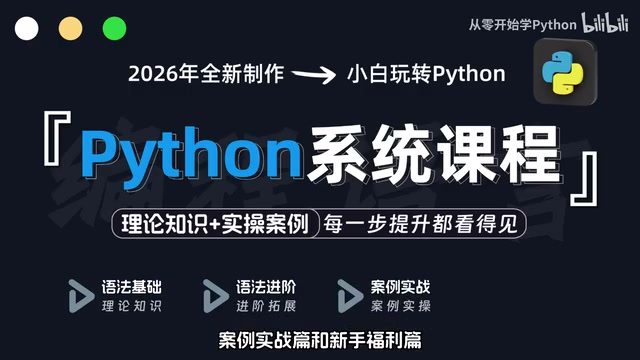
The value of this layering lies in reducing decision-making costs for beginners. The most common dilemma for zero-foundation learners isn't a lack of effort—it's not knowing what to learn first. Arranging content by stage at least gives learners a reference roadmap. That said, a caveat is warranted: "from novice to master in seven days" is typical marketing talk. Programming ability develops through sustained hands-on practice, and no course can compress that process.
Grammar Basics: Starting from Software Installation
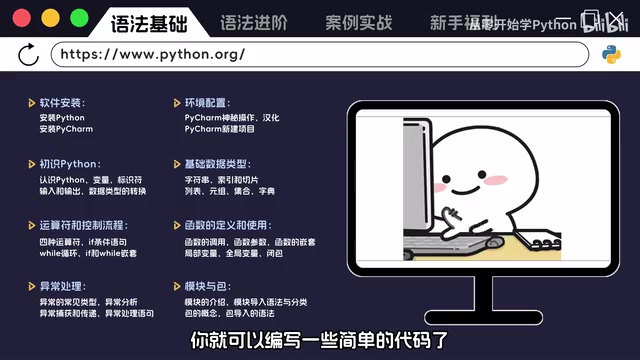
The basics section begins with software installation, then covers variables, operators, data types, functions, and more. The creator emphasizes "cultivating good code standards and logical thinking," which is an accurate positioning—what beginners most easily overlook is precisely standards, not syntax itself.
After completing this part, learners can write simple code. This means the goal of the basics section is "making it run," not "making it good." For zero-foundation learners, the key at this stage is not to skip steps. Installing the environment, writing the first line of code, understanding variable scope—every step is worth slowing down for.
Advanced Grammar: Object-Oriented Programming and Regex
The advanced section covers object-oriented programming, inheritance, polymorphism, regular expressions, and other topics. This content determines whether learners can understand Python's advanced features, and it's the watershed between "being able to write scripts" and "being able to build systems."
Object-oriented programming is where many self-taught learners get stuck. The creator mentions "building a correct and complete programming system"—vague phrasing, but the direction is right: inheritance and polymorphism aren't for exams; they're for reusing and extending code in real projects. Regular expressions are a practical skill, appearing frequently in text processing, log analysis, and similar scenarios.
Object-Oriented Programming (OOP) is a paradigm that organizes code around "objects," with core concepts including classes, instances, encapsulation, inheritance, and polymorphism. A class is a template for creating objects; an instance is a concrete object generated from that template. Inheritance allows subclasses to reuse the attributes and methods of parent classes, while polymorphism lets different subclasses respond differently to the same method. In Python, everything is an object. Understanding OOP helps you read the source structure of standard libraries and third-party frameworks, and it's a key step in transitioning from writing scripts to building maintainable projects.
Regular Expressions (Regex) are a mini-language for describing string-matching rules, combining metacharacters (such as ., *, +, ?, [], ()) into patterns for searching, replacing, extracting, and validating. Python supports them through the built-in re module, with common functions including re.search, re.findall, re.sub, and re.compile. Regex is extremely efficient in log parsing, data cleaning, and form validation, but it has poor readability—using comments and online testing tools is recommended.
2. Case-Based Practice: From Web Scraping to Office Automation
The practice section is the centerpiece of this course. The directions listed by the creator include scraping images and videos, data storage/analysis/mining, office automation, and more, with the goal of "improving hands-on skills and adding project experience."
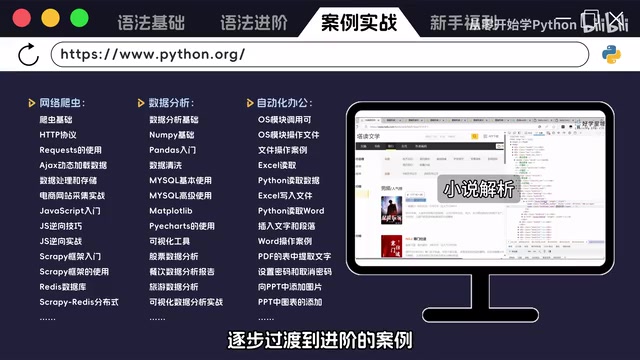
These chosen directions clearly lean toward mass appeal. Web scraping and office automation are the two most popular Python applications among non-professional developers—the barriers are relatively manageable, and the results are easy to perceive. The creator also mentions "monetizing what you learn," reflecting a realistic motivation behind programming learning today—many people learn Python for side income or to improve workplace efficiency.
A bit of cold water is needed: web scraping involves target websites' terms of service and relevant laws and regulations, while office automation only creates real value when combined with specific business scenarios. What a course provides is case templates; whether you can transfer them to your own work depends on the learner's proactive thinking.
Web Scraping refers to programs that automatically crawl web page information according to certain rules. In Python, requests is commonly used to fetch pages, BeautifulSoup or lxml to parse HTML, and Scrapy to build large-scale scraping projects. The legal boundaries of scraping deserve attention: you should comply with the target website's robots.txt protocol, control request frequency to avoid stressing servers, refrain from scraping personal privacy or copyrighted content, and obtain authorization for commercial use. China's Cybersecurity Law, Data Security Law, and Personal Information Protection Law all impose constraints on data collection activities.
Office Automation refers to using programs to replace repetitive document, spreadsheet, and email operations. In the Python ecosystem, openpyxl and pandas can read and write Excel, python-docx handles Word, python-pptx generates PPTs, smtplib sends emails, and pyautogui simulates keyboard and mouse operations. The value of office automation isn't in technical difficulty but in the ability to abstract business processes—first break down repetitive work into programmable steps, then solidify them with code.
3. Beginner Perks: The Real Value of the Resource Pack
The creator has prepared a development environment resource pack, courseware, materials, e-books, mind maps, and study plan tables for learners, claiming that "almost all the materials you can think of are here."
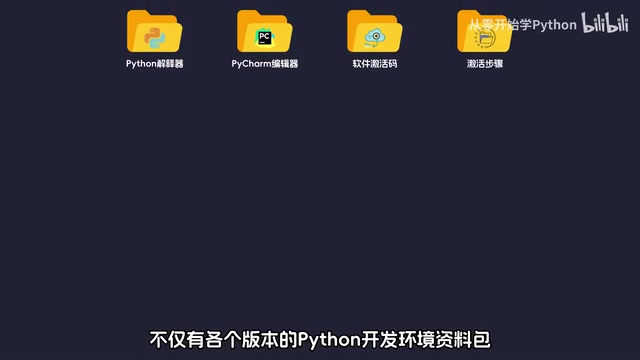
For zero-foundation learners, consolidating companion resources does save the time cost of gathering materials from everywhere, and mind maps and study plan tables help build a big-picture view. But such "mega-bundles" often have low actual usage rates—the more resources there are, the easier it is to fall into the illusion that "bookmarking equals learning." It's recommended to pick one study plan table to follow after downloading, and use the rest as needed.
4. Who This Course Is For
Judging from the content structure, this course targets beginners with no programming experience at all, as well as self-taught learners who want to systematically organize their Python knowledge. Its strengths are a complete path and concentrated resources; its weakness is the tension between the "300 episodes" volume and the "seven-day quick mastery" marketing—learners need to manage their own pace.
For readers preparing to get started, a few suggestions: type out all the exercises in the basics section by hand; don't skip object-oriented programming when you reach it in the advanced section; in the practice section, choose one direction related to your work or interests and go deep, rather than skimming every case. A course is scaffolding—real ability comes from the code you write yourself.
One-line Summary
A breakdown of the four-stage design, practice directions, and target audience of Bilibili's 300-episode Python beginner course.
Paragraph Summary
This article breaks down a Bilibili Python beginner course billed as 300 episodes. The course progresses through four sections—grammar basics, advanced grammar, case-based practice, and beginner perks: the basics section goes from software installation to functions, emphasizing code standards; the advanced section covers object-oriented programming, inheritance and polymorphism, and regular expressions; the practice section focuses on web scraping, data storage and analysis, and office automation to appeal to mass demand; the perks section provides environment packs, courseware, e-books, mind maps, and study plan tables. The article acknowledges its strengths—a complete path and concentrated resources—while noting that "seven-day quick mastery" is marketing talk, that scraping requires compliance awareness, and that resource packs easily lead to the illusion that "bookmarking equals learning." It also offers suggestions for hands-on practice at each stage.
Related articles

RePlan-VLA: Progress-Aware Replanning Breakthrough for Long-Horizon Robotic Manipulation
The RePlan-VLA framework converts VLA models' short-horizon capabilities into reliable long-horizon execution through progress-aware adaptive replanning, improving success rates by 21.9% and 10.4% on RoboCasa365 and CALVIN, and validating real-world deployment on a Franka Research 3 robot.

Geometric Bridge Flow Matching: A New Breakthrough in Blind Rigid Motion Correction
Geometric bridge flow matching enables blind rigid motion correction in head CBCT, achieving 37.1 dB PSNR and 0.27 mm RPE on simulated data in ~9.1 minutes, outperforming existing methods.

Google Releases Gemini 4 Hydrogen: 2.5x Faster Without Sacrificing Intelligence
Google releases the lightweight Gemini 4 Hydrogen: 2.5x faster task completion, AA Intelligence Index of 54 beating its flagship sibling, 7.3s single-step on Agent Arena faster than Claude and GPT rivals, four thinking levels with pay-as-you-need pricing, now available across AI Studio and more.