31-Year-Old Digital Media Pioneer Salon Ceases Publication: Is the Independent Digital News Model at Its End?

Salon, a pure online news magazine that operated for 31 years, has announced its closure, marking a landmark setback for the business model of independent digital news.
Salon, an online news magazine that has been online for 31 years, published an unsigned announcement declaring that it will cease publication. As one of the earliest pure online news outlets, Salon attributed its closure to profound changes in the commercial realities of independent digital journalism, saying its publishing model is "no longer sustainable." The article points out that its predicament came from the triple squeeze of fragile advertising dependence, the ceiling on subscription conversion, and passivity in platform distribution. These problems are not unique to Salon, but when layered onto a veteran site, they ultimately crushed its cost and revenue structure. Salon's exit is therefore symbolic: content can survive technological cycles, but business models may not. For content creators, matching revenue structure with cost structure is the key to sustainability.
A Period at the End of an Era: Salon Announces It Will Cease Publication
According to an RSS source, the online news magazine Salon, which has been online for 31 years, today published an unsigned announcement declaring that it will cease publication. As one of the earliest pure online news outlets, Salon's shutdown is not only the exit of a single media brand, but is also seen as a landmark setback for the business model of independent digital news.
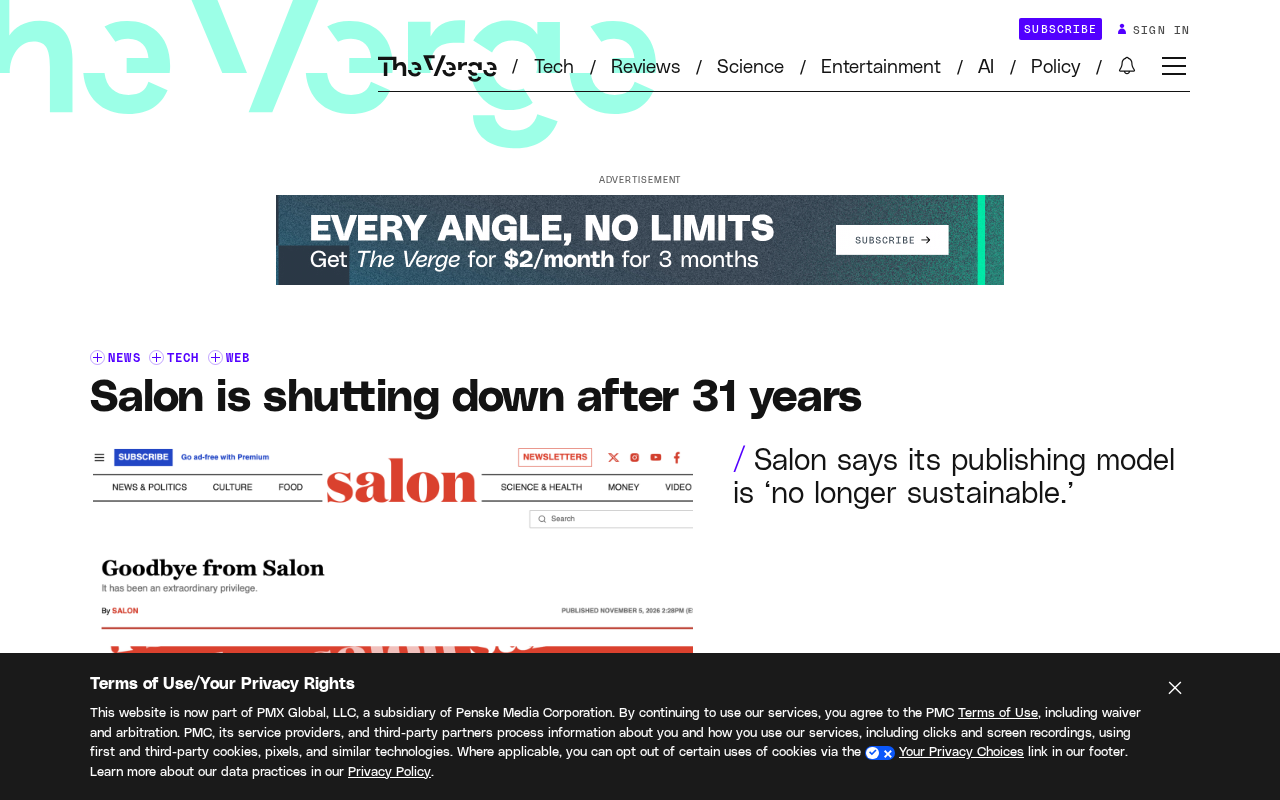
In the announcement, Salon attributed the decision to the fact that "the commercial realities of independent digital journalism have changed profoundly over the years," and stated bluntly that its publishing model is "no longer sustainable." In just a few words, it captures the helplessness of a veteran digital media outlet under the combined pressures of traffic logic, the advertising market, and readers' paying habits.
From Pioneer to Exit: What Salon's 31 Years Mean
Salon was founded 31 years ago and was one of the few news magazines in the early internet era to operate in a purely online form. At a time when traditional media still dominated, Salon, together with similar sites, proved that "you can do in-depth journalism without a print edition." It established its identity through cultural commentary, political reporting, and opinion columns, and it also cultivated readers and writers for later digital-native media.
For this reason, Salon's cessation carries strong symbolic significance. It did not die from the quality of its content, but from the commercial structure that supports the continuous production of content. When a digital media outlet that has operated for more than thirty years struggles to find a sustainable path, the entire industry needs to re-examine the cost of the word "independent."
Digital-native media refers to media organizations that, from the very beginning, have used the internet as their only or primary distribution channel and have no tradition of print editions. Unlike the "digital transformation" of newspapers and magazines, digital-native media carry no historical baggage, have lighter organizations, publish faster, and experimented earlier with new forms such as blogs, comments, and aggregation. Salon, along with Slate and BuzzFeed, is often regarded as an early representative of this lineage; they proved the viability of online in-depth reporting and opinion content, and they also trained a group of writers who later entered mainstream media. But being digital-native also means lacking the subscription base and local advertising moat of the print era. Once the platform traffic dividend fades, their commercial fragility is exposed all at once.
The Business Model Dilemma of Independent Digital News
The "profound changes in commercial realities" mentioned in Salon's announcement point to several long-standing industry problems:
- Fragility of advertising dependence: Programmatic advertising has allowed platforms to reprice the value of traffic, and small and medium-sized independent media have limited bargaining power.
- The ceiling on subscription conversion: Readers' paying habits are concentrating around top-tier media, and long-tail media struggle to accumulate a sufficiently large base of paying users.
- Passivity in platform distribution: Changes in search and social platform algorithms directly affect traffic, and media lack stable channels for reaching readers.
These factors are not unique to Salon, but when layered onto a veteran site that had operated for more than thirty years, they ultimately crushed the feasibility of its publishing model. The judgment in the announcement that the model is "no longer sustainable" is essentially an acknowledgment of the long-term imbalance between its cost structure and revenue structure.
Programmatic advertising refers to the sale of advertising inventory through automated bidding systems that match advertisers with media inventory in real time. It turns ad slots into standardized commodities that can be instantly priced by algorithms; while efficiency improves, prices also become highly transparent. For small and medium-sized independent media, this means they must compete in the same bidding pool as a vast number of long-tail sites, lacking brand premiums and data advantages, so revenue per unit of traffic is continuously pushed down. Platforms (search, social, and ad exchanges) hold pricing power and user data, while media can only passively accept settlement outcomes. This is precisely the structure in which Salon found itself: advertising revenue fluctuates with traffic, and traffic is in turn subject to platform algorithms, so the revenue side has long lacked predictability.
Subscription conversion refers to the proportion and scale of free readers that media outlets convert into paying users. The digital subscription market shows an obvious concentration at the top: media with brand trust and irreplaceable content can accumulate millions of paying users, while long-tail media, constrained by reader scale, degree of content differentiation, and willingness to pay, often see conversion rates remain in the single digits. In addition, subscription fatigue (it is difficult for the same reader to pay for multiple media outlets at once) and the abundance of free alternatives make it very difficult for small and medium-sized media to make subscriptions a main revenue source sufficient to cover editorial costs. This often leaves the "advertising + subscription" dual pillar unstable on both ends in practice.
Lessons for Content Creators
Salon's exit is also instructive for content creators in the AI and technology fields. No matter how the medium changes, the sustainability of content production ultimately depends on whether the revenue structure matches the cost structure. For independent creators, the risk of a single revenue source is amplified when platform rules change; for media organizations, brand trust and reader relationships remain core assets for withstanding traffic fluctuations.
Salon's 31 years prove one thing: content can survive technological cycles, but business models may not. The cessation announcement gave no further details, but the questions it leaves behind deserve serious thought from everyone who depends on digital content for a living.
One-line Summary
Salon, a pure online news magazine that operated for 31 years, has announced its closure, marking a landmark setback for the business model of independent digital news.
Paragraph Summary
Salon, an online news magazine that has been online for 31 years, published an unsigned announcement declaring that it will cease publication. As one of the earliest pure online news outlets, Salon attributed its closure to profound changes in the commercial realities of independent digital journalism, saying its publishing model is "no longer sustainable." The article points out that its predicament came from the triple squeeze of fragile advertising dependence, the ceiling on subscription conversion, and passivity in platform distribution. These problems are not unique to Salon, but when layered onto a veteran site, they ultimately crushed its cost and revenue structure. Salon's exit is therefore symbolic: content can survive technological cycles, but business models may not. For content creators, matching revenue structure with cost structure is the key to sustainability.
Related articles

Anthropic Fable 5.2 Hands-On: 3A Games and Excel Clones from One Prompt
Anthropic Fable 5.2 hands-on: three-line prompts generate a playable Gears of War clone, a full Excel clone, and a DaVinci Resolve clone. Benchmarks, Ultra Code mode, token costs, and pricing analyzed — is it worth replacing Opus 5.5?

RL Racing Agent Stuck Against the Wall? Try These Recovery Strategies
RL racing agent stuck against walls? We analyze recovery data, observation limits, and action space, comparing DAgger, behavior cloning, and SAC with diagnostic experiments.

Giving AI Agents Long-Term Memory: A New Approach to Supply Chain Disruption Decisions
A developer uses Hindsight to build persistent memory for a supply chain AI agent, enabling retrieval of past disruptions and decision outcomes. The article analyzes its architecture, memory retention and recall design, and engineering challenges such as what to remember and how to evaluate memory effectiveness.