RL Racing Agent Stuck Against the Wall? Try These Recovery Strategies

PPO racing agent gets stuck on walls; ablation experiments are needed to isolate data, observation, and action-space bottlenecks.
The article discusses a developer's SuperTuxKart RL agent that gets stuck against walls. The PPO policy completed 91/105 races versus a simple path follower's 100/105, with failures concentrated in wall-stuck and post-rescue falls. Causes fall into three categories: insufficient recovery data, limited observation range, and an action space lacking braking. In single-player time trials, behavior cloning and DAgger average ~38.3s, SAC mixed replay ~38.7s, but four-car racing is untested. The article recommends quick ablation experiments—extending lookahead, adding braking, targeted DAgger labeling, attention visualization—to locate the bottleneck rather than blindly adding data. It also notes post-rescue states are out of distribution and need augmentation. Core conclusion: diagnose before treating; recovery ability matters more than pure speed.
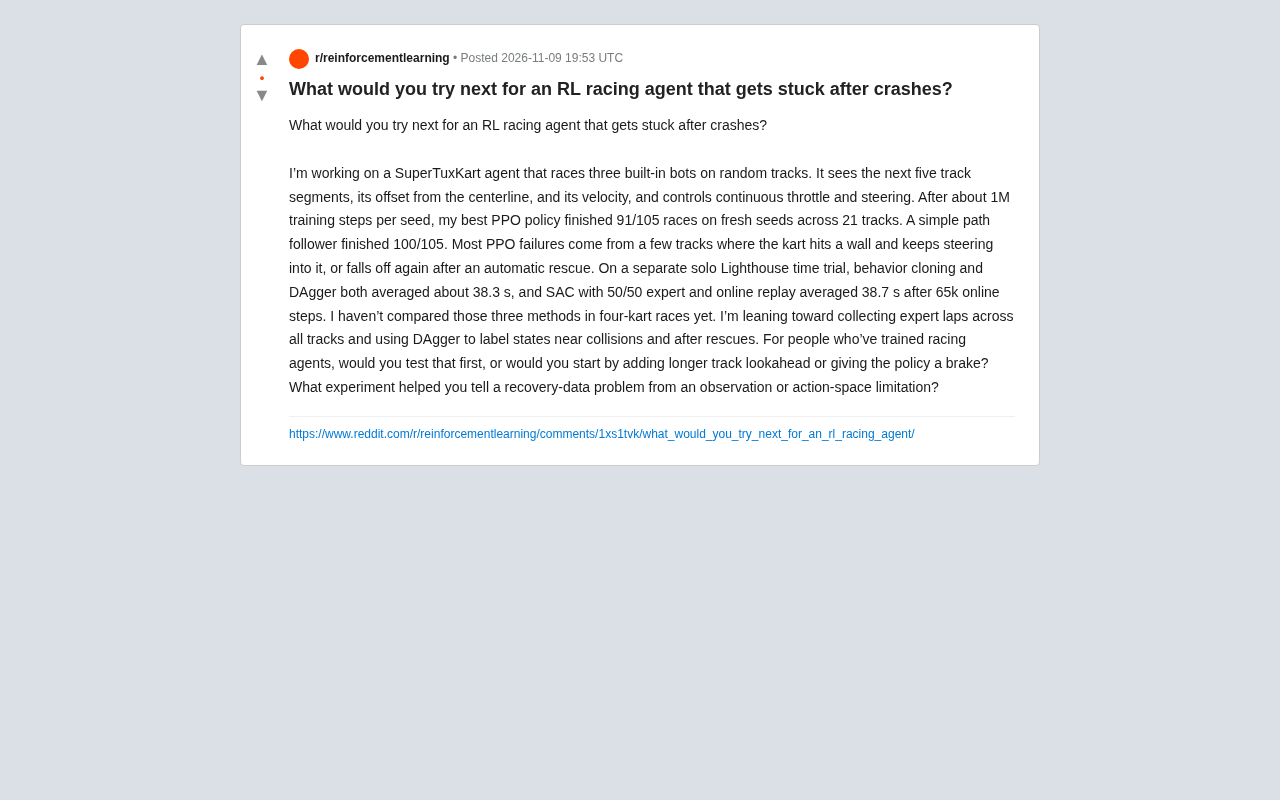
In a reinforcement learning (RL) racing game, an agent getting stuck after hitting a wall is a classic challenge. A developer training a SuperTuxKart agent found that the PPO policy completed 91/105 races across 21 tracks, while a simple path follower completed 100/105. The failures were concentrated on a few tracks: the kart keeps steering into the wall after hitting it, or falls off again after the automatic rescue. This raises a key question: how do you distinguish between a recovery-data problem, an observation limitation, or an action-space limitation?
Background: Three Possible Causes Behind Getting Stuck Against the Wall
The agent's observations include the next five track segments, centerline offset, and speed, and its actions are continuous throttle and steering control. After about 1 million training steps, the PPO policy's performance is still unsatisfying. The developer leans toward collecting expert lap-time data and using DAgger to label states near collisions and after rescues. But in a four-car racing scenario, behavior cloning, DAgger, and SAC (mixed expert and online replay) have not yet been compared.
From a technical standpoint, getting stuck can stem from three layers:
- Insufficient recovery data: The agent rarely experiences states like "how to get unstuck after being stuck," so the policy fails in these regions.
- Observation limitation: The field of view from five track segments may not be enough to anticipate the escape path after a collision.
- Action-space limitation: With only throttle and steering and no braking, the agent cannot adjust its posture by slowing down.
PPO (Proximal Policy Optimization) is a mainstream on-policy reinforcement learning algorithm that ensures training stability by limiting the step size of policy updates. It uses a clipped objective function to prevent the policy from changing too much in a single update, and it performs well in continuous action spaces, so it is often used in tasks such as autonomous driving and robot control. PPO's limitation is its low sample efficiency: old data is discarded after each update, requiring a large amount of environment interaction. In a racing game, this means the agent must repeatedly experience edge states such as hitting walls to learn recovery strategies, and such states are inherently unlikely to appear during random exploration, further exacerbating the scarcity of recovery data.
DAgger (Dataset Aggregation) is an interactive imitation learning algorithm. It first trains an initial policy with expert demonstrations, then lets the policy run in the environment and collects the states it visits, asks the expert to label the correct actions for those states, aggregates the new data into the training set, and retrains, iterating in this way. Compared with pure behavior cloning, DAgger's key advantage is that the training distribution gradually covers the regions where the policy itself is prone to errors—such as states near collisions and after rescues. In an RL racing scenario, this means DAgger can provide expert action labels specifically for stuck states, rather than only fitting the distribution of expert trajectories.
Experimental Comparison: Behavior Cloning, DAgger, and SAC
In the LighthouseAd single-player time trial, behavior cloning and DAgger averaged about 38.3 seconds, and SAC (50/50 expert and online replay) averaged 38.7 seconds after 65k online steps. These results are close in the single-player scenario, but the interaction complexity of four-car racing is higher. Multi-source analysis (based on the Reddit discussion and experience from similar RL racing projects) suggests that DAgger has an advantage in labeling states near collisions because it can actively query the expert's actions in critical states.
However, some developers point out that simply adding more recovery data may not be enough. If the observation itself cannot distinguish "should I reverse or steer after hitting the wall," then no amount of data will teach the policy the correct behavior. Therefore, start with ablation experiments: fix the data, change the observation (e.g., add a longer track lookahead) or the action space (e.g., add braking), and observe the performance changes.
SAC (Soft Actor-Critic) is an off-policy maximum-entropy reinforcement learning algorithm whose objective maximizes policy entropy while maximizing return, encouraging exploration and improving robustness. Its off-policy nature allows SAC to mix expert demonstration data with online interaction data in the replay buffer, achieving an effect similar to "demonstration augmentation." The "SAC (50/50 expert and online replay)" mentioned in the article means that half of the replay buffer comes from expert trajectories and half from the agent's own interactions. This mixing lets SAC balance data efficiency and exploration, but unlike DAgger, SAC does not actively query the expert's actions in critical states; it passively uses existing expert data, so its coverage of sparse critical states such as collision recovery may be weaker than DAgger's.
Behavior cloning is the simplest imitation learning method: it directly trains a policy on state-action pairs as supervised learning data, essentially distribution matching. Its problem is covariate shift: when the policy runs on its own, it enters states that do not appear in the expert data (such as getting stuck against a wall), and errors accumulate and amplify. In racing tasks, behavior cloning can learn normal driving but lacks generalization to edge states such as collision recovery, which explains why it performs reasonably in single-player time trials yet exposes its shortcomings in scenarios that require recovery ability.
Diagnostic Methods: How to Locate the Root Cause
To distinguish a recovery-data problem from observation/action limitations, you can design the following experiments:
- Increase the track lookahead length: Extend the five track segments to see farther and observe whether the stuck frequency decreases. If it drops significantly, the observation limitation is the main cause.
- Add a braking action: Give the policy a braking dimension and see whether it can learn to slow down and escape. If braking is used frequently and the success rate improves, the action-space limitation is the cause.
- Targeted DAgger: Query the expert only for states near collisions and after rescues, and compare the change in overall success rate. If the improvement is limited, the problem may not be the data.
- Visualize attention: Inspect the policy's observation input when it is stuck to determine whether it "sees" the wall but cannot output the correct action.
Some developers report that in similar projects, after adding braking, the policy learned to slow down before hitting the wall, reducing stuck situations. But others argue that longer lookahead is the key, because the agent needs to plan an escape path in advance. These two approaches are not mutually exclusive and can be tested at the same time.
Ablation study is an experimental design method used in machine learning for attribution analysis: by systematically removing or modifying a component, input, or capability of a model and observing the performance changes, one can judge that factor's contribution to the final result. In this article's context, an ablation study means fixing the training data and algorithm and changing only the observation dimensions (such as extending the track lookahead) or the action space (such as adding braking), then comparing the change in stuck rate. The value of this controlled-variable approach is that it separates the three hypotheses of "insufficient recovery data," "observation limitation," and "action-space limitation," avoiding the inability to attribute causes when multiple factors are changed at once. Compared with directly investing in large-scale data collection, ablation experiments are low-cost and short-cycle and can quickly narrow down the problem, making them a standard means of locating bottlenecks in RL engineering practice.
Out-of-Distribution (OOD) states refer to states that the agent encounters during deployment or evaluation whose distribution differs significantly from the training data. States after an automatic rescue are a typical example: the agent rarely experiences being teleported back to the track by a rescue during training, so such states account for a very low proportion of the training distribution. When the policy faces OOD states, its output actions lack data support and are prone to failure. Solutions include actively injecting rescue states during training for data augmentation, or using DAgger to have the expert label actions for these states, thereby bringing OOD states into the training distribution.
Practical Advice: From Diagnosis to Iteration
For this developer, the recommendation is to prioritize quick ablation experiments rather than directly investing in large-scale data collection. Specific steps:
- Use the existing PPO policy to test on the tracks where it gets stuck, and record the state distribution.
- Quickly train a variant with braking and compare the stuck rate.
- If braking works, then combine it with DAgger to label recovery states; if not, try increasing the lookahead.
- In the four-car scenario, compare DAgger and SAC, focusing on collision recovery caused by interactions.
Interestingly, states after an automatic rescue may be out of distribution and require specialized data augmentation. Some developers suggest actively injecting rescue states during training so that the policy learns to recover from anomalies.
In short, diagnose before treating. Through controlled-variable experiments, you can identify the bottleneck and avoid blindly adding data or adjusting the network architecture. For RL racing agents, recovery ability is often more important than pure speed.
One-line Summary
A PPO racing agent gets stuck against walls; ablation experiments are needed to distinguish data, observation, and action-space bottlenecks.
Paragraph Summary
The article discusses a wall-stuck problem encountered by a developer training a SuperTuxKart reinforcement learning agent. The PPO policy completed 91/105 races across 21 tracks, falling short of the simple path follower's 100/105, with failures concentrated in continuing to steer after hitting a wall or falling off again after a rescue. The author attributes the causes to three categories: insufficient recovery data, limited observation range, and an action space lacking braking. In single-player time trials, behavior cloning and DAgger average about 38.3 seconds, and SAC with mixed replay about 38.7 seconds, but four-car racing has not yet been compared. The article recommends prioritizing quick ablation experiments—extending track lookahead, adding braking, targeted DAgger labeling of states near collisions, and visualizing attention—to locate the bottleneck rather than blindly adding data. It also notes that states after automatic rescue are out of distribution and require specialized data augmentation. The core conclusion is to diagnose before treating; recovery ability is often more important than pure speed.
Related articles

The Complete Guide to Choosing Models in Ollama: From Configuration to Quantization Pitfalls
A complete guide to choosing models in Ollama: from checking your hardware to browsing the official library, explaining Tools, Thinking, Vision, and Decision tags, plus trade-offs between parameter size, quantization, and context cache to avoid crashes.

Is Ollama Secure by Default? The Truth About GPU Freeloading and a Self-Check Guide
Ollama binds to loopback by default, but one environment variable or a copied Docker command can expose your GPU. This article explains how GPU freeloading works, the scale of scanning, and DNS rebinding paths, plus a three-layer self-check and fix guide.

Cherry Studio + MCP in Practice: Building Automated AI Agents and a Local Knowledge Base
Based on a Bilibili Cherry Studio tutorial: configure MCP, build automated AI agents for web scraping and report generation, and set up a local knowledge base with Ollama + Qwen3, plus real-world pitfalls.