3,500 Enterprise AI Use Cases Reveal: Is AI Investment Actually Worth It?
Survey of 3,500 enterprise AI use cases shows 80%+ of companies are seeing positive ROI.
A survey of 1,000+ enterprises covering 3,500 AI use cases shows that AI investment is delivering real returns: 44.3% report moderate ROI, 37.6% report high ROI, and only 5% report negative ROI. Time savings is the most common benefit, but coding, risk reduction, and AI Agent use cases deliver the highest returns. Production-grade Agent deployments jumped from 11% to 42%, and systematic multi-scenario deployment is the key to amplifying returns.
Enterprise AI Adoption: Not a Bubble, But an Accelerating Reality
Despite the media's persistent "AI bubble" narrative, multiple authoritative studies show that enterprise AI adoption is meaningfully accelerating.
A major inflection point in software development: The most significant shift in 2025 has occurred in coding and software engineering. It's not just software engineering teams — other parts of organizations are beginning to think about how to use code to communicate and build products. This is one of the biggest themes of the year.
Three technological forces are driving this inflection point: the widespread adoption of AI coding assistants like GitHub Copilot and Cursor, which have transformed code completion from a "nice-to-have" into a development standard; a leap in code understanding and generation capabilities from frontier models like Claude and GPT-4o, which can now handle complex cross-file refactoring tasks; and the rise of "Vibe Coding," which enables non-professional developers to build functional prototypes by describing requirements in natural language. Together, these forces have made programming no longer the exclusive domain of software engineers, but a productivity tool accessible to everyone.
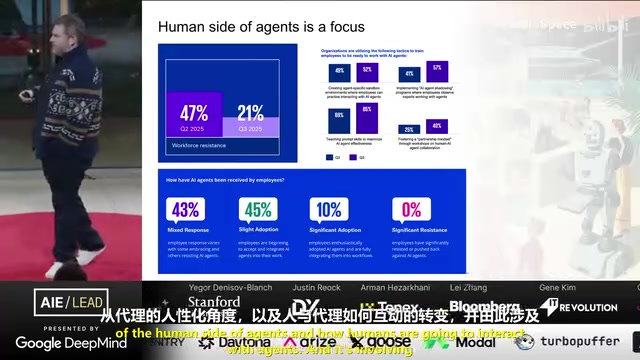
AI Agents moving from experimentation to production: According to KPMG's quarterly pulse survey, among companies with annual revenue exceeding $1 billion, the share with full production-grade Agent deployments jumped from 11% in Q1 2025 to 42% in Q3. These aren't pilots or experiments — these are AI Agents actually doing real work.
AI Agents are AI systems capable of autonomously perceiving their environment, forming plans, and executing multi-step tasks — distinct from traditional single-turn question-and-answer AI interactions. Their core architecture typically includes a perception layer (receiving inputs), a reasoning layer (planning based on large language models), and an execution layer (calling tools, APIs, or external systems). The explosion of Agent technology in 2024–2025 has been enabled by the maturation of Function Calling, Retrieval-Augmented Generation (RAG), and multi-agent collaboration frameworks such as AutoGen and LangGraph. Typical enterprise Agent applications include: automated customer service ticket handling, cross-system data integration, and automated code generation and testing.
But most enterprises are still "testing the waters": McKinsey's latest State of AI research shows that only 7% of organizations consider themselves to have fully scaled AI deployments, while roughly 62% are still in the experimentation or pilot stage. Interestingly, larger organizations are actually ahead of smaller ones when it comes to scaling — which runs counter to the intuition that "smaller companies are more agile."
ROI Research Methodology: Letting 1,000 Companies Speak Through Data
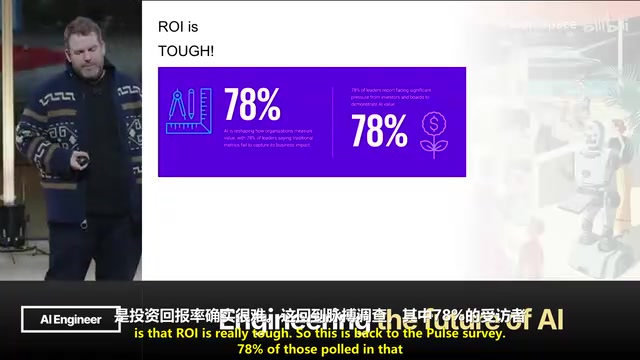
Traditional ROI measurement methods are breaking down. A KPMG survey found that 78% of respondents believe ROI will become an even more important consideration in the future — but equally, 78% say that traditional impact metrics and measurement methods can no longer keep up with the new realities AI has created.
This dilemma has deep methodological roots. The traditional ROI formula is (Gain − Cost) / Cost × 100%, but measuring AI project ROI faces unique challenges: benefits are often soft (e.g., improved decision quality), lag in appearing (capability accumulation takes time), and are difficult to isolate from other variables. The McKinsey Global Institute has noted in its AI economics research that more than 40% of AI value comes from hard-to-quantify "intangible benefits," such as improved employee satisfaction and enhanced organizational learning capacity. This explains why such a high proportion of enterprises feel that traditional measurement methods have become obsolete.
Faced with this challenge, the research team decided to collect data directly from enterprise practitioners. Starting in late October, through the roisurvey.ai platform, more than 1,000 independent organizations have submitted approximately 3,500 AI use cases. The research categorizes AI-driven impact into eight categories:
- Time savings
- Increased output
- Quality improvement
- New capability acquisition
- Improved decision-making
- Cost reduction
- Revenue growth
- Risk reduction
It's worth noting that respondents are active listeners of AI podcasts — a highly engaged group — so there is some selection bias. Nevertheless, a sample of 3,500 use cases still carries considerable reference value.
Key Findings: Enterprise AI Investment Is Genuinely Creating Returns
Overall ROI Performance Exceeds Expectations
The survey results are clear: 44.3% of respondents report seeing moderate ROI, 37.6% report high ROI (significant or transformative), and only about 5% report negative ROI. And negative ROI doesn't necessarily mean project failure — it simply means that current costs still exceed returns.
Even more noteworthy are future expectations: 67% of respondents believe ROI will achieve high growth over the next year. Even among teams currently experiencing negative ROI, 53% expect to see high growth. Optimism about AI investment returns is running very strong.
Time Savings Is the Starting Point — But Far From the Whole Story
Time savings accounts for roughly 35% of use cases, making it the most common ROI category. Most use cases cluster around saving 1–10 hours per week, with 5 hours being a common figure.
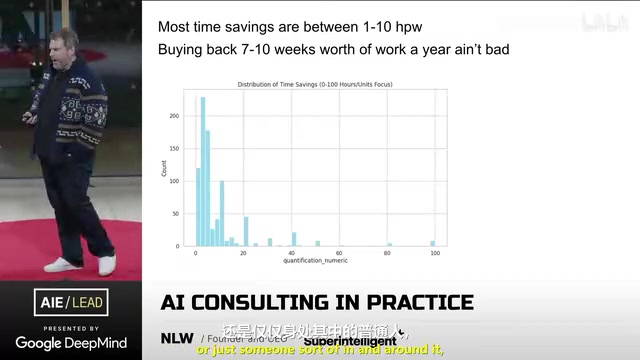
This number may seem modest, but consider the math: saving 5–10 hours per week means reclaiming 7–10 full working weeks per year. For an enterprise, that's very substantial value.
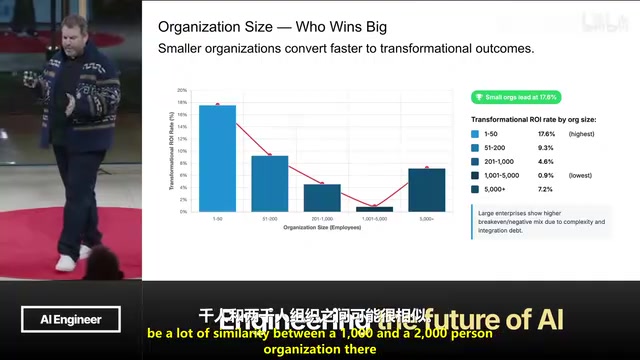
But the story goes well beyond time savings. Breaking down the data by organization size reveals some interesting differences:
- Mid-sized organizations (200–1,000 employees): More focused on "increased output" use cases — these organizations have reached a certain scale but are still actively expanding.
- C-suite executives and leadership: Compared to frontline employees, they are more focused on increased output and new capability acquisition rather than pure time savings; 17% of use cases submitted by executives have already produced transformative impact.
- Small organizations (1–50 employees): Achieve transformative returns earlier.
Three High-ROI Areas Worth Digging Into
1. Coding use cases deliver the highest ROI: As expected, coding and software-related use cases show above-average ROI, with below-average rates of negative ROI. This aligns closely with the AI adoption inflection point in programming this year.
2. Risk reduction use cases are "few but mighty": While only 3.4% of use cases cite risk reduction as the primary benefit, 25% of those use cases — a full one in four — report transformative ROI. This phenomenon has a deep industry context: risk reduction AI use cases are especially prominent in finance, healthcare, law, and compliance. Take financial compliance as an example: anti-money laundering (AML) systems must process hundreds of millions of transaction records annually, and traditional rule-based engines have false positive rates exceeding 95%, generating enormous manual review costs. AI models trained on historical cases can reduce false positive rates by 60–80% while improving detection of genuine risks. AI-assisted diagnosis in healthcare and contract risk review in legal services share similar "low-frequency, high-value" characteristics — fewer use cases, but each one delivers outsized value. This also explains why compliance and risk management back-office functions, which face enormous volumes of work, are precisely where AI excels.
3. Healthcare and manufacturing stand out: Despite technology and professional services having the largest sample sizes, use cases from healthcare and manufacturing show significantly higher impact than the overall average — an area worth further investigation.
AI Agents and Automation: The Next Wave of High Returns
One of the most important findings in the survey is this: use cases involving automation or AI Agents report far higher self-reported ROI than any other type. This trend holds for both automation and Agents.
This echoes the KPMG data showing Agent adoption jumping from 11% to 42%, signaling that enterprise AI is evolving from "assisting humans" to "autonomous execution." For companies planning their AI strategy, Agent-based workflows and process automation should be priority investment areas.
Systematic Deployment Is the Key to Amplifying AI Returns
The survey reveals what is almost a linear relationship: the more use cases a person or organization submits, the better the ROI they report.
This aligns with McKinsey's research on "leaders vs. laggards
Related articles
Meta Muse Hits 900K Downloads in Six D…
Meta Muse Hits 900K Downloads in Six Days: The AI Agent Era Has Officially Arrived
Meta's AI agent Muse hit 902K downloads in 6 days, topping US App Store and Google Play charts above ChatGPT and Claude. A deep dive into Muse's capabilities and the AI Agent race.
 Industry Insights
IRS Fully Embraces Claude AI, Accelerating Federal Government's AI Adoption
The IRS is recruiting staff with 24/7 Claude AI access, marking Anthropic's breakthrough into the federal government. Explore the strategic implications and tax use cases.
 Industry Insights
The IRS Mobile App Debate: A Trust Crisis in Government Digital Transformation
The IRS's proposed mobile app has sparked heated debate. This article analyzes the core arguments, exploring data security, privacy, and the trust crisis in government digital transformation.