360M Small Model Plays Terminal: WorldTUI's Creative Experiment

Developer trains terminal emulator WorldTUI with a 360M small model, exploring an interactive experiment of "pretend execution."
WorldTUI is an open-source experimental project trained by a developer, using a language model with only 360M parameters to "play" a terminal interface rather than actually executing commands. The model learns from terminal session data to output prompts, simulate command results, and generate error messages, featuring low inference cost, simple deployment, and clear security boundaries. Hacker News community discussion focused on its technical implementation (such as corpus construction) and the philosophical extension of "world simulation," considering this reverse approach of "small model + extremely narrow scenario" an interesting contrast to the general large-model path, demonstrating the potential of lightweight models in vertical interaction.
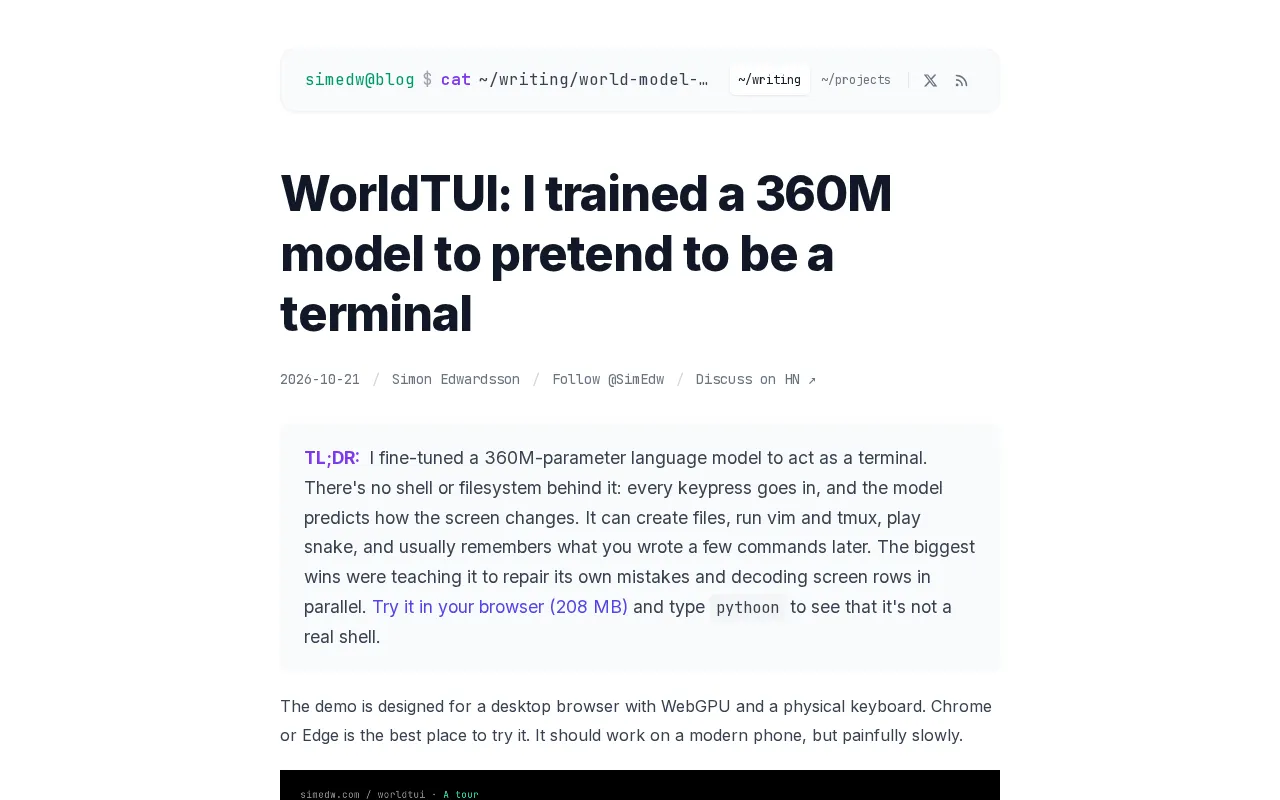
On Hacker News, a developer shared a project called WorldTUI: he trained a language model with only 360M parameters specifically to "pretend" to be a terminal interface. This seemingly eccentric idea sparked lively discussion in the community, and also reflects an interesting reverse thinking in current AI application exploration—not pursuing general capabilities, but letting the model focus on simulating specific interaction scenarios.
Project Origin: When the Model Becomes a "Terminal Actor"
The core idea of WorldTUI is not complicated: the developer trained a small-scale model using terminal session data, enabling it to respond to user input like a shell terminal. It does not need to actually execute commands; instead, it "plays" the terminal through language modeling—outputting prompts, simulating command results, and even generating plausible-looking error messages.
According to the original Hacker News post, this 360M-parameter model is far smaller in scale than mainstream large models, but it is precisely this lightweight nature that gives it unique playability: low inference cost, simple deployment, and clear behavioral boundaries. The developer positions it as an interactive experience experiment rather than a productivity tool.
Why "Pretend" Instead of "Execute"?
The fun part of this project is that it deliberately gives up authenticity. Traditional terminal emulators require a real command parsing and execution environment, while WorldTUI chooses to let the model "perform" terminal behavior. This design brings several intriguing characteristics.
On one hand, the model can generate completely fictitious but correctly formatted output, such as simulating a non-existent file system, or returning a fabricated yet structurally reasonable directory listing for the ls command. On the other hand, because there is no real execution layer, security concerns are greatly reduced—the worst case is that the model outputs meaningless content, rather than actually deleting files or executing dangerous commands.
Some community comments pointed out that this "world simulation" approach can be extended to more scenarios: pretending to be a database client, pretending to be a game console, or even pretending to be a certain historical version of the DOS system. The model's role here shifts from "assistant" to "environment."
Terminal Emulators and Shell Execution Environments
Traditional terminal emulators (such as GNOME Terminal, iTerm2) are essentially input/output devices responsible for passing characters typed by the user to the shell (such as Bash, Zsh) and rendering the text results returned by the shell. The actual command parsing, process creation, and file system operations are all completed by the shell and the operating system kernel. WorldTUI skips this entire execution chain: the model directly predicts output text based on input, and no system calls occur. This means it does not need a sandbox or permission control, because there is no execution capability that can be abused. This distinction is similar to the relationship between a "flight simulator" and a "real aircraft"—the former can simulate a crash without consequences, while the latter must strictly follow safety procedures.
Trade-offs Behind the 360M Parameters
Choosing the 360M scale is not accidental. In the current open-source small model ecosystem, this size sits at the balance point between "can run" and "can remember enough patterns." Compared with large models that often have tens of billions of parameters, a 360M model can run smoothly on consumer-grade hardware with low response latency, making it suitable for interactive scenarios.
The cost is also obvious: the model's world knowledge and instruction-following capabilities are limited, and it easily "breaks character" when facing complex inputs or inputs outside the training distribution. The original author also admitted that the project is more like a proof of concept, demonstrating the potential of small models in specific vertical interactions rather than aiming to replace real terminals.
This trade-off is representative in AI application development. While the large-model race focuses on parameter scale, a group of developers is going the opposite way, using extremely small models to tackle extremely narrow scenarios. WorldTUI is a highly imaginative case under this trend.
Typical Scale and Capability Boundaries of Small Language Models (SLMs)
The number of parameters is usually regarded as a rough indicator of model capacity. 360M parameters falls into the category of small language models, two orders of magnitude smaller than GPT-3's 175B or Llama 3's 8B. At this scale, the model can grasp grammar patterns, common command formats, and short-range context relatively well, but it is difficult for it to store large amounts of factual knowledge or perform multi-step reasoning. Its advantages are low memory usage during inference (after quantization it can run within a few GB), fast generation speed, and suitability for edge devices and real-time interaction. The cost is that when facing inputs outside the training distribution, the model is prone to formatting errors or logical breaks. WorldTUI chooses this scale precisely to strike a balance between "terminal-like enough" and "lightweight enough," rather than pursuing general intelligence.
Community Response and Further Thoughts
The discussion on Hacker News (42 upvotes, 15 comments) shows that readers' interest in this project is concentrated in two directions: first, technical implementation details, such as the source of training data and how to construct terminal session corpora; second, philosophical discussion—when models can simulate environments convincingly enough to confuse people, will our definition of "real" interaction become blurred?
Some commenters were reminded of early text adventure games and MUDs, believing that WorldTUI is essentially recreating a retro immersive experience with modern AI technology. Others suggested that such models could be used for teaching demonstrations or interface prototyping, allowing designers to quickly validate interaction flows without building a real backend.
From an SEO and product perspective, the "small model + vertical scenario" path represented by WorldTUI deserves continued attention. It reminds us that the value of AI applications does not necessarily come from larger and stronger general models; sometimes a lightweight model focused on playing a specific role can instead create a unique user experience.
The project's open-source nature also lowers the barrier to reproduction, and it is expected to attract more developers to try similar experiments. For practitioners interested in AI programming and open-source tools, this is an interesting sample for observing the possibilities of small model deployment.
One-line Summary
A developer trained WorldTUI, a terminal emulator, with a 360M small model to explore an interactive experiment of "pretending to execute."
Paragraph Summary
WorldTUI is an open-source experimental project trained by a developer, using a language model with only 360M parameters to "play" a terminal interface rather than actually executing commands. The model learns from terminal session data to output prompts, simulate command results, and generate error messages, featuring low inference cost, simple deployment, and clear security boundaries. The Hacker News community discussion focused on its technical implementation (such as corpus construction) and the philosophical extension of "world simulation," considering this reverse approach of "small model + extremely narrow scenario" an interesting contrast to the general large-model path, demonstrating the potential of lightweight models in vertical interaction.
Related articles

Turning AI Intruders Against Themselves: A Hands-On Look at AgentCapture
AgentCapture is an AI countermeasure honeypot platform that integrates with existing networks and reverse proxies, using lossless deployment, AI agent identification, attacker profiling, and session replay to turn automated intruders against themselves.

WorkBuddy In-Depth: The Leap from Conversational AI to Office Automation
What is WorkBuddy? Tencent's AI agent desktop tool understands Chinese commands and directly operates computer files, handling office automation from resume sorting to scheduled reports. This article analyzes its fundamental differences from conversational AI like ChatGPT, its core capabilities, and applicable scenarios.

WorkBuddy for Absolute Beginners: From Web Chat to AI Agent Productivity in Practice
Still using web-based AI chat and feeling more exhausted? This article breaks down the essential difference between chat and AI Agents, and explains how WorkBuddy, as a ready-to-use desktop tool, helps beginners turn AI from an advisor into an executor for real productivity gains.