40C3 halfnarp Launches: Optimizing Conference Agendas with Preference Submissions
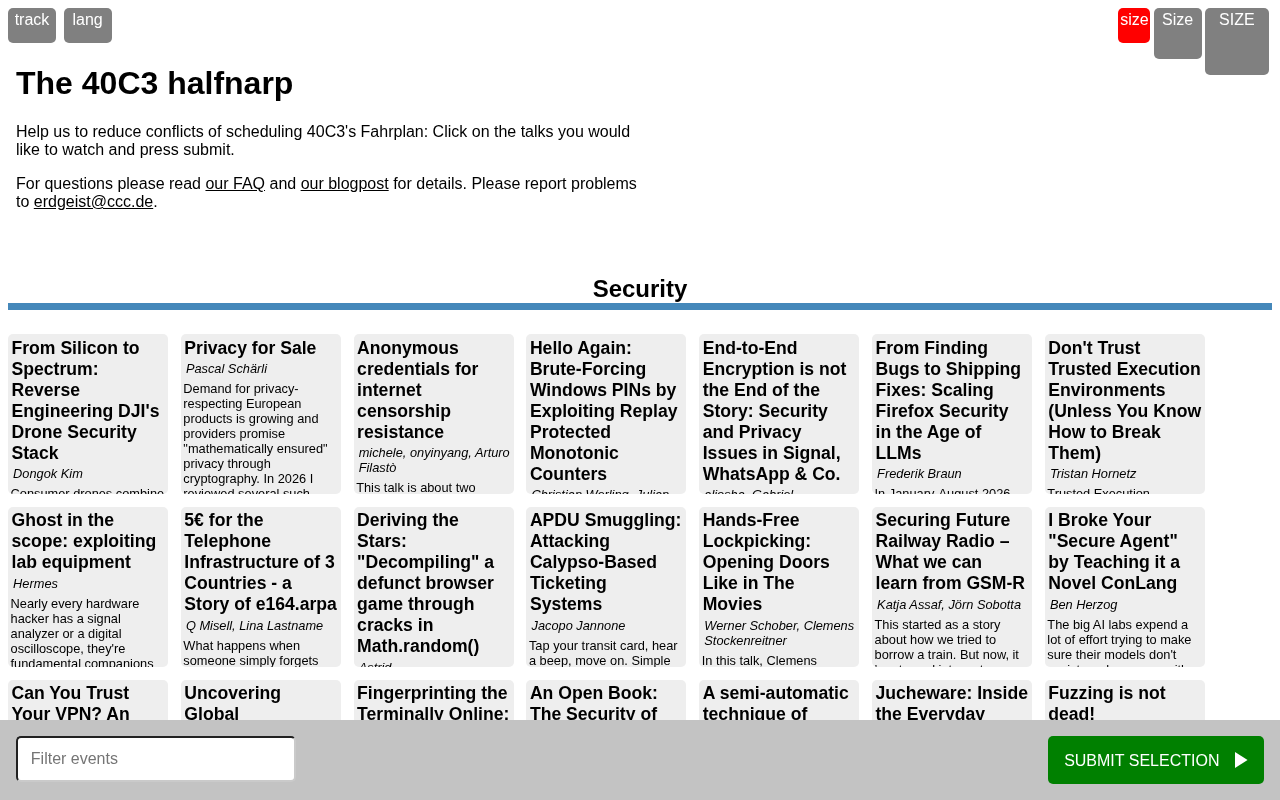
halfnarp lets attendees submit talk preferences before the agenda is finalized, using data to support conference scheduling decisions.
40C3 halfnarp is a conference tool project submitted on Hacker News. Its core idea is to let attendees submit preferences for each talk before the agenda is officially set, using preference data as scheduling input. Traditional agendas are decided one-way by organizers, and attendees can only passively accept clashing results after publication; halfnarp tries to move this step earlier so attendees can indirectly participate in agenda design. Preference data can help organizers identify popular talks, audience overlaps, and low-preference time slots, thereby optimizing venue allocation and time arrangement. The project currently has very low discussion volume (3 points, 0 comments) and is still early-stage, but its lightweight decision-support positioning is highly compatible with community conferences that have many talks and scattered topics.
One of the most frustrating parts of a large tech conference is often not the talks themselves, but agenda scheduling. When multiple high-quality sessions run in the same time slot, attendees can only choose by intuition, and organizers struggle to judge which talk should get the big room and which should avoid conflicts. A project called 40C3 halfnarp is trying to solve this old problem on Hacker News through "preference submission."
From "Passively Reading the Schedule" to "Actively Voting"
Traditional conference agendas are usually the result of a one-way decision by organizers: talks are solicited, an agenda committee schedules them, and the timetable is published. Attendees only learn which talks clash at the moment of publication, and feedback channels are virtually nonexistent.
halfnarp's approach is to move this step earlier. It asks attendees to submit their preferences for each talk before the agenda is finalized. This preference data becomes an input to scheduling rather than a complaint afterward. According to the project submission page on Hacker News, the tool's core positioning is to "submit talk preferences to aid scheduling" — letting preference submissions serve agenda planning.
This approach turns attendees from passive recipients of a schedule into indirect participants in the agenda. For organizers, preference data can reveal which talks are popular and which time slots are prone to conflicts, enabling more rational decisions about room allocation and time arrangement.
Where the Value of Preference Data Lies
Conference scheduling is essentially a constrained optimization problem: many talks, limited time slots, varying room capacities, and the need to avoid popular talks clashing with each other. Without data, organizers can only rely on experience and intuition; with preference data, they can at least answer a few key questions.
- Which talks are "must-see" and need larger venues or more central time slots
- Which talks have highly overlapping audiences and would hurt each other if placed in the same slot
- Which time slots have generally lower preference and are suitable for niche or experimental content
halfnarp does not make decisions for organizers directly; instead, it aggregates scattered attendee intentions into a readable signal. This "lightweight decision support" positioning is more realistic than systems that attempt fully automated scheduling, and easier for conference organizers to accept.
Constrained optimization problem (COP) is a classic problem type in operations research and computer science: finding a solution that optimizes (maximizes or minimizes) an objective function while satisfying a set of constraints. Conference scheduling is a typical example — constraints include room capacity, speaker availability, total number of time slots, and the objective is to maximize overall attendee satisfaction. Such problems are usually NP-hard, meaning that as the number of talks increases, the computational cost of enumerating all scheduling options explodes, so practical systems mostly use heuristic algorithms or integer programming to find near-optimal solutions. halfnarp's preference data happens to provide a quantitative basis for the objective function: without preference data, the objective function cannot be defined; with it, scheduling turns from "guesswork" into a computable optimization problem.
A Piece of the Conference Toolchain Puzzle
Conference operations involve many stages: call for talks, review, scheduling, venue, streaming, and post-event archiving. Most tools focus on a single stage, and halfnarp fills the gap of "pre-scheduling preference collection."
Based on the Hacker News submission, the project currently has low discussion volume, with only 3 points and 0 comments at the time of submission. This means it is still in an early stage, and the community has yet to provide large-scale feedback. For developers interested in conference tools, community operations, or group decision-making, such early-stage projects are worth watching — their design trade-offs often reveal the outline of a real need.
A Natural Fit for Community-Driven Conferences
Preference submission mechanisms are particularly suitable for community-driven conferences. These events typically feature many talks, scattered topics, and diverse attendee backgrounds, making it hard for organizers to cover everyone's interests based on the judgment of a few people. Letting attendees express preferences in advance is equivalent to returning part of the agenda design power to the community.
Of course, this mechanism has prerequisites: attendees need to be willing to spend time filling out preferences, and organizers need to trust the data and actually adjust scheduling accordingly. If preference collection is merely a formality, or the data is not incorporated into decisions, the tool's value will be greatly diminished. Whether halfnarp can close this loop in real conference scenarios still needs to be tested in practice.
Wisdom of Crowds is one of the theoretical pillars behind mechanisms like halfnarp. In his 2004 book of the same name, James Surowiecki pointed out that when conditions such as diversity, independence, and decentralization are met, the aggregated judgment of a crowd is often better than that of the smartest individual in the group. Preference submission is essentially a lightweight form of crowdsourcing wisdom: each attendee independently expresses their intention, and the aggregated signal reflects the overall interest distribution better than the intuition of a few agenda committee members. However, the premise of the wisdom of crowds is that preference expressions are genuine and independent — if attendees influence each other or fill out forms randomly, the aggregated signal becomes distorted. This also explains why halfnarp's value depends heavily on the quality of responses, not just on the tool itself.
Summary
The question 40C3 halfnarp raises is simple: why should attendees only passively accept the agenda after it is published? Its answer is to move preference submission earlier and let data participate in scheduling. The project currently has limited visibility, but its direction is clear — pinning down a specific and real pain point in the conference toolchain is easier to implement than building an all-in-one platform. For teams preparing community conferences, lightweight tools like this are worth adding to the consideration list.
One-line Summary
halfnarp lets attendees submit talk preferences before the agenda is finalized, using data to support conference scheduling decisions.
Paragraph Summary
40C3 halfnarp is a conference tool project submitted on Hacker News. Its core idea is to let attendees submit preferences for each talk before the agenda is officially set, using preference data as input for scheduling. Traditional conference agendas are decided one-way by organizers, and attendees can only passively accept clashing results after publication; halfnarp tries to move this step earlier so attendees can indirectly participate in agenda design. Preference data can help organizers identify popular talks, audience overlaps, and low-preference time slots, thereby optimizing venue allocation and time arrangement. The project currently has very low discussion volume (3 points, 0 comments) and is still early-stage, but its lightweight decision-support positioning is highly compatible with community conferences that have many talks and scattered topics.
Related articles

AI Coding Enters the Team Collaboration Era: Interpreting Three Major Moves from Meta, GitHub, and Mistral
Meta acquires Conductor, GitHub Copilot Fusion becomes available, Mistral opens Large 4 weights—three moves show AI coding shifting from code generation to organizing development workflows. This article explains task orchestration, model collaboration, and cost control for developers.

Building a RAG Assistant with Dify: A Practical Guide to Knowledge Bases, Workflows, and Agent Nodes
How should knowledge bases, workflows, and Agent nodes connect in a Dify RAG assistant? We break down the division of labor and wiring logic for a shippable app.
 Tech Frontiers
The AI Industry Doesn't Lack Marketing—It Lacks Good Products
AI faces market selloffs and public skepticism—is marketing really the problem? This analysis of market signals and product experience argues the core困境 is incomplete products and a gap between promises and experience; the only way to change perceptions is to ship better products.