AI Coding Enters the Team Collaboration Era: Interpreting Three Major Moves from Meta, GitHub, and Mistral

Meta acquires Conductor, GitHub launches Fusion, Mistral opens weights—AI coding turns toward organizing workflows.
The article reviews three simultaneous developments in AI coding tools: Meta's acquisition of the multi-agent orchestration tool Conductor signals competition extending from code generation to task orchestration; Conductor Cloud becomes read-only on November 13, shuts down on November 20 and deletes data, with local support until early 2027. GitHub Copilot Fusion is officially available, offering model routing and multi-model collaboration but billed by actual models used; effectiveness should be measured by success rate, total cost, and manual review time. Mistral opens Large 4 weights for teams needing deployment control, though compute and maintenance costs fall on them. All three point to one trend: AI coding is moving from generating code to organizing the entire development workflow, making task decomposition, acceptance criteria, and cost control key capabilities.
AI coding tools are undergoing a key shift: from "single-point code generation" to "organizing the entire development workflow." Meta's acquisition of the multi-agent orchestration tool Conductor, GitHub's official release of Copilot Fusion, and Mistral's open-sourcing of the Large 4 model weights—these three developments all point to the same question: as AI-generated code grows, who organizes tasks, who reviews results, and who controls operating costs?
Meta Acquires Conductor: Multi-Agent Orchestration Becomes the New Battleground
Conductor officially announced that it is joining Meta. The core capability of this tool is managing multiple coding agents, enabling them to collaboratively complete development tasks. The announcement mentioned that the team hopes to bring new products early next year, and what existing users need to pay attention to right now are adjustments to the cloud service: Conductor Cloud will become read-only on November 13, shut down on November 20 and begin deleting cloud user data. The official team has provided methods for migrating to local and exporting data. The local version will still receive new models and critical fixes until early 2027.
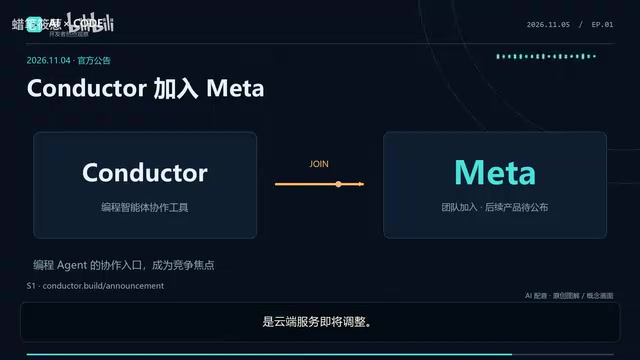
This news is easy to view as an ordinary team acquisition, but its real signal is this: competition in coding tools is extending to the task orchestration layer. An analogy with distributed systems makes this clear—spinning up more nodes does not automatically solve consistency problems. Letting multiple agents work in parallel likewise requires task orchestration, definition of modification boundaries, change isolation and merge review, and ultimately verification of results. By bringing the Conductor team under its wing, Meta is betting that the "orchestration layer" will become the next high-value area in AI coding.
For developers, the short-term action is clear: if you rely on Conductor Cloud, you need to complete data migration or export before November 13 to avoid losing work after the cloud shutdown.
Multi-Agent Orchestration refers to using a scheduling layer to coordinate multiple AI agents with independent capabilities, enabling them to divide work, communicate, and merge results. Think of the coordinator role in distributed systems: a single agent can complete tasks independently, but once tasks need to run in parallel and review each other, you must define who is responsible for which part, where modification boundaries lie, and how conflicts are merged. This is exactly what Conductor does—it does not produce models, but manages the collaboration process among multiple coding agents. The value of such tools lies not in "more" but in "order": without an orchestration layer, multiple agents working in parallel only amplify conflicts and duplicated work.
GitHub Copilot Fusion: Model Routing and Collaboration Officially Available
GitHub announced that Copilot Fusion is officially generally available. It is a model routing and collaboration system that decides which models to use based on the task, arranging multiple models to work together when necessary, rather than requiring you to switch manually at every step. The official announcement described three modes of collaboration: one model completes the task directly; a highly efficient model tries first, and after quality checks a decision is made on whether to escalate; or one model drafts, another reviews, and then it goes back for revision.
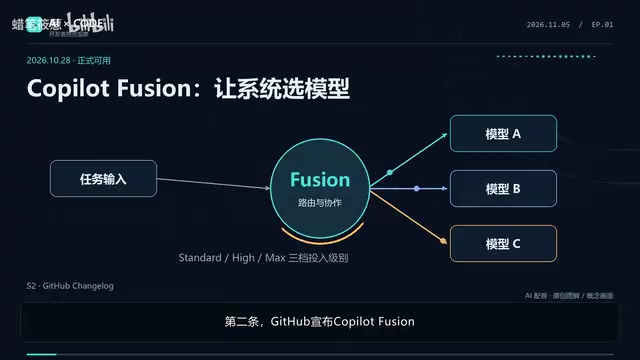
For developers, the key is not the number of models but clearly stating task requirements and acceptance criteria. Also note that Fusion is billed according to the models actually used—multi-model collaboration does not mean free. A more pragmatic approach is to take the same set of real tasks and measure three metrics: success rate, total cost, and manual review time. There is a gap between generating code quickly and delivering features quickly—a gap filled with testing and rework.

Model Routing refers to a system automatically selecting the most appropriate model based on task characteristics, rather than always using a fixed one. Typical strategies include assigning simple tasks to cheap, fast models and escalating complex or high-risk tasks to stronger models. This differs from manually switching models one by one: the routing layer reads signals such as task description, context size, and historical success rate to make decisions. Its engineering significance lies in removing "which model to use" from the user's cognitive burden, but the trade-off is less predictable cost—therefore, when billing is based on actual calls, teams must build their own comparison table of success rates and total costs.
Mistral Open-Sources Large 4 Weights: Another Option for Deployment Control
Mistral has released the model weights for Large 4, allowing development teams to download, customize, and deploy them on their own infrastructure. For teams focused on deployment control and engineering integration, this means one more option. But open weights do not equal zero-cost deployment—compute, service stability, and maintenance all need to be factored in. The official announcement emphasized improvements in coding capability and inference efficiency. Such benchmark results can serve as a reference, but whether the model suits your project still needs to be verified in your own codebase.
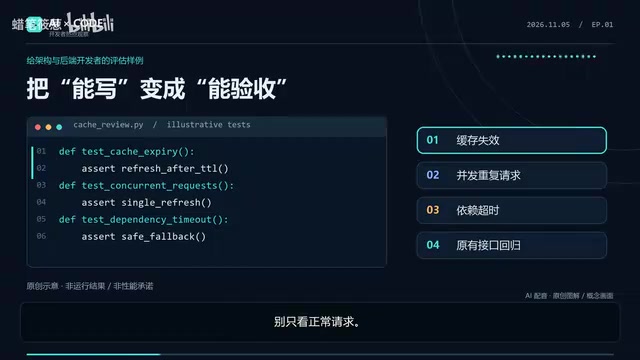
The verification method deserves to be concrete. Rather than asking the model to write a polished little example, have it modify a piece of caching logic—and don't just focus on normal requests. Write cache invalidation, concurrent duplicate requests, and dependency timeouts into the acceptance criteria, then check whether it broke existing interfaces. Such tasks are closer to real development and better expose the model's actual level in an engineering context.
Open Weights is not entirely equivalent to "open source": it means model parameters can be downloaded, allowing self-deployment and fine-tuning, but training data and training code may not be public. For teams, the core value of open weights is deployment control—data stays within the internal network, customization can be done for private codebases, and you are not affected by API provider shutdowns. But deployment costs are easily underestimated: inference compute, service stability, version upgrades, and operations all need to be borne by yourself. Usually, self-deployment is only more cost-effective than calling an API when usage volume is high or compliance requirements are strong.
The Common Direction of the Three Moves: From Generating Code to Organizing Workflows
Looking at the three news items together, the trend is clear: AI coding is moving from "generating code" to "organizing the entire development workflow." How tools collaborate, how models divide work, and how results are accepted will increasingly affect development efficiency. For developers in architecture, distributed systems, and Python, the real capability to build may not be writing cleverer prompts, but designing task decomposition, defining acceptance criteria, and controlling operating costs—these are precisely the parts of multi-agent systems that most resemble distributed engineering.
Which direction are you more focused on: multi-agent collaboration, mutual model review, or local deployment of open weights? These choices will ultimately come back to your own development workflow.
One-line Summary
Meta acquires Conductor, GitHub launches Fusion, Mistral opens weights—AI coding turns toward organizing workflows.
Paragraph Summary
The article reviews three simultaneous developments in AI coding tools: Meta's acquisition of the multi-agent orchestration tool Conductor signals that competition is extending from code generation to the task orchestration layer; Conductor Cloud will become read-only on November 13, shut down on November 20 and delete data, while the local version is supported until early 2027. GitHub Copilot Fusion is officially available, offering model routing and multi-model collaboration, but billed according to the models actually used; effectiveness should be measured by success rate, total cost, and manual review time. Mistral's open-sourcing of Large 4 weights provides an option for teams needing deployment control, but compute and maintenance costs must be borne by themselves. All three point to one trend: AI coding is moving from generating code to organizing the entire development workflow, making task decomposition, acceptance criteria, and cost control key capabilities.
Related articles
 Tech Frontiers
Sherlock: An Open-Source Tool for Tracking Usernames Across Social Networks
Sherlock is an open-source Python tool that tracks social accounts across networks by username. This article covers its core features, why developers love it, typical use cases, and privacy compliance considerations.
 Tech Frontiers
GitHub Daily·Nov 07: Agent-Ready and Context Compression
GitHub Trending Nov 07: meta's agent-ready design system astryx, billion-context's 5x context compression, sherlock nearing 100k stars, plus local-first localthings and bare-metal GPU orchestration nvke.
 Tech Frontiers
Buoyant Open-Sources Kinference: An Inference Control Plane for vLLM on K8s
Buoyant open-sources Kinference, an inference control plane for vLLM on Kubernetes, with declarative routing, KV-cache-aware load balancing, and per-tenant metrics—claiming 95% lower median TTFT in official benchmarks.